Remote Sensing for Natural Resources >
Multi-scale residual dehazing network for remote sensing images based on dual attention
Received date: 2024-04-24
Revised date: 2024-07-11
Online published: 2026-06-03
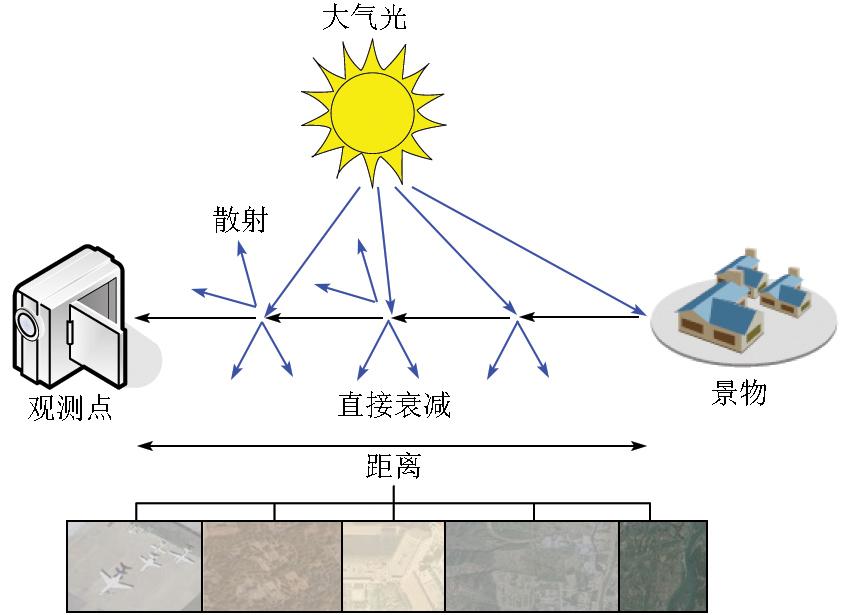
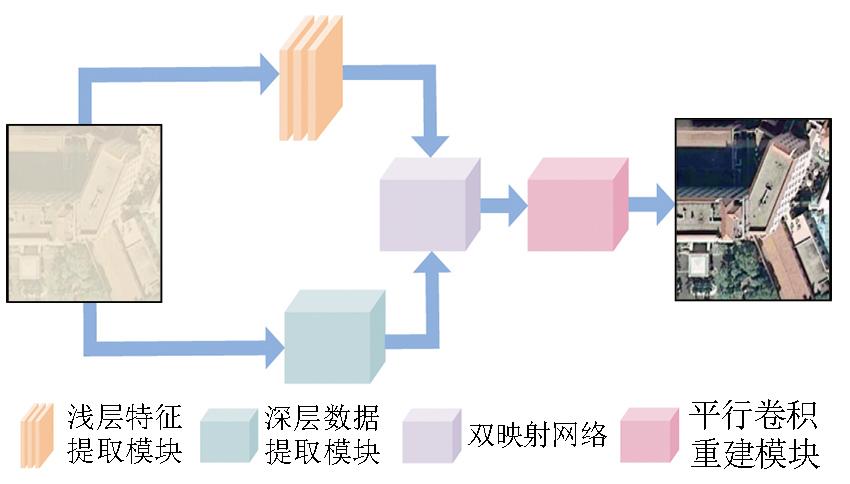
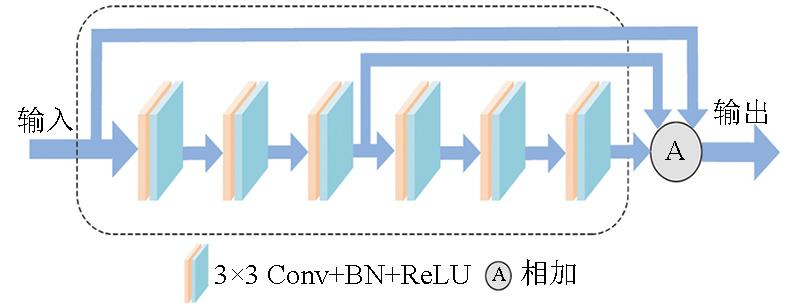
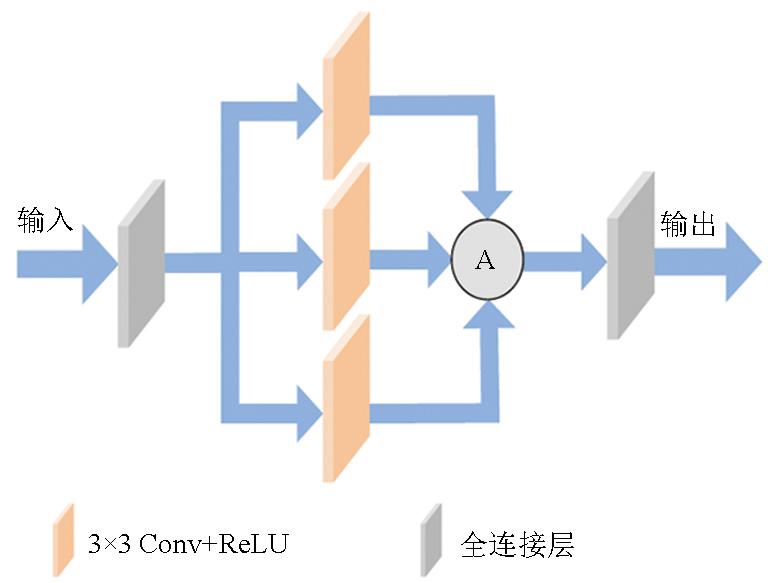
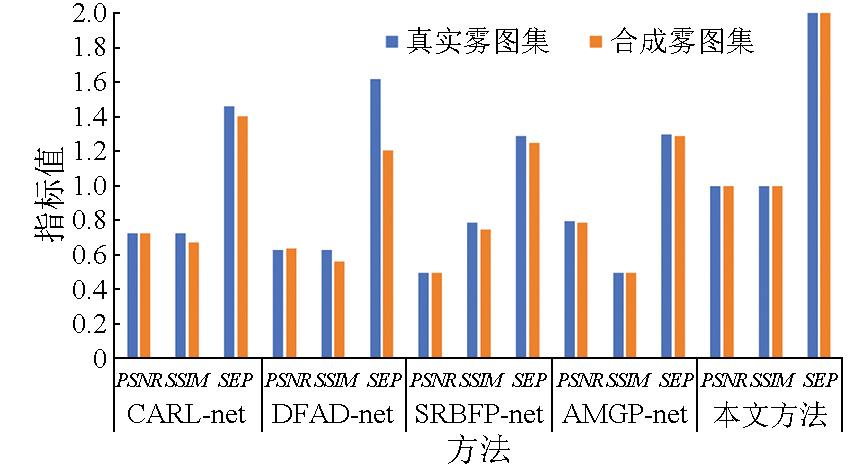
Hazes reduce the quality of remote sensing images while limiting the performance of back-end visual applications. Hence, this study proposed a multi-scale residual dehazing network based on dual attention. First, an atmospheric scattering model was constructed to combine the atmospheric light value and transmissivity to derive the atmospheric power of light. Second, an end-to-end deep learning model was used to clarify remote sensing images with hazes. The dehazing network consists of a shallow feature extraction module, a deep data extraction module, a dual mapping network, and a parallel convolution reconstruction module. Finally, the proposed dehazing network was compared with CARL-net, DFAD-net, SRBFP-net, and AMGP-net through subjective and objective comparison experiments. The results indicate that the proposed dehazing network obtained a visual state close to the original haze-free scene, exhibiting high contrast, bright chroma, corresponding saturation, and clear transmission map details. Moreover, it effectively removed image noise while maintaining the edge of the foreground part. Compared to the above four networks, the proposed dehazing network achieved superior peak signal-to-noise ratio (PSNR) and structure similarity index measure (SSIM), higher algorithm processing efficiency, and stable algorithm processing time with the increase of image resolution.
Key words: attention; residual; atmospheric power of light; end-to-end; dual mapping
LI Yuan , FU Hui , LIU Haozhi . Multi-scale residual dehazing network for remote sensing images based on dual attention[J]. Remote Sensing for Natural Resources, 2025 , 37(4) : 31 -39 . DOI: 10.6046/zrzyyg.2024154
表1 合成遥感雾图清晰化效果对比Tab.1 Comparison of clarity effect of synthetic remote sensing images with hazes |
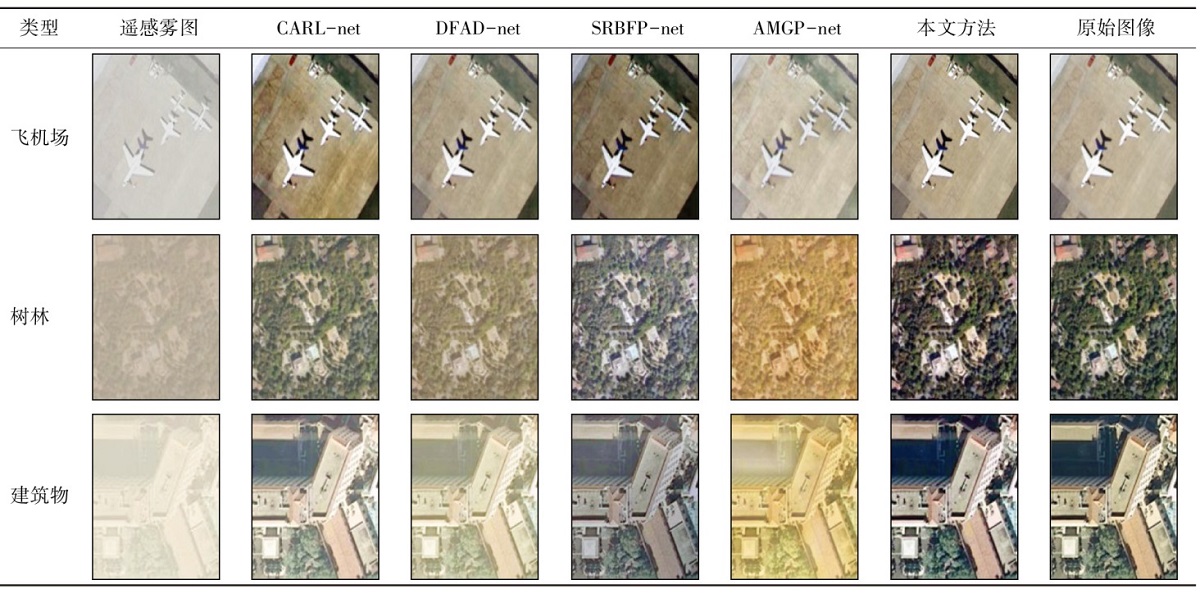 |
表2 真实遥感雾图清晰化效果对比Tab.2 Comparison of clarity effect of real remote sensing images with hazes |
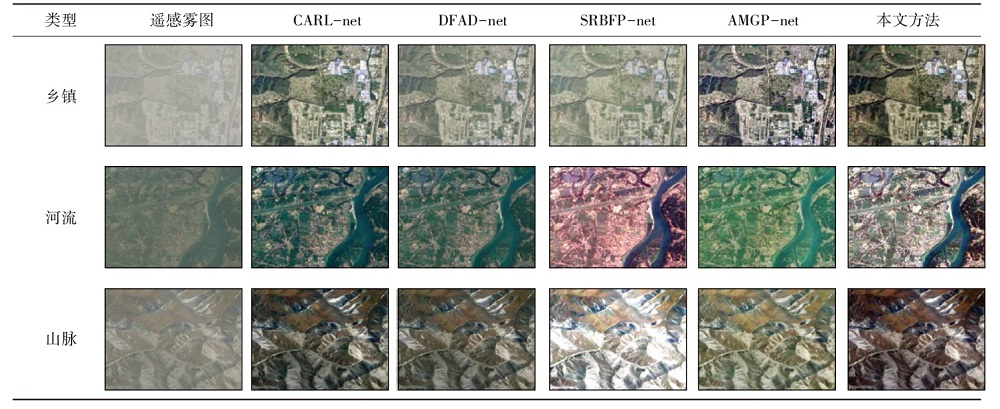 |
表3 透射图对比Tab.3 Comparison of transmission images |
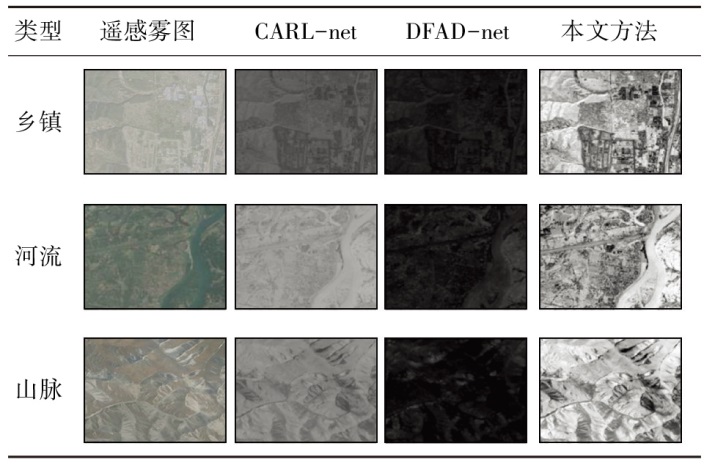 |
表4 不同方法的全参考客观评价指标对比Tab.4 Comparison of full-reference objective evaluation indicators of different methods |
| 方法 | 指标 | 数据集 | |
|---|---|---|---|
| 真实雾图集 | 合成雾图集 | ||
| CARL-net | PSNR | 18.250 9 | 18.469 1 |
| SSIM | 0.815 6 | 0.802 2 | |
| DFAD-net | PSNR | 17.272 5 | 17.561 8 |
| SSIM | 0.779 5 | 0.765 8 | |
| SRBFP-net | PSNR | 15.984 2 | 16.115 3 |
| SSIM | 0.837 1 | 0.825 9 | |
| AMGP-net | PSNR | 18.951 8 | 19.101 4 |
| SSIM | 0.732 6 | 0.743 8 | |
| 本文方法 | PSNR | 20.926 1 | 21.260 9 |
| SSIM | 0.912 8 | 0.908 9 | |
表5 不同方法的全参考客观评价指标归一化对比Tab.5 Normalized comparison of full-reference objective evaluation indicators of different methods |
| 方法 | 指标 | 数据集 | |
|---|---|---|---|
| 真实雾图集 | 合成雾图集 | ||
| CARL-net | PSNR | 0.729 3 | 0.728 7 |
| SSIM | 0.730 3 | 0.676 9 | |
| SEP | 1.459 6 | 1.405 6 | |
| DFAD-net | PSNR | 0.630 3 | 0.640 6 |
| SSIM | 0.630 1 | 0.566 6 | |
| SEP | 1.620 4 | 1.207 2 | |
| SRBFP-net | PSNR | 0.500 0 | 0.500 0 |
| SSIM | 0.790 0 | 0.748 6 | |
| SEP | 1.290 0 | 1.248 6 | |
| AMGP-net | PSNR | 0.800 2 | 0.790 2 |
| SSIM | 0.500 0 | 0.500 0 | |
| SEP | 1.300 2 | 1.290 2 | |
| 本文方法 | PSNR | 1.000 0 | 1.000 0 |
| SSIM | 1.000 0 | 1.000 0 | |
| SEP | 2.000 0 | 2.000 0 | |
表6 合成与真实遥感雾图消融实验效果对比Tab.6 Comparison of ablation results between synthetic and real remote sensing images with hazes |
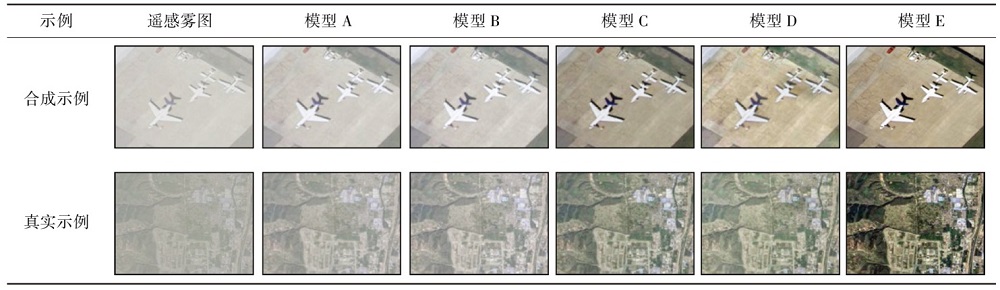 |
表7 合成遥感雾图消融实验指标对比Tab.7 Comparison of ablation parameters of synthetic remote sensing images with hazes |
| 指标 | 模型A | 模型B | 模型C | 模型D | 模型E |
|---|---|---|---|---|---|
| PSNR | 15.113 2 | 15.891 4 | 20.138 2 | 18.472 5 | 21.260 9 |
| SSIM | 0.625 3 | 0.703 1 | 0.874 5 | 0.842 6 | 0.908 9 |
表8 真实遥感雾图消融实验指标对比Tab.8 Comparison of ablation parameters of real remote sensing images with hazes |
| 指标 | 模型A | 模型B | 模型C | 模型D | 模型E |
|---|---|---|---|---|---|
| PSNR | 15.412 8 | 15.892 7 | 20.102 1 | 18.215 3 | 20.926 1 |
| SSIM | 0.652 3 | 0.719 2 | 0.853 1 | 0.815 6 | 0.912 8 |
表9 本文方法的参数量Tab.9 Parameter quantity of the proposed method |
| 类型 | 说明 | 种类 | 卷积 核数 | 卷积核 大小 | 参数量 |
|---|---|---|---|---|---|
| 输入层 | 输入 | — | — | — | — |
| 特征提 取模块 | 浅层特征 提取模块 | Conv+ReLU | 32 | 3×3 | 896 |
| Conv+ReLU | 32 | 3×3 | 896 | ||
| Conv+ReLU | 32 | 3×3 | 896 | ||
| 深层数据 提取模块 | Conv | 32 | 3×3 | 896 | |
| Conv | 32 | 3×3 | 896 | ||
| Conv | 32 | 3×3 | 896 | ||
| Conv+ReLU | 64 | 3×3 | 55 360 | ||
| Conv+ReLU | 64 | 3×3 | 36 928 | ||
| 映射 网络 | 双映射网络 | Conv BN+ReLU | 64 — | 3×3 — | 36 928 — |
Conv BN+ReLU | 64 — | 3×3 — | 36 928 — | ||
| Conv BN+ReLU | 64 — | 3×3 — | 36 928 — | ||
| Conv BN+ReLU | 64 — | 3×3 — | 36 928 — | ||
| Conv BN+ReLU | 64 — | 3×3 — | 36 928 — | ||
| Conv BN+ReLU | 64 — | 3×3 — | 36 928 — | ||
| 输出层 | 平行卷积 重建模块 | Conv+ReLU | 4 096 | 1×1 | 266 240 |
| Conv+ReLU | 128 | 3×3 | 4 718 720 | ||
| Conv+ReLU | 128 | 3×3 | 147 584 | ||
| Conv+ReLU | 128 | 3×3 | 147 584 | ||
| Conv+ReLU | 4 096 | 1×1 | 528 384 | ||
| 总计 | — | — | — | 6 127 744 |
表10 不同方法的处理效率对比Tab.10 Comparison of processing efficiency of different methods(ms) |
| 方法 | 分辨率 | |||
|---|---|---|---|---|
| 330×220 | 640×480 | 780×500 | 950×650 | |
| CARL-net | 1 089.5 | 2 395.4 | 3 051.3 | 4 182.1 |
| DFAD-net | 627.3 | 1 804.8 | 2 409.5 | 3 091.4 |
| SRBFP-net | 451.2 | 1 161.3 | 1 485.9 | 2 465.3 |
| AMGP-net | 609.4 | 1 585.9 | 2 233.5 | 2 669.3 |
| 本文方法 | 618.2 | 1 636.1 | 2 293.6 | 2 538.4 |
| [1] |
单慧琳, 王硕洋, 童俊毅, 等. 增强小目标特征的多尺度光学遥感图像目标检测[J]. 光学学报, 2024, 44(6):382-394.
|
| [2] |
孙航, 方帅领, 但志平, 等. 层级特征交互与增强感受野双分支遥感图像去雾网络[J]. 遥感学报, 2023, 27(12):2831-2846.
|
| [3] |
王科平, 杨艺, 费树岷. 雾霾图像清晰化算法综述[J]. 智能系统学报, 2023, 18(2):217-230.
|
| [4] |
|
| [5] |
连文杰, 叶少珍. 注意力机制下的多层次特征融合图像去雾算法[J]. 福州大学学报(自然科学版), 2024, 52(1):7-13.
|
| [6] |
|
| [7] |
|
| [8] |
|
| [9] |
|
| [10] |
唐剑, 车文刚, 高盛祥. 融入注意力机制的多尺度卷积图像去雾方法[J]. 计算机工程与科学, 2023, 45(8):1453-1462.
|
| [11] |
|
| [12] |
王科平, 肖梦临. 基于增强型金字塔及图像超分辨率去雾网络[J]. 兵器装备工程学报, 2023, 44(11):299-307.
|
| [13] |
张浩文, 杨燕, 张金龙, 等. 基于注意力与多尺度分组并联网络的去雾算法[J]. 传感器与微系统, 2023, 42(10):151-155.
|
| [14] |
唐斌, 陈清容, 段春红. 基于大气散射模型的图像去雾及亮度增强算法[J]. 光电子·激光, 2024, 35(3):303-310.
|
| [15] |
|
| [16] |
|
/
| 〈 |
|
〉 |