
Full Length Article

Preserving environmental quality of ecotourism sites through community participation in Purulia District of West Bengal, India

  • Piyall CHATTERJEE , * ,
  • Soumyendra Kishore DATTA
Expand
  • Department of Economics the University of Burdwan, West Bengal, 734013, India
* E-mail address: (Piyali CHATTERJEE).

Received date: 2023-04-27

  Revised date: 2024-02-11

  Accepted date: 2024-08-22

  Online published: 2025-08-14

Abstract

The importance of valuing environmental resources, especially in ecotourism sites, has become increasingly important over the last two decades. Ecotourism is now considered as an important source of livelihood of local stakeholders in backward regions. Therefore, the preservation of ecotourism sites through community participation seems very important to maintain continued flow of tourists. This study aimed at recognizing the importance of community participation for the preservation of ecotourism sites. For this, this study executed a survey based on non-probability sampling in two ecotourism sites (Garpanchkot and Baranti) covering 100 respondents in Purulia District, West Bengal of India. The central issue of this study was to assess the tendency of community participation for the conservation of ecotourism sites and find the optimum condition for offering participatory labour time. This study showed that the participation of young people is high, and the majority of respondents are aware of the importance in protecting ecotourism sites. Because respondents were too poor to offer money, the contingent valuation method (CVM) was used to elicit their willingness to pay (WTP) participatory labour time for the conservation of ecotourism sites. Respondents’ age, income, education level, caste, and their perceived environmental quality had significant relationship with their WTP participatory labour time by applying the ordinary least square (OLS) model. It was found that the mean WTP participatory labour time of each respondent in a month is approximately 3.64 h. The significance of this study is that community participation can improve the sense of belonging, trust, and credibility of ecotourism sites, making them more appreciative of the value and protection of these sites.

Cite this article

Piyall CHATTERJEE , Soumyendra Kishore DATTA . Preserving environmental quality of ecotourism sites through community participation in Purulia District of West Bengal, India[J]. Regional Sustainability, 2024 , 5(3) : 100163 . DOI: 10.1016/j.regsus.2024.100163

1. Introduction

Tourism is a social, cultural, and economic phenomenon, which entails the movement of people to countries or places outside their usual environment for personal, business or professional purposes (UNWTO, 2008). People get different types of benefits from tourism. From the economic view, it creates employment, generates foreign exchange, and raises governmental revenue, which triggers the economic growth of a country. But unregulated tourist activities may cause substantial damages to the environment and natural resources. Ecotourism aims to prevent these damages by focusing on tourism that has minimal adverse impacts on the environment and local community. On the other hand, ecotourism focuses on raising tourists’ awareness of the protection of the local environment and concentrates on ecological conservation through community participation.
When tourists visit any ecotourism site, their behaviours often prove detrimental to the upkeep of amenities in the region (Sun et al., 2021). Rampant use of plastic and other solid waste materials, indiscriminate throwing of garbage, noise pollution, overutilization of air and water, CO2 emission, soil erosion, and displacement of biodiversity often tend to degrade the environment and result in the loss of environmental quality (Shaheen et al., 2019; Andlib and Salcedo-Castro, 2021; Baloch et al., 2023). The effects of these negative interventions will be manifest in diverse types of problems for tourists and local stakeholders in the foreseeable future (Azam et al., 2018; Hoang et al., 2020).
It has sometimes been observed that the elimination of an existing ecotourism site due to deterioration in its quality leads to the emergence of substitute sites. These problems can be avoided by developing ecotourism, which constitutes responsible travel to the natural resources, conserves the environment, and improves the well-being of local stakeholders (TIES, 1990). Ecotourism Global Market Report 2024 (Dharmadhikari, 2024) reported that the global ecotourism market size would grow from 2.20×10⁸ USD in 2023 to 2.49×10⁸ USD in 2024 with a compound annual growth rate (CAGR) of 13.5%. The global ecotourism market size is further likely to grow to 4.30×10⁸ USD in 2028 with a CAGR of 14.5%. The increasing emergence of eco-friendly accommodation opportunities for tourists is likely to have a positive impact on the expansion ecotourism market. In developing countries like India, Indonesia, and Thailand, ecotourism is being promoted as a vehicle for reducing emissions from forest degradation and deforestation by providing incentives to local communities for forest conservation efforts.
According to Sustainable Development Goal (SDG) 11 (sustainable cities and communities), ecotourism has an important role in promoting sustainable resource management practices in urban and rural areas. This might encourage responsible tourism development and minimise adverse environmental impacts. Sustainability of nature resources can be increased by directly providing some authority to local communities (Khan and Bhagwat, 2010). A positive relationship between community participation and ecotourism development is often observed in the protected areas (Eshun and Tichaawa, 2019; Ali et al., 2022; Darda and Bhuiyan, 2022). Sometimes, however, the conflict of interest among multiple stakeholders and their perceptions regarding ecotourism are often misinterpreted (Byrd, 2007), which impedes the participation of local communities (Gan, 2021).
India has many economically poor but natural resource-rich regions. These resources provide the scope of developing ecotourism that might earn revenue in the region and contribute to the livelihood of local stakeholders. Local stakeholders also have responsibilities to take part in the process of environmental conservation in ecotourism sites for maintaining their standard of living. Purulia District in India is located in an undulated hilly terrain with lush green vegetation and has ample opportunities for the development of ecotourism. Recently, yearly visitation rate of tourists in different ecotourism sites of the district is increasing due to its distinct natural and scenic beauty, cultural richness, quietness, local foods, and attraction of different ecotourism resorts (Palit and Saren, 2021). With the increasing number of visitors, the lack of proper knowledge and awareness about maintaining the environment may cause damage to the environment in the future (Stefănica et al., 2016; Aslan et al., 2021). Biodiversity and ecological balance of an ecotourism site might be affected due to unregulated activities by tourists. The livelihood of local stakeholders would be seriously affected as tourists may prefer to visit other ecotourism sites instead of the damaged ecotourism sites. So, it is the responsibility of local stakeholders to maintain the sustainability of local ecotourism sites by offering participatory labour time. Community participation would serve as the best practice with sort of competitive advantage (Garrod, 2003).
Most of the earlier studies focused on estimating local stakeholders’ willingness to pay (WTP) in terms of money for the betterment of ecotourism sites (Subanti at al., 2017; Hamuna et al., 2018). But in this study, local stakeholders’ WTP participatory labour time instead of money was used in the contingent valuation method (CVM) analysis for the improvement of environment quality in ecotourism sites. This study is imperative to pursue the following objectives: (i) developing an optimal model that involves community participation for the conservation of ecotourism sites; (ii) focusing on the socio-economic features and environmental awareness of local stakeholders; and (iii) analyzing local stakeholders’ WTP participatory labour time for the conservation of ecotourism sites.

2. Literature review

2.1. Environmental awareness of ecotourism site conservation

Uzulmez et al. (2022) determined the level of environmental awareness and ecotourism perception of local tourist guides by ascertaining the factors that influence the perception of ecotourism. Giriwati et al. (2019) stated that ecotourism has high potential to increase local community’s empowerment opportunities in East Java, Indonesia. Ecotourism also helps in the conservation of the environment through enhancing local community’s awareness and participation. Moreover, Upadhaya et al. (2022) analyzed local stakeholders’ perception regarding the impact and importance of ecotourism in Chitwon National Park (CNP), Nepal. Purulia District is a quite backward district in India and the major part of its population are economically weaker, so the importance of development of ecotourism here cannot be denied. As local stakeholders in Purulia District are very poor, they are unable to contribute money for the ecological conservation and betterment of environmental quality, but they can share their participatory labour time. Local stakeholders are likely to get multiple benefits by preserving the environment, which might hardly be evaluated in terms of price. Therefore, local respondents are very likely to provide participatory labour time for maintaining and preserving the environmental quality of ecotourism sites (Schiappacasse et al., 2013; Berhanu, 2023).

2.2. Willingness to pay (WTP)

Several studies tried to estimate WTP for the conservation of ecotourism sites and development of community. For example, Wollie et al. (2021) conducted a survey of 57 respondents in Alelo Bad hot spring water of Ethiopia and found that gender, age, family size, off farm income, education level, and initial bid values significantly affect WTP. Aseres and Sira (2020) tried to examine visitors’ WTP using the CVM to maintain sustainability and conserve the biodiversity of protected areas in Ethiopia. According to their findings, 75.0% of visitors were willing to protect ecotourism site. Specifically, the WTP was estimated at 1.00 USD for domestic tourists and it was estimated at 7.40 USD for foreign tourists. Apdohan et al. (2021) attempted to assess the WTP of both local stakeholdersand tourists, as the basis for collecting fees for the conservation of ecotourism sites in Agusan Marsh Wildlife Sanctuary (AMWS), the Philippines. They used the open-ended CVM to estimate WTP. It is found that tourists’ WTP was 3.68 USD and local stakeholders’ WTP was 1.44 USD. They suggested raising WTP from 1.77 to 3.68 USD to make more fund available for protecting the sites. Musa et al. (2020) estimated the WTP of coastal communities to develop the mangrove area as an ecotourism site in Marudu Bay, Sabah, Malaysia. They found that the WTP of coastal communities depends on the bidding prices and different socio-demographic factors. In the last few years, participatory labour timeoffered has been used as non-monetary mode of payment in some studies (Vondolia and Navrud, 2019; Endalew et al., 2020; Meginnis et al., 2020; Abdeta et al., 2023).

2.3. Willingness to accept (WTA)

Ting et al. (2021) purported to estimate local stakeholders’ WTP, willingness to work (WTW), and WTA compensation for the conservation of Sanjiangyuan National Park, China. Their study indicated income, education, and social trust level as important factors for local stakeholders’ WTP and WTA, but gender and age turned out to be insignificant using the generalized linear model. Further matching governmental funding was found to be linked with local stakeholders’ inclination to WTP, WTW, and WTA.
Some studies (Li et al., 2018; Chu et al., 2020; Al-Assaf, 2021) have analyzed the importance of socio-economic factors determining local stakeholders’ WTA compensation for ecotourism site conservation. Other factors like perception, environmental awareness, local available facility, and peoples’ attitudes had varied impacts on WTA compensation for ecotourism site conservation.

2.4. Community participation in ecotourism site conservation

It has been pointed out that despite the importance of community participation for the development of ecotourism sites, different problems often emerge (Gumede and Nzama, 2020; Chan et al., 2021; Hasana et al., 2022). These are manifest in political intervention on local communities, lack of proper skill among local communities, infringement on the usual development norms, etc.
Gumede and Nzama (2020) suggested the local community participation improvement model (LCPIM) based on bottom up ecotourism development and inclusive participation of the local stakeholders. Ma and Wen (2019) used a choice experiment model to assess community participation and their WTP regarding the setting up of national parks. This will promote ecotourism sites and create ecological employment opportunities. Hassan et al. (2018) demonstrated that local communities play an important role in the development of Tasik Kenyir, an ecotourism site in Malaysia. They found that factors like family size, environment, marital status, and the distance between ecotourism sites and habitations had an impact on community participatory labour time.

3. Materials and methods

3.1. Study area

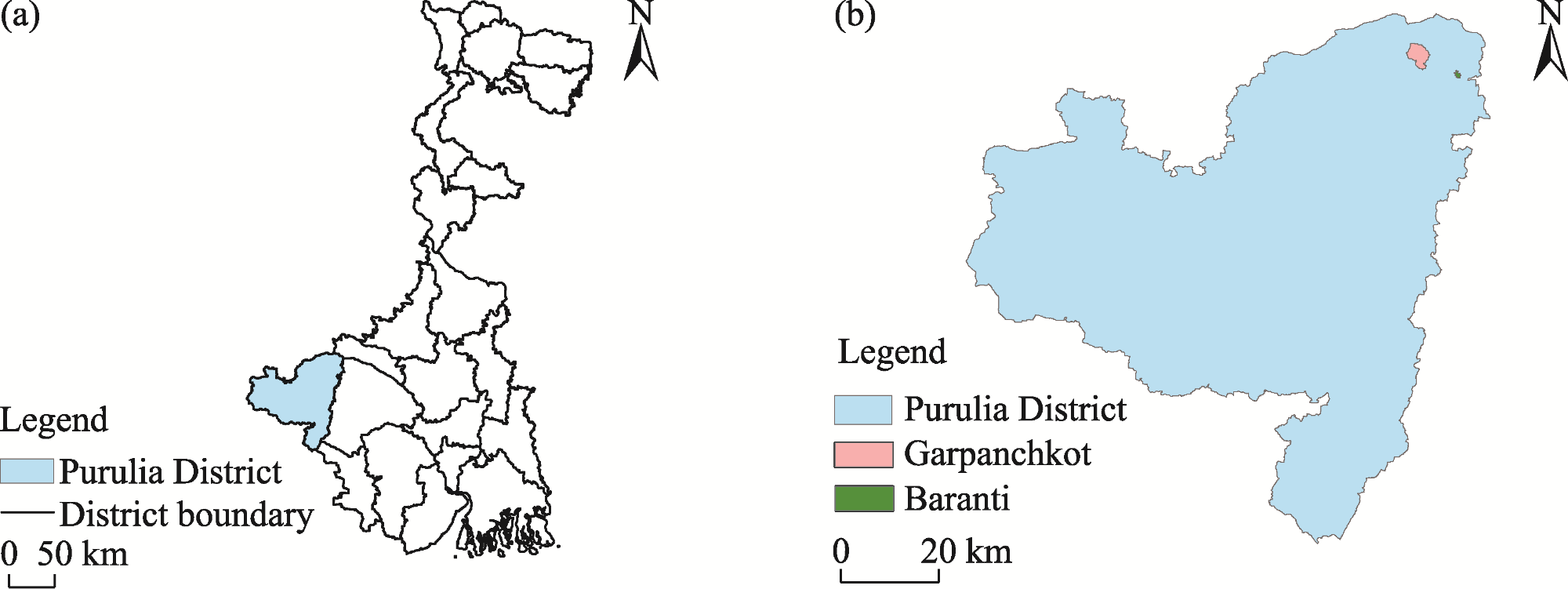
Purulia District (22°04′00′′N-23°45′00′′N, 85°55′00′′E-86°55′00′′E) is located in West Bengal, India (Fig. 1). The tourism of Purulia District is based on its hills, forests, archaeological excavations, and the ruins of ancient buildings and temples. The majority of tourist sites in this district were considered or treated as ecotourism sites. Among these sites, we selected two adjacent ecotourism sites: Garpanchakot (23°36′00′′N, 86°46′00′′E) and Baranti (23°34′52′′N, 86°50′47′′E), in the northeastern part of Purulia District. Garpanchkot is situated on the slope of Panchet Hill and is adjacent to the Panchet Lake. The Damodar River flows at the foot of the hill. Garpanchakot is well known for its rich biodiversity and reservoir of medicinal plants. The relics of fort and temple, terakotta temple work, Panchet Hill, Snake Park, forest of sal (Shorearobusta), Sonajhuri (Acacia auriculiformis), and palas (Buteamonosperma) are the main attractions of this ecotourism site. Sal, Sonajhuri, and palas are native to India and are often recognized by their botanical names. Baranti is also situated in the northeastern part of Purulia District. Both sides of this ecotourism site are encompassed by the Panchet Hill and Biharinath Hill. It is a less crowded, quiet, peaceful, and isolated place to explore and stay at the lap of nature to relax mind. The Baranti Lake is at the heart of this ecotourism site, which is surrounded by hillocks. These hillocks are covered with thick green forest, which looks like green carpet covering the hillocks. There are many resorts and hotels available at the lap of the nature in Garpanchkot and Baranti.
Fig. 1. Overview of West Bengal (a) and Purulia District (b).

3.2. Data source

This study interviewed 100 respondents, engaging in ecotourism related works at Garpanchot and Baranti. Data were collected from these stakeholders by a structured questionnaire during February-March, 2022. Apart from filling the questionnaire, face to face interview was also conducted to elicit specific information and perception of local stakeholders towards the conservation of ecotourism sites and WTP participatory labour time. For selecting respondents, most common form of non-probability sampling like convenience sampling method was used. This is useful when we collected the samples based on the ease of accessibility and specific characteristics of the respondents involving community members in the study area.
Garpanchkot has 76 households including 210 persons and Baranti has 64 households with 192 persons. The total number of populations in Garpanchkot and Baranti is about 402 persons. The number of populations engaged in community work in these two ecotourism sites is 140 persons. But as the persons take part in community activity only by turn of their scheduled time in weeks, not all of them could be interviewed during survey time. The respondents were selected from different ecotourism-related activities, which varied from cooking in nearby hotels to serving food there, working in local resorts, gardening in ecotourism sites, acting as local tourist guide, worshiping as priest in small temples inside the site, removing waste materials littered by tourists, selling local chhou mask and clay idols to tourists, moving small merry-go-round for children, overseeing car parking area, etc. Here, altogether 100 respondents were surveyed for this study and the same proportion of households were chosen from each ecotourism site. We selected 54 respondents from Garpanchkot and 46 respondents from Baranti. This study used 5-point Likert scale to capture local respondents’ perception and the degree of awareness on various aspects of preserving ecotourism sites.

3.3. Contingent valuation method (CVM)

The CVM focuses on ex-ante valuation and direct estimation of WTP or WTA. It is an experimental approach that allows for the valuation of a variety of environmental goods (Perni, 2021). However, it has also certain drawbacks. While local stakeholders sure that if they lose any level of benefits, they may want considerable sums of money to compensate their loss of benefits. On the other hand, local stakeholders believe that paying some money may not be worth the additional benefit. Sometimes, WTP may be measured by participatory labour time of local stakeholders who are usually poor enough to pay for extra benefits gained. There are also shortcomings in the design of the hypothetical market for the survey, the reliability and validity of the control estimate, and the inaccuracy of the non-market valuation of the CVM (Diamond and Hausman, 1994; McFadden and Train, 2017; Bishop and Boyle, 2019). Despite these drawbacks, it is widely used in environmental resource assessment. Sethy and Senapati (2023) used the CVM and the double hurdle model to identify the determinants of WTP and WTA in the Chilika Lake of Odisha, and results indicated that without support of local communities, it is difficult to conserve ecotourism sites that significantly impact their well-beings.
The CVM is suitable for considering the provision of participatory labour time as payment, as most of local stakeholders in the study area are too poor to offer money. This method is particularly capable of evaluating a hypothetical change in an environmental good and can express the full range of a good’s total economic value.
The CVM includes five stages: setting up the hypothetical market, obtaining bids, estimating mean WTP or WTA, estimating bid curves, and aggregating the data. In this study, we used bidding game for collecting data. In bidding game, the bid price starts from a very low amount and the respondent is asked whether he or she would pay this amount or not. If respondent says ‘yes’, then the bid price gradually increases, and it is repeated until the first ‘no’ comes. If respondent says ‘no’ at the initial bid price, then the bid price is lowered until respondent says ‘yes’. However, although the response to the bid price is kept voluntary (i.e., somebody might be reluctant to participate in the bidding game), respondents seek to participate in the bidding game when get informed that their fellow members are also making response.

3.4. Ordinary least square (OLS) model

Usually, different econometric models were used for estimating WTP. In modeling of WTP, the maximum WTP at the end of the bidding game was used as the dependent variable, and the OLS model was used to derive the determinants of WTP (Gunatilake et al., 2012). The equation of WTP is as follows (Piper, 1998; Bharali, 2012):
$Y=\alpha +{{\beta }_{1}}{{X}_{1}}+{{\beta }_{2}}{{X}_{2}}+{{\beta }_{3}}{{X}_{3}}+{{\beta }_{4}}{{X}_{4}}+{{\beta }_{5}}{{X}_{5}}$,
where Y is the WTP participatory labour time (h); α is the intercept; β1-β5 are the coefficients of the explanatory variables; X1 is the age of respondents (years old); X2 is the income of respondents (USD/month); X3 is the education level of respondents; X4 is the environmental quality; and X5 is the caste of respondents.
When asked about respondents’WTP participatory labour time for the upkeep of local environment, they are expected to weigh participatory labour time (out of their available participatory labour time) that they can optimally offer for the preservation of ecotourism sites. Therefore, it is necessary to deduce the optimal conditions for providing participatory labor through the theoretical framework involving optimal control technology.

3.5. Theoretical model for the determination of optimum participatory labour time

The related conservation work carried out by local stakeholders means that when they provide participatory labour time, it may contribute to the conservation of ecotourism sites or the environment. In the absence of this sort of participatory labour time, ecotourism sites are unlikely to be properly maintained, thus losing the potential visitors. This also stands in the way of providing continued earning opportunity for local stakeholders. Hence, local stakeholders’ WTP participatory labour time is very importance for protecting ecotourism sites.
So, the total available time of an individual’s WTP participatory labour time for the conservation of ecotourism sites or the environment related activities is constituted of the following three parts:
LT=Lp+Le+Lx,
where LT is the total available time (h); Lp is the participatory labour time (h); Le is the leisure time (h); and Lx is the wage-earning labour time (h). The participatory labour of local stakeholders is likely to lead to the growth of fruits, flowers, or medicinal plants.
For the sake of simplicity, the small amount of material goods that is earned from participatory labour is considered to be 1, while wage-earning is considered greater than 1. Under this assumption, individual consumption is measured in monetary value, which is calculated as follows:
Ct=β(WLx+Lp),
where Ct is the consumption at time t; β is the marginal propensity to consume; and W is the wage-earning per hour (USD/h).
Utility of an individual is considered to be a function of consumption, leisure time, and environmental quality. This study measured environmental quality perceived by respondents in terms of 5-point Likert scale.
$U=U\left( {{C}_{t}},{{L}_{e}},{{E}_{A}} \right)$,
where U is the utility of an individual and EA is the environmental quality. Local stakeholders are interested to have increased welfare from consumption and higher leisure time, as well as a better environmental quality in ecotourism sites, thereby increasing their well-being. When the partial derivatives of U with respect to consumption, leisure time, and environmental quality are positive, i.e., ${{U}_{{{C}_{t}}}}$>0, ${{U}_{{{L}_{e}}}}$>0, and ${{U}_{{{E}_{A}}}}$>0, it implies that the marginal utility of consumption, leisure time, and environmental quality is positive.
Local stakeholders took into care the local environmental asset regeneration while they strive to maximize utility over their expected lifetime. Environmental asset regeneration can be expressed as follows:
$\frac{\text{d}{{E}_{A}}}{\text{d}t}=f({{L}_{p}},{{E}_{A}},{{L}_{o}})$,
where f is the functional representation of asset regeneration and Lo is the other persons’ participatory labour time (h).
When ${{f}_{{{E}_{A}}}}$>0, it implies that the marginal asset regeneration of environmental quality is positive. Environmental asset increases with the increase of environmental quality. With the rise in participatory labour time by local stakeholders, improvement in environmental quality may emerge. Even piecemeal environmental preservation activities may lead to better environmental quality. When ${{f}_{{{L}_{p}}}}$>0 and ${{f}_{{{L}_{o}}}}$>0, it implies that marginal asset regeneration from participatory labour time and other person’ participatory labour time is positive.
Thus, the problem faced by local stakeholders is to maximize the present value of utility under conditions of asset regeneration dynamics. It can be expressed as follows:
$\text{Max}\int_{0}^{\overline{T}}{U({{C}_{t}}},{{L}_{e}},{{E}_{A}}){{\text{e}}^{-rt}}\text{d}t$ subjects to $\frac{\text{d}{{E}_{A}}}{\text{d}t}=f({{L}_{p}},{{E}_{A}},{{L}_{o}})$,
where r stands for the rate of interest and $\overline{T}$ indicates the expected lifetime of local stakeholders (a).
The current value Hamiltonian is mainly used in the study of inter-temporal choice and dynamic economic decision-making and provides a method for decision-makers to maximize utility under the conditions of uncertainty and time preference. The current value Hamiltonian is expressed as follows:
${{H}_{c}}=U({{C}_{t}},{{L}_{e}},{{E}_{A}})+\lambda \left[ f({{L}_{p}},{{E}_{A}},{{L}_{o}} \right]=U\left[ \beta (W{{L}_{x}}+{{L}_{p}}),({{L}_{T}}-{{L}_{p}}-{{L}_{x}}),{{E}_{A}} \right]+\lambda f({{L}_{p}},{{E}_{A}},{{L}_{o}})$,
where Hc is the current value Hamiltonian and λ is the shadow price or accounting price of the stock of environmental asset. In a utility maximization problem covering multiple time periods, the current value Hamiltonian is used to represent the maximum utility for the current time period.
First order conditions for maximization of the Hamiltonian function are shown as follows:
$\frac{\delta {{H}_{C}}}{\delta {{L}_{p}}}=\beta {{U}_{C}}-{{U}_{{{L}_{e}}}}+\lambda {{f}_{{{L}_{p}}}}=0\text{; }{{U}_{{{L}_{e}}}}=\beta {{U}_{C}}+\lambda {{f}_{{{L}_{p}}}}$,
$\text{ }\frac{\delta {{H}_{c}}}{\delta {{L}_{x}}}=\beta W{{U}_{C}}-{{U}_{{{L}_{e}}}}=0;\text{ }{{U}_{C}}=\frac{{{U}_{{{L}_{e}}}}}{\beta W}$,
$\frac{\text{d}\lambda }{\text{d}t}=r\lambda -\frac{\delta {{H}_{c}}}{\delta {{E}_{A}}}=r\lambda -{{U}_{{{E}_{A}}}}+\lambda {{f}_{{{E}_{_{A}}}}}$,
where δ stands for the sign of partial derivative and UC is the marginal utility of consumption.
At steady state ($\frac{\text{d}\lambda }{\text{d}t}=0$), λ is shown as follows:
$\lambda =\frac{{{U}_{{{E}_{A}}}}}{r-{{f}_{{{E}_{A}}}}}$.
Now putting the values UC and λ into Equation 8, we can obtain the following equation:
$\frac{\beta {{U}_{{{L}_{e}}}}}{\beta W}-{{U}_{{{L}_{e}}}}+\frac{{{U}_{{{E}_{A}}}}}{r-{{f}_{{{E}_{A}}}}}{{f}_{{{L}_{p}}}}=0\Rightarrow \left[ 1-\frac{1}{W} \right]{{U}_{{{L}_{e}}}}=\left[ \frac{{{U}_{{{E}_{_{_{A}}}}}}}{r-{{f}_{{{E}_{A}}}}} \right]{{f}_{{{L}_{p}}}}$.
When$(r-{{f}_{{{E}_{A}}}})$>0 and ${{f}_{{{L}_{p}}}}$>0, it indicates that at the optimal steady state level, the discounted value of marginal utility of environmental asset due to individual participatory labour time is equalized to some weighted value of marginal utility of leisure time. So, for obtaining optimal participatory labour time from an individual, the aforesaid condition should be met in order to make a trade-off between leisure time and the provision of participatory labour time.

4. Results and discussion

4.1. Socio-economic features of respondents

Table 1 shows that the participation of young people is high. The majority of respondents were recorded in ages between 15 and 44 years old. The lowest age range (15-24 years old) of respondents had the highest percentage, while the highest age range (55-65 years old) of respondents had the lowest percentage.
Table 1 Socio-economic features of respondents.
Feature Variable Mean value Percentage (%)
Gender Male - 92.0
Female - 8.0
Age 15-24 years old - 33.0
25-34 years old - 25.0
35-44 years old - 20.0
45-54 years old - 14.0
55-65 years old - 8.0
Education level Non-formal education - 6.0
Primary education - 21.0
Junior middle school education - 17.0
High school education - 38.0
College education - 18.0
Income 0.00-60.24 USD/month 44.11 26.0
60.25-120.48 USD/month 77.70 61.0
120.49-180.72 USD/month 134.04 8.0
180.73-240.96 USD/month 212.85 3.0
>240.96 USD/month 265.06 2.0

Note: - means no value.

It was also revealed from Table 1 that 92 male respondents engaged in different kinds of sectors to maintain their livelihood at Garpanchkot and Baranti. Males were exposed to more opportunities for diversified livelihoods than females. In resorts, employment scope was higher for males compared to females (Kabil et al., 2022).
Table 1 shows that the majority of respondents had high school education. Illiteracy rate among respondents was relatively low. Specifically, 21.0% of respondents had a primary education, and 17.0% of respondents had a junior middle school education. A substantial portion (38.0%) of respondents had a high school education, which implied that some of them have dropped out before completing high school education. Moreover, 18.0% of respondents had a college education.
It was also observed from Table 1 that the majority of respondents (61.0%) were rather poor, having monthly income between 60.25 and 120.48 USD, with a mean value of 77.70 USD. Further, 26.0% of respondents earned below 60.24 USD, with a mean income of only 44.11 USD. About 8.0% of respondents earned between 120.49 and 180.72 USD, with a mean value of 134.04 USD. Very few respondents (3.0%) earned between 180.73 and 240.96 USD, with a mean value of 212.85 USD, while only 2.0% of respondents earned above 240.96 USD. On the whole, a sizable percentage of respondents appeared to be rather poor.

4.2. Awareness level of respondents

We used 5-point Likert scale to assess the perception of respondents on environmental protection of ecotourism sites (Garpanchkot and Baranti). We considered five statements related to environmental protection of ecotourism sites and wanted to know the perception of respondents to these statements. The scales were divided into strongly agree, agree, neither agree nor disagree, disagree, and strongly disagree. ‘Strongly agree’ was indicated by assigning value of 1, while ‘strongly disagree’ was indicated by putting value of 5.
From Table 2 we can see that the majority of respondents were aware about the importance of environmental protection of ecotourism sites. Specifically, 65.0%, 59.0%, and 54.0% of respondents strongly agreed with Statements 1-3, respectively. Then, 35.0%, 40%, and 39.0% of respondents agreed with Statements 1-3, respectively. Respondents realized the importance of sustainable management of ecotourism sites, which was beneficial for them and secured their long-term basis source of livelihoods. In terms of Statement 4, 16.0% of respondents neither agreed nor disagreed and 38.0% of respondents disagreed. In terms of Statement 5, we cannot reach any direct conclusion because 41.0% of respondents agreed with this statement and 40.0% of respondents disagreed with this statement. Respondents were in the best position to see whether any changes in ecotourism sites have taken place. When it was observed that tourists throw their papers, food plates, and plastic bottles, the sensibility and awareness among respondents drive them to connect these kinds of behaviours of tourists to the lack of proper concern and knowledge of the environment. Thus, when ecotourism sites got degraded by such reckless activities, respondents felt despaired by these behaviours. They believed that present tourists should be concerned about the environmental quality of ecotourism sites (Confente et al., 2021).
Table 2 Perception of respondents on environmental protection of ecotourism sites.
Statement Strongly agree (%) Agree (%) Neither agree nor disagree (%) Disagree (%) Strongly disagree (%) Mean of 5-point Likert scale value Standard Deviation
1. Do you think that forest resource should not be depleted here? 65.0 35.0 0.0 0.0 0.0 1.35 0.48
2. Do you think that the surrounding environment should not be soiled with waste, paper, plates, and food residuals? 59.0 40.0 1.0 0.0 0.0 1.42 0.51
3. Do you think that the use of plastic should be banned here? 54.0 39.0 5.0 2.0 0.0 1.55 0.68
4. Do you think that environmentally friendly vehicles should be used here? 6.0 40.0 16.0 38.0 0.0 2.86 1.00
5. Do you think that there is ecological degradation due to the lack of proper knowledge of tourists? 3.0 41.0 8.0 40.0 8.0 3.09 1.11
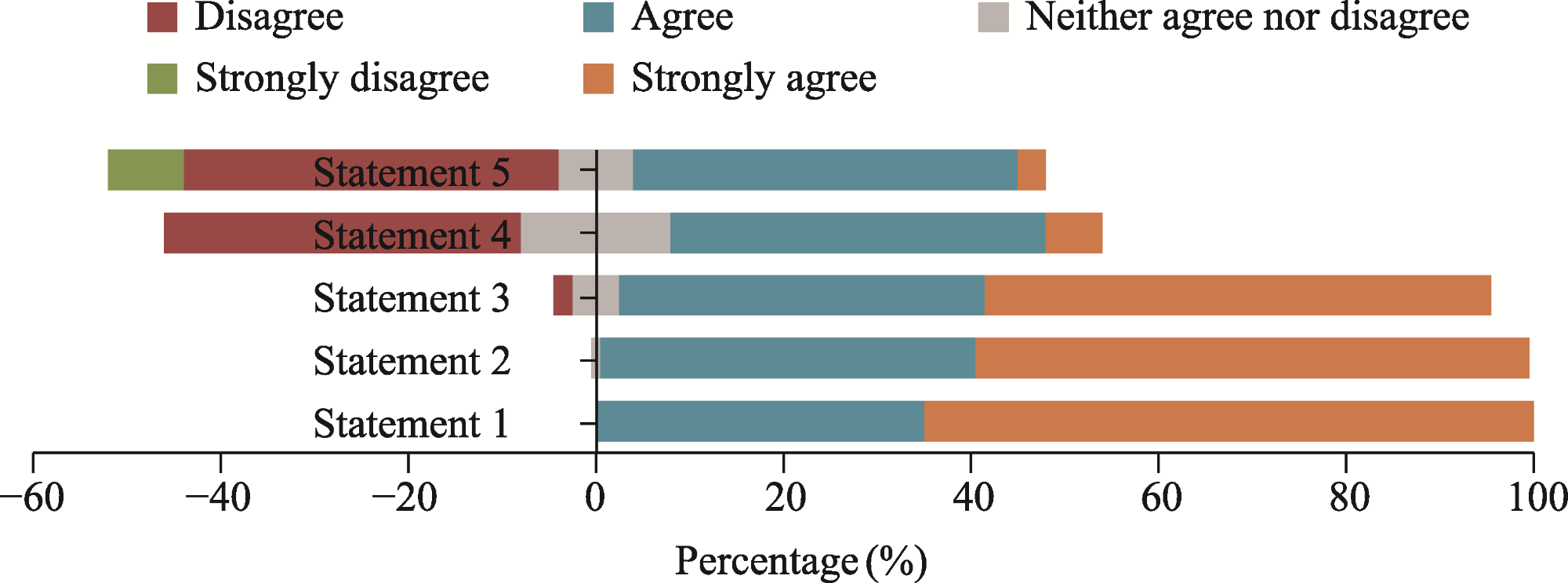
To get a clear overview of the above-mentioned variation in attitude of respondents towards environmental quality, we presented 5-point Likert scale survey data in Figure 2. For simplification, we considered ‘strongly agree’ and ‘agree’ as positive and ‘strongly disagree’ and ‘disagree’ as negative. Neither agree nor disagree was divided into two sides: negative side and positive side. Figure 2 shows that 65.0% of respondents strongly agreed with Statement 1 and 35.0% of respondents agreed with this statement. Moreover, 16.0% of respondents neither agreed nor disagreed with Statement 4. Therefore, we divided it into two equal sides, 8.0% of respondents agreed with Statement 4 and 8.0% of respondents disagreed with Statement 4. Therefore, about 46.0% of respondents disagreed with this statement, so it was located at negative side.
Fig. 2. Percentage of the perception of respondents to five statements. Statement 1: do you think that forest resource should not be depleted here? Statement 2: do you think that the surrounding environment should not be soiled with waste, paper, plates, and food residuals? Statement 3: do you think that the use of plastic should be banned here? Statement 4: do you think that environmentally friendly vehicles should be used here? Statement 5: do you think that there is ecological degradation due to the lack of proper knowledge of tourists?

4.3. Respondents’ WTP participatory labour time

We used bidding game of the CVM to elicit local stakeholders’ WTP participatory labour time for improvement and protection of environmental quality in a hypothetical scenario. Abdeta (2022a, b) examined the application of the CVM in developing countries and found that only a small percentage of countries included non-monetary modes of payment in WTP value estimation. In this study, we first identified local stakeholders who engaged themselves in different kinds of preservation related work in two ecotourism sites (Garpanchkot and Baranti). Their work include removing litters and waste matter left by tourists, watering trees and plants, weeding and sprinkling pesticides, picking up dry leaves, twigs, and flowers, undertaking new plantation, keeping the entire environment clean, and taking care of the old small temples inside the site. Local stakeholders were asked to state how much participatory labour time in a month they are willing to offer for above mentioned preservation related work in ecotourism sites. The OLS model was used to analyse the relationship between local stakeholders’ WTP participatory labour time and five explanatory variables (age, income, education level, environmental quality, and caste) (see Table 3). The OLS model results are presented in Table 4.
Table 3 Expected impact of explanatory variables on respondents’ willingness to pay (WTP) participatory labour time.
Variable Description Measurement Hypothesis
Y Respondents’ WTP participatory labour time - -
X1 Age - People with the lower ages have more enthusiasm and strength, and the longer local employment potential compared to higher age group. Thus, the higher age group will be less willing to offer participatory labour time.
X2 Income - Higher income groups have more consciousness of the protection of environmental quality and have potential to further increase their income by enhancing the attraction of visitors to these sites. As a result, the higher the income, the more enthusiastic people are to provide more participatory labour time for the local cleaning work.
X3 Education level - People with relatively higher levels of education are more aware of the importance of environmental sustainability and protection. Thus, local stakeholders with the higher education have significantly more WTP participatory labour time for keeping the environment clean and pollution free.
X4 Environmental quality Based on the mean value of 5-point Likert scale for each statement Maintenance or improvement of environmental quality may induce offering of increased participatory labour time. Those who think environmental quality of ecotourism site got deteriorated and have better awareness about the importance of environmental upkeep, are likely to offer more participatory labour time compared to those who are not bothered about change in environmental quality or suffer from the lack of its awareness.
X5 Caste General caste was assigned a value of 1, and otherwise 0 People not belonging to the general caste have more enthusiasm, closeness to nature and more WTP participatory labour time for implementation of the environmental restoration programme compared to people of general caste.

Note: - means no measurement or hypothesis.

Table 4 Results of respondents’ WTP participatory labour time and explanatory variables based on the ordinary least square (OLS) model.
Explanatory variable Coefficient Standard error t-statistic P-value
Age -0.0537 0.0153 -3.5019 0.0007
Income 0.0007 0.0004 1.5493 0.1247
Education level 0.1124 0.0455 2.4680 0.0154
Environmental quality -0.0824 0.4221 -0.1953 0.8455
Caste -0.6449 0.3607 -1.7880 0.0770
Constant 4.4884 1.1588 3.8732 0.0002
R2=0.3393 F-statistic=9.6529 (P-value=0.0000)
Adjusted R2=0.3041 Durbin-Watson statistic=1.5790
The OLS model of WTP participatory labour time and five explanatory variables was observed to be good fit with R2=0.3393, which was statistically significant at 1% level. Hence, the underlying hypothesis that the respondents’ WTP participatory labour time was associated with their age, income, education level, and caste, had been accepted, and null hypothesis of no association was rejected. This hypothesis was also developed and supported by Pineda et al. (2023). The value of Durbin-Watson statistic also inclined to support the hypothesis. Age and education level were found to be significant at 1% level, while caste was observed to be significant at 10% level.
We first calculated the mean value of all these five explanatory variables. After that we multiplied the mean value of each explanatory variable by their respective estimated coefficient as obtained in the above regression equation. Therefore, we derived mean WTP participatory labour time by each respondent in a month, which was approximately 3.68 h.
Here, 3.68 h may be considered as the estimated mean WTP participatory labour time for respondents. In a theoretical frame without uncertainty, sample mean WTP participatory labour time is an estimate of true WTP participatory labour time (Boman, 2022). Hanley et al. (1997) found that there is the need for movement from sample to population to reflect the proper valuation of WTP participatory labour time for all stakeholders (140 persons in this case). Now we divided 140 persons into four equal separate groups, with 35 persons in each group, and the total WTP participatory labour time of each group was 128.80 h per month, which is approximately equal to 5.37 d. They can arrange their weekly work according to their own time. This will really contribute to preserve the environmental quality of ecotourism sites.

5. Conclusions and recommendations

5.1. Conclusions

This study unveiled the WTP participatory labour time by respondents in preserving ecotourism sites and provided an optimal control model for developing the equilibrium condition of participatory labour time and an institutional framework for better management and preservation of ecotourism sites. Further, it has been observed that many young people (15-44 years old) have more WTP participatory labour time for protecting the environmental quality of ecotourism sites. The CVM was applied to elicit respondents’ WTP participatory labour time for the protection of ecotourism sites. It was found that the mean WTP participatory labour time of each respondent in a month is approximately 3.68 h. Hence, if such a policy for developing an ecotourism site be taken up, there may be voluntary offering of more participatory labour time by young people for sustaining the benefits from such an endeavour. In other regions of Purulia District and adjacent Bankura District, there are some such ecotourism sites that can be developed through governmental interference and local stakeholders’ participation. This research can contribute to the development of local community and improve the living standards of local stakeholders. Beautification of ecotourism sites through community participation may also attract foreign tourists and contribute to foreign exchange earnings.

5.2. Recommendations

With proper planning and community participation, SDG 11 can be achieved within ecotourism sites. For example, strong area development planning with local government intervention to provide safe, clean, and green spaces may help to protect cultural and natural heritage.
In the entire analysis, it is stressed that community participation is a crucial factor for the development of ecotourism sites. This study suggests that more power should be devolved to local panchayats who are expected to take the pioneering role in coordinating the local efforts and participation. State Tourism Department may appoint an officer who will monitor the ecotourism related work in backward areas and ensure the maximum cooperation between Panchayat Raj Institution and local communities. It can take the help of local Non-Governmental organizations (NGOs) who work for the grassroots level and have adequate cognition on local communities and ecotourism sites of remote areas.
It also seems important to form a managerial body that will monitor the development process of ecotourism sites. Some representatives from local government (i.e., Panchayat Raj Institution), and some senior college educated, experienced, and skilled local stakeholders may be the part of this body. They would implement decisions related to the development of local ecotourism sites, efficiently distribute the participatory work among the members of optimum operational group and keep monitoring the full process.
Finally, the main activities will be done at the operational level. Local communities, which are supposed to offer participatory labour time for the development of project, should be included at this level. This level can be divided into two categories: optimum operational level and remedial level. Those local stakeholders who have already gained some knowledge and skills relevant to the development of the project can be included in the optimum operational group and they can take part actively in this process. But those who have lack of adequate knowledge and skills may be included into the remedial level. After getting appropriate training, local stakeholders at remedial level would become resourceful and then they may be part of the optimum operational level.
The necessary funds need to be regularly allocated from higher administrations to the local bodies, which should be used by them to improve the beauty of the roads connecting ecotourism sites with urban areas, to ensure clean and hygienic environment, and to provide safe accommodation for local stakeholders. In order to motivate local stakeholders’ better involvement and contribution towards the preservation of ecotourism sites, NGOs should provide guidance, training, and awareness lessons for them. Apart from this, participation by local female’s self-help groups should be encouraged for accessory activities. In this context, efforts by such self-help groups in the creation of homestay facility in the region, keeping the cleanliness of home, cooking activities and delivery of food, providing care to elderly tourists, and watering of flowery plants around the homestay might play an effective role in protecting ecotourism sites in Purulia District. In addition, establishing a road map to link these sites with other ecotourism sites nearby may also attract more tourists to this area.

Authorship contribution statement

Piyali CHATTERJEE: conceptualization and writing - original draft; and Soumyendra Kishore DATTA: conceptualization, writing - original draft, and writing - review & editing. All authors approved the manuscript.

Ethics statement

Ethics approval was obtained from the Ethics Committee of the University of Burdwan, India. In addition, the participants provided their informed consent in participating for the study.

Declaration of conflict of interest

The authors declare that they have no known competing financial interests or personal relationships that could have appeared to influence the work reported in this paper.

Acknowledgements

The authors wish to thank local stakeholders as well as the tourists at Garpanchakot and Baranti ecotourism sites for their helpful collaboration.
[1]
Abdeta D., 2022a. Households’ willingness to pay for forest conservation in Ethiopia: A review. J. For. Sci.-Prague. 68(11), 437-451.

[2]
Abdeta D., 2022b. Willingness to pay for forest conservation in developing countries: A systematic literature review. Environ. Sustain. Indic. 100201, doi: 10.1016/j.gecco.2023.e02551.

[3]
Abdeta D., Ayana A.N., Bekele Y., 2023. Willingness to pay for forest conservation: Evidence from a contingent valuation survey analysis in Southwest Ethiopia. Global Ecology and Conservation. 46, e02551, doi: 10.1016/j.gecco.2023.e02551.

[4]
Al-Assaf A., Albalawneh A., Majdalawi M., et al., 2021. Local communities’ willingness to accept compensation for sustainable ecosystem management in Wadi Araba, South of Jordan. Sustainability. 13(9), 5190, doi: 10.3390/su13095190.

[5]
Ali M.B., Quaddus M., Rabbanee F.K., et al., 2022. Community participation and quality of life in nature-based tourism: Exploring the antecedents and moderators. J. Hosp. Tour. Res. 46(3), 630-661.

[6]
Andlib Z., Salcedo-Castro J., 2021. The impacts of tourism and governance on CO2 emissions in selected south Asian countries. Etikonomi. 20(2), 385-396.

[7]
Apdohan J.R.D., Lopez S.O., Seronay R.A., 2021. Willingness to pay towards the conservation of ecotourism resources at Agusan Marsh Wildlife Sanctuary, Agusan del Sur, Philippines. Int. J. Conserv. Sci. 12(3), 1163-1170.

[8]
Aseres S.A., Sira R.K., 2020. Estimating visitors’ willingness to pay for a conservation fund: sustainable financing approach in protected areas in Ethiopia. Heliyon. 6(8), e04500, doi: 10.1016/j.heliyon.2020.e04500.

[9]
Aslan A., Altinoz B., Özsolak B., et al., 2021. The nexus between economic growth, tourism development, energy consumption, and CO2 emissions in Mediterranean countries. Environ. Sci. Pollut. Res. 28, 3243-3252.

[10]
Azam M., Alam M.M., Hafeez M.H., 2018. Effect of tourism on environmental pollution: Further evidence from Malaysia, Singapore and Thailand. J. Clean. Prod. 190,330-338.

[11]
Baloch Q.B., Shah S.N., Iqbal N., et al., 2023. Impact of tourism development upon environmental sustainability: A suggested framework for sustainable ecotourism. Environ. Sci. Pollut. Res. 30(3), 5917-5930.

[12]
Berhanu D., 2023. Labor as a payment vehicle for the rangeland improvement: an application of contingent valuation method in Yabello District, Southern Ethiopia. Malaysian Journal of Sustainable Agriculture. 7(1), 25-31.

[13]
Bharali A., 2012. A study on the demand for ecotourism using non-market valuation methods:the case study of Kaziranga National Park. PhD Dissertation. Silchar: Assam University.

[14]
Bishop R.C., Boyle K.J., 2019. Reliability and validity in nonmarket valuation. Environ. Resour. Econ. 72(3), 559-582.

[15]
Boman M., 2022. The sample median as an estimator of population mean true willingness to pay under valuation uncertainty: A synthesis and analysis of the literature. Appl. Econ. 54(55), 6393-6405.

[16]
Byrd E.T., 2007. Stakeholders in sustainable tourism development and their roles: Applying stakeholder theory to sustainable tourism development. Tour. Rev. 62(2), 6-13.

[17]
Chan J.K.L., Marzuki K.M., Mohtar T.M., 2021. Local community participation and responsible tourism practices in ecotourism destination: A case of Lower Kinabatangan, Sabah. Sustainability. 13(23), 13302, doi: 10.3390/su132313302.

[18]
Chu X., Zhan J.Y., Wang C., et al., 2020. Households’ willingness to accept improved ecosystem services and influencing factors: application of contingent valuation method in Bashang Plateau, Hebei Province, China. J. Environ. Manage. 255, 1009925, doi: 10.1016/j.jenvman.2019.109925.

[19]
Darda M.A., Bhuiyan M.A.H., 2022. A Structural Equation Model (SEM) for the socio-economic impacts of ecotourism development in Malaysia. PLoS One. 17(8), e0273294, doi: 10.1371/journal.pone.0273294.

[20]
Dharmadhikari S., 2024. Ecotourism Global Market Report 2024. [2023-01-11]. https://www.researchandmarkets.com/report/ecotourism?srsltid=AfmBOoq2y0XBQEkvfHUsOVELzYhN-SqUR2r-0wQ1nn0crJSLUztTScrA.

[21]
Diamond P.A., Hausman J.A., 1994. Contingent valuation: Is some number better than no number? J. Econ. Perspect. 8(4), 45-64.

[22]
Endalew B., Wondimagegnhu B.A., Tassie K., 2020. Willingness to pay for church forest conservation: A case study in northwestern Ethiopia. J. For. Sci. 66(3), 105-116.

[23]
Eshun G., Tichaawa T.M., 2019. Reconsidering participation for local community well-being in ecotourism in Ghana. Geojournal of Tourism and Geosites. 27(4), 1184-1200.

[24]
Gan J.E., 2021. Ecotourism and Malaysia’s Orang Asli: The social construction of indigeneity in community boundary-drawing. J. Ecotourism. 21(1), 54-70.

[25]
Garrod B., 2003. Local participation in the planning and management of ecotourism: A revised model approach. J. Ecotour. 2(1), 33-53.

[26]
Giriwati S.S.N., Lyati W., Hawa C.L., et al., 2019. Local community participation in ecotourism development: The case of Sumberwangi Hamlet Destination, East Java, Indonesia. PEOPLE: International Journal of Social Sciences. 5(1), 81-98.

[27]
Gumede T.K., Nzama A.T., 2020. Enhancing community participation in ecotourism through a local community participation improvement model. African Journal of Hospitality Tourism and Leisure. 9(5), 1252-1272.

[28]
Gunatilake H., Maddipati N., Sumeet P., 2012. Willingness to Pay for Good Quality, Uninterrupted Power Supply in Madhya Pradesh, India. [2023-03-11]. https://www.adb.org/publications/willingness-pay-good-quality-uninterrupted-power-supply-madhya-pradesh-india.

[29]
Hamuna B., Rumahorbo B.T., Keiluhu H., 2018. Willingness to pay for existence value of mangrove ecosystem in Youtefa Bay, Jayapura, Indonesia. Journal of Environmental Management and Tourism. 5(29), 907-915.

[30]
Hanley N., Shogren J.F., White B., 1997. Environmental Economics in Theory and Practice. London: Macmillan, 391.

[31]
Hasana U., Swain S.K., George B., 2022. Management of ecological resources for sustainable tourism: A systematic review on community participation in ecotourism literature. International Journal of Professional Business Review. 7(1), e0269. doi: 10.26668/businessreview/2022.v7i1.269.

[32]
Hassan E.K.N.E., Shuib A., Kunasekaran P., et al., 2018. Local community participation in ecotourism development in Tasik Kenyir, Malaysia. World Applied Sciences Journal. 36(1), 85-92.

[33]
Hoang T.T.H., Van Rompaey A., Meyfroidt P., et al., 2020. Impact of tourism development on the local livelihoods and land cover change in the Northern Vietnamese highlands. Environment, Development and Sustainability. 22, 1371-1395.

[34]
Kabil M., Ali M.A., Marzouk A., et al., 2024. Gender perspectives in tourism studies: A comparative bibliometric analysis in the MENA region. Tourism Planning & Development. 21(3), 276-298.

[35]
Khan M.S., Bhagwat S.A., 2010. Protected areas: A resource or constraint for local people? Moun. Res. Develop. 30(1), 14-24.

[36]
Li H., Yang X.H., Zhang X., et al., 2018. Estimation of rural households’ willingness to accept two PES programs and their service valuation in the Miyun Reservoir Catchment, China. Sustainability. 10(1), 170, doi: 10.3390/su10010170.

[37]
Ma B., Wen Y.L., 2019. Community participation and preferences regarding conservation and development policies in China’s giant panda nature reserves. Sustainability. 11(18), 4852, doi: 10.3390/su11184852.

[38]
McFadden D., Train K., 2017. Stated preference methods and their applicability to environmental use and non-use valuations. In: McFaddenD., TrainK., (eds.). Contingent Valuation of Environmental Goods:A Comprehensive Critique. Camberley: Edward Elgar Publishing, 153-187.

[39]
Meginnis K., Hanley N., Mujumbusi L., et al., 2020. Non-monetary numeraires: Varying the payment vehicle in a choice experiment for health interventions in Uganda. Ecol. Econ. 170, 106569, doi: 10.1016/j.ecolecon.2019.106569.

[40]
Musa F., Fozi N.M., Hamdan D.D.M., 2020. Coastal communities’ willingness to pay for mangrove ecotourism at Marudu Bay, Sabah, Malaysia. J. Sustain. Sci. Manag. 15(4), 130-140.

[41]
Palit S., Saren U.K.P.M., 2021. Perception of tourism on the socio-economic improvement of Purulia: A case study from the Ajyodha Hills, Purulia, West Bengal, India. Psychology and Education. 58(3), 3483-3496.

[42]
Perni Á., Barreiro-Hurlé J., Martinez-Paz J., 2021. Contingent valuation estimates for environmental goods: Validity and reliability. Ecol. Econ. 189, 107144, doi: 10.1016/j.ecolecon.2021.107144.

[43]
Pineda F., Padilla J., Granobles-Torres J.C., et al., 2023. Community preferences for participating in ecotourism: A case study in a coastal lagoon in Colombia. Environmental Challenges. 11, 100713, doi: 10.1016/j.envc.2023.100713.

[44]
Piper S., 1998. Using contingent valuation and benefit transfer to evaluate water supply improvement benefits. J. Am. Water. Resour. Assoc. 34(2), 311-320.

[45]
Schiappacasse I., Lavin F., Nahuelhual L., et al., 2013. Labor as welfare measure in contingent valuation: The value of a forest restoration project. Agricultural Science and Research. 40(1), 69-84

[46]
Sethy M.K., Senapati A.K., 2023. Perceptions towards ecotourism practice and the willingness to pay: Evidence from Chilika coastal wetland ecosystem, Odisha. International Journal of Geoheritage and Parks. 11(3), 497-513.

[47]
Shaheen K., Zaman K., Batool R., et al., 2019. Dynamic linkages between tourism, energy, environment, and economic growth: Evidence from top 10 tourism-induced countries. Environ. Sci. Pollut. Res. 26, 31273-31283.

[48]
Stefănica M., Butnaru G.I., 2016. Research on tourists’ perception of the relationship between tourism and environment. Procedia Economics and Finance. 20, 595-600.

[49]
Subanti S., Hakim A.R., Irawan B.B., et al., 2017. Determinant of willingness to pay and economic value for tourism object using contingent valuation method: The case of Sangiran sites, Province of central Java, Indonesia. Journal of Environmental Management and Tourism. 8(4), 867-874.

[50]
Sun Y.P., Yesilada F., Andlib Z., et al., 2021. The role of eco-innovation and globalization towards carbon neutrality in the USA. J. Environ. Manag. 299, 113568, doi: 10.1016/j.jenvman.2021.113568.

[51]
TIES The International Ecotourism Society, 1990. The Definition. [2023-01-11]. https://ecotourism.org/ties-overview/.

[52]
Ting M., Min Q.W., Kun X., et al., 2021. Resident willingness to pay for ecotourism resources and associated factors in Sanjiangyuan National Park, China. Journal of Resources and Ecology. 12(5), 693-706.

DOI

[53]
UNWTO World Tourism Organization of the United Nations, 2008. Tourism Highlights. Madrid: UNWTO.

[54]
Upadhaya S., Tiwari S., Poudyal B., et al., 2022. Local people’s perception of the impacts and importance of ecotourism in Central Nepal. PLoS One. 17(5), e0268637, doi: 10.1371/journal.pone.0268637.

[55]
Uzulmez M., Ercanİştin A., Barakazi E., 2023. Environmental awareness, ecotourism awareness and ecotourism perception of tourist guides. Sustainability. 15(16), 12616, doi: 10.3390/su151612616.

[56]
Vondolia G.K., Navrud S., 2019. Are non-monetary payment modes more uncertain for stated preference elicitation in developing countries? Journal of Choice Modeling. 30, 73-87.

[57]
Wollie G., Adem M., Menelek D., et al., 2021. Households willingness to pay for the development of community based tourism around Alelo Bad hot spring water: The Ethiopian case study. Journal of Hospitality Management and Tourism. 12(2), 18-28.

Outlines

/