
Full Length Article

Innovation in two contrasting value chains: Constraints and opportunities for adopting alternative crop production in the Vietnamese Mekong River Delta

  • Sang Thanh LE , a, * ,
  • Nhu Huynh MAO b ,
  • Paul KRISTIANSEN b ,
  • Michael COLEMAN b
Expand
  • aSoil Science Department, College of Agriculture, Can Tho University, Can Tho, 900100, Vietnam
  • bSchool of Environmental and Rural Science, University of New England, Armidale, 2351, Australia
* E-mail address: (Sang Thanh LE).

Received date: 2024-03-11

  Accepted date: 2025-02-21

  Online published: 2025-08-13

Copyright

This is an open access article under the CC BY-NC-ND license (http://creativecommons.org/licenses/by-nc-nd/4.0/).

Abstract

Agricultural production (especially intensive rice production) is a primary income source for over 2.0×10⁷ people in the Vietnamese Mekong River Delta. However, adverse climate change impacts, socio-economic change, and high dependence on farm inputs for intensive production constrain the longer-term sustainability of rice systems. Government and agribusiness actors are encouraging more farmers to grow non-rice crops and supporting the upscaling of alternative crops to paddy rice. We used a qualitative approach to investigate the value chain characteristics, as well as constraints and opportunities of alternative crops via two case studies (baby corn and honeydew melon) in An Giang and Hau Giang provinces, Vietnam. Data collection involved focus group discussions with local farmers and interviews with farmers and industry experts. Thematic analysis was used to compile the findings, and the results were validated with local government staff. The baby corn value chain featured on-going and stable market demand (including value-addition) and better vertical coordination (e.g., written contracts and financial support). The honeydew melon value chain featured positive relationships between farmers and traders despite less-developed vertical coordination. There are opportunities for value chain engagement through product quality certification, value-addition, and accessing high-value domestic and export markets. However, farmers require crop-specific and generic support from private and public sectors. Increased labour requirements and limited access to finance and credit limit value chain participation. Upscaling and marketing alternative crops can enhance farmer profitability and support non-farming agricultural business establishment, economic growth, and community development. Efficient value chains will be critical to ensure the adoption of alternative crops and development of crop-specific agribusiness models. These findings can inform policy-makers and change facilitators in designing targeted interventions to support the adoption of alternative crops in the study area as well as in Vietnam and globally.

Cite this article

Sang Thanh LE , Nhu Huynh MAO , Paul KRISTIANSEN , Michael COLEMAN . Innovation in two contrasting value chains: Constraints and opportunities for adopting alternative crop production in the Vietnamese Mekong River Delta[J]. Regional Sustainability, 2025 , 6(1) : 100198 . DOI: 10.1016/j.regsus.2025.100198

1. Introduction

1.1. Agricultural production in the Vietnamese Mekong River Delta (VMRD)

Agricultural production is the main source of income for more than 2.0×10⁷ residents living in the VMRD, where two-thirds of the area (more than 2.50×10⁶ hm2) is dedicated to agricultural production, with rice as the principal commodity (GSO, 2021). In recent decades, agricultural production has increased significantly as a result of agricultural intensification, particularly the widespread adoption of three rice crops annually (‘triple-rice’). However, the adverse impacts of climate change and salinization have reduced triple-rice productivity in vulnerable areas, particularly during the dry season, when saline intrusion and drought are most prominent, and the problem is forecasted to worsen in the future (Jiang et al., 2019; Kaveney et al., 2023).
In addition to the biophysical impacts of climate change and agricultural intensification, socioeconomic factors are prompting farmers in the VMRD to diversify their farming options and household livelihoods more generally. Low rice profitability is driving some farmers towards higher value crops (Thanh et al., 2021). Labour shortages are becoming more acute for agriculture in the region as a result of migration and changing career aspirations, particularly among younger people (Tran, 2019; Duyen et al., 2021), and market opportunities are also changing with greater emphasis on exports, certified produce, and value-addition (World Bank Group, 2015).
In response, the Government of Vietnam (GoV) advocates climate change adaptation in the form of sustainable and climate resilient farm management practices, as illustrated in Resolution 120 and the Agricultural Restructuring Plan (GoV, 2021). These national strategies encourage ‘transformative adaptation’, changing from a ‘triple-rice’ monoculture to the production of other annual crops, such as vegetables and fruits, either as a dry-season rotation with rice or as a year-round alternative. A recent national strategy advocated for the transformation of over 8.50×10⁴ hm2 of less productive rice growing land to the production of other annual crops, perennial crops, and integrated rice and aquaculture (MARD, 2023). Value chains for alternative crops are likely to be relatively poorly understood and underdeveloped in relation to dominant crops in different agricultural systems, posing significant challenges for upscaling (Kaveney et al., 2023; Weituschat et al., 2023). Analysis of farmer needs and perceptions about market engagement can improve production and marketing of alternative or novel crops, potentially benefiting farmers and other value chain actors by identifying and facilitating opportunities for income growth and for value chain development (Kaplinsky and Morris, 2001). There were limited examples of value chain mapping for alternative (non-rice) crops in the VMRD (Huong et al., 2013a; Yang et al., 2022).
Adaptation constraints make it more difficult to plan and implement adaptation actions (Klein et al., 2014). In the VMRD, farmers moving away from rice production need to manage at least two new challenges. The first is to establish a resilient production system for alternative crops, generating acceptable yields while achieving economic viability and balancing production costs (e.g., agronomic inputs and credit), resource availability (e.g., labour and migration, irrigation, and infrastructure), and risk profile (e.g., crop losses and price fluctuations). The second is to establish profitable relationships with value chain actors for alternative crops (Poole, 2017), especially where farmers have primarily or solely relied on rice markets, meaning that their existing relationships are likely to be most relevant to this crop. Where smallholder farmers predominate, these challenges are amplified since they may lack the scale and resources to adapt effectively (Neil et al., 2008).
Adaptation opportunities make it easier to plan and implement actions (Klein et al., 2014). The process of farming adaptation and regional upscaling is made possible by existing and emerging market opportunities, including demand for alternative crops or products, demand for quality assurance programmes (such as good agricultural practice (GAP)), and effective stakeholder engagement, financial support, and appropriate planning policies. Adaptation is also enabled by technical factors, including knowledge and skills in using existing resources and machinery, effective extension services, and suitable storage and transport infrastructure (Huong et al., 2013a; Global GAP, 2023).

1.2. Transformative adaptation and innovation

Ideally, a comprehensive adaptive response would include both adaptation and mitigation. However, for most smallholder farmers whose livelihoods are already being affected by climate change, adaptation is the more urgent option (IFAD, 2008). Adaptation responses to significant challenges can occur at a range of spatial and temporal scales, and various models have been developed to describe potential responses from incremental to transformative adaptation and innovation (Brown et al., 2015; Thanh et al., 2021; Weituschat et al., 2023).
Incremental adaptation to climate change involves relatively minor modifications to the farming system, for example, changing the cropping calendar or the timing and frequency of input use, or adopting stress-tolerant varieties of existing crops (Datta et al., 2022). For rice farmers in the VMRD, incremental adaptations have included growing salt- or dry-tolerant rice varieties, altering the cropping calendar, changing from triple-rice to double-rice production (with a fallow period), or introducing a diverse rotation system (Nguyen et al., 2020; Paik et al., 2020).
However, transformative adaptation may instead be a necessary response to the major impacts of climate change (Kates et al., 2012; Fedele et al., 2019). Transformative adaptation involves substantial and fundamental farm system changes, such as producing a new crop or commodity, alternative land uses, changes in labour sources, and new farming locations. Each of these responses may help mitigate socioeconomic and environmental vulnerabilities to climate change (Fedele et al., 2019; Datta et al., 2022). Asia is particularly vulnerable to climate change impacts, including weather extremes, sea level rise, and erratic rainfall. These climatic risks and uneven economic development among rural communities and vulnerable smallholder farmers suggest that transformative adaptation will become increasingly common (Le et al., 2024).
Common drivers influencing innovation in cropping transformation include a range of economic, marketing, human resources, and bio-physical factors. Economic factors may include limited access to credit and financial instruments (e.g., contracts and insurance) (Linh et al., 2019; Mushtaq et al., 2020), while marketing factors can include on-going and stable market demand, value-addition, better vertical coordination, and product certification (Khong, 2022; Le et al., 2024). Access to a reliable labour supply and support from private and public sector agencies are an important aspect of human resources for crop transformation, and technical training and input provision are key elements of agronomic capacity building for adopting alternative crops (Huong et al., 2013b; World Bank Group, 2016).
Effective adaptation (either incremental or transformative) requires continued improvement in rural community adaptive capacity, to overcome adaptation constraints and to make the most of opportunities to adapt (Vermeulen et al., 2018). Options to enhance adaptive capacity in rural communities in the VMRD currently include production and marketing training and technical assistance, facilitation of value chain linkages, financial support, and the provision of supporting public infrastructure (World Bank Group, 2016; Phuong et al., 2018; NESC, 2021). Some work has been carried out on adaptation in the Vietnamese Red River Delta (Huong et al., 2013a, b), however, this region features markedly different weather conditions and crop seasonality to the VMRD. It is therefore important to identify relevant constraints and opportunities that smallholder farmers in the VMRD must address when contemplating a transformative adaptation towards growing an alternative (non-rice) crop, and their capacity to engage effectively with markets for these crops (Ackerl et al., 2023; Kaveney et al., 2023).

1.3. Research questions

We sought to identify and analyse relevant constraints and opportunities for smallholder farmers seeking to innovate their farming system through transformative adaptation from rice to alternative crops. Documenting farmer experiences and perceptions about engagement in alternative crop value chains can contribute to the development of production and marketing of alternative crops. We adopted a case study approach focusing on two crops with different value chain structures for shifting from year-round production of rice to year-round production of baby corn (Zea mays L.) in An Giang Province, Vietnam, and honeydew melon (Cucumis melo L.) in Hau Giang Province, Vietnam. The specific research aims were to: (1) identify relevant constraints and opportunities for smallholder farmers, which influence the production and marketing of these two alternative crops and farmer capacity to engage effectively in these value chains; and (2) compare and contextualise these constraints and opportunities to facilitate the development and upscaling of sustainable value chains for alternative crops.

2. Materials and methods

2.1. Case study regions

An Giang and Hau Giang provinces, Vietnam, are prominent contributors to agriculture in the VMRD, with more than 80% of their total area allocated to agricultural production. An Giang is an upstream province, whereas Hau Giang is located centrally in the VMRD. Both provinces rely heavily on rice production, with An Giang being the most significant rice producing province in the VMRD since the 19th century (MARD, 2016a, b). Despite their different biogeographic locations, climate change-mediated extreme weather events threaten rice production in both provinces (Brown et al., 2018; Jiang et al., 2019) as do various demographic and market-based changes (Demont and Rutsaert, 2017; Ba et al., 2019; Khong, 2022).
In line with Resolution 120 and the Agricultural Restructuring Plan, agriculture in these two provinces has undergone significant transformation in response to climate change and socioeconomic pressures, to improve sector sustainability and profitability through diversification. In areas where rice yields have been found to decline, it has become more common for farmers to grow alternative crops, including baby corn in An Giang and honeydew melon in Hau Giang. During 2021-2025, a target was established to transform a total of nearly 2.00×10⁴ hm2 of rice production to alternative crops (e.g., baby corn) in An Giang (An Giang People’s Committee, 2021). In Hau Giang, plans were made to transform more than 0.24×10³ hm2 of rice production to alternative crops (e.g., honeydew melon) in 2023 (Hau Giang DARD, 2023). Changing to year-round production of baby corn and honeydew melon can therefore be considered transformative adaptations, which are supported and encouraged by government strategies and offer potential benefits including improved profitability over rice farming and suitability to local conditions under a changing climate.
Honeydew melon was a relatively recent alternative crop, while baby corn has been produced on a wider scale for about two decades, commonly under contract farming arrangements. These crop production systems were selected as case studies for this study as previous informal discussions with local stakeholders suggested that they differed in terms of production system and value chain characteristics, while we also focused on different geographic locations for each case study crop. Previous discussions also indicated that they were the main alternative crops in the two study areas, though there was no detailed information available on number of growers or planted area at the time of writing.

2.2. Data collection

To address our research questions, we used a qualitative research approach to elicit the experiences and perceptions of farmers and other stakeholders in two case study value chains in the VMRD. Based on the themes identified in the literature relating to economic, marketing, human resources, and bio-physical factors, we developed research questions for discussions with farmers and other value chain actors to document their experiences of producing and selling in emerging non-rice value chains, including problems encountered (constraints) and possibilities for improvement to benefit farmers, rural communities, traders, buyers, and consumers (opportunities). The value chain characterisation focused on describing the inter-linkages of value chain actors and product flow from production to market, identifying common features and differences in the broad operations of each case study value chain, and allowing their constraints and opportunities to be placed in context.
A semi-structured focus group discussion (FGD) schedule (Harrell and Bradley, 2009) and two key informant interview (KII) schedules, one for farmers and one for industry experts, were prepared. Each of these three forms of data collection was used to collect information for both case studies. These data collection activities acquired basic demographic information on research participants (gender, location, experience, and role) as well as the following qualitative information: the operational characteristics of the two value chains that were the focus of this study and constraints and opportunities related to farming systems in the VMRD, including farmer engagement with the two case study value chains.
The farmer and expert KII schedules were piloted (with a farmer and an agricultural extension officer, respectively), while a pilot FGD was conducted with five farmers in the VMRD. Issues identified during piloting were corrected (e.g., redundancy, unclear wording, and missing questions), and the schedules finalised. Human research ethics approval was provided by the University of New England (HE22-166).
We obtained consent from the Department of Agriculture and Rural Development (DARD) to conduct this study in the two case study provinces. Local DARD staff in An Giang and Hau Giang provided general information on the study sites and operation of the value chains (including focal production areas for the two case study crops) and facilitated linkage with local farmer and value chain networks for participant recruitment. Using a purposive sampling approach (Nyumba et al., 2018), research participants were selected not at random but based on their experience in the case study crop value chains and their willingness and ability to provide relevant information.
Preliminary value chain description was conducted with DARD staff in each province to identify key actors, their role, and the direction of resource flow. The value chain maps were refined and finalised through collection of FGD and KII data, and were validated through further consultation with DARD staff to provide a context for the detailed discussion of constraints and opportunities for the two value chains.
Participants in FGD and KII included farmers (male and female), collectors, traders, local input suppliers, DARD staff, and farmer union leadership, with participants suggested by local DARD staff. Four farmer FGDs (two for each crop) were completed. Two research team members acted as enumerators and facilitators and ensured that all valid responses were recorded accurately and completely. Both enumerators took notes during data collection activities, with the information synthesised during data collation and cleaning.
The data collection activities enabled triangulation (Bogner et al., 2009; Collins et al., 2015) to validate the research findings by approaching the research questions using more than one qualitative method (group discussion and expert interview), acquiring multiple perspectives (farmers and other public and private sector stakeholders in the value chains for each case study crop), and having more than one enumerator involved in data collection and synthesis. Data collection was completed from November to December in 2022.
Participants in the 4 FGDs included 7 female farmers and 35 male farmers (20 farmers from An Giang and 22 farmers from Hau Giang, with 2 FDGs held in each province). The research team attempted to achieve a balance of female and male farmer participation in the FGDs, however this was not feasible given that males made up the vast majority of participants in agricultural production. A total of 14 KIIs were completed, comprising 4 farmers (1 female farmer and 3 male farmers) and 10 other value chain experts (3 female farmers and 7 male farmers) across the 2 case studies (7 key informants from An Giang and 7 key informants from Hau Giang). Key informants included government extension staff, farm input suppliers, traders, and wholesalers. These informants were able to provide varied perspectives regarding support to farmers and value chain functioning for these crops. Data saturation (i.e., collection of all key insights with respect to a research topic) can occur with relatively small sample sizes within a homogenous study population such as farmers and related value chain stakeholders (Guest et al., 2006, 2017; Hennink and Kaiser, 2022). We therefore considered that the data collection approach used and the number of participants collected sufficient data to identify key themes related to each case study.

2.3. Data entry, cleaning, and analysis

Data were entered into Microsoft Excel 365 software (Version 2410; Microsoft, Redmond, the USA), with each column of data representing a particular question or topic and each row representing either a single key informant or the collective opinion of FGD participants. Data were translated from Vietnamese to English, data cleaning was carried out to ensure accuracy, and researchers followed up with research participants to clarify response as needed. Three separate data sets were prepared: a FGD data set and two KII data sets for farmers and other industry experts.
Thematic analysis (Braun and Clarke, 2006; Kiger and Varpio, 2020) was used across the three data sets to interpret response with respect to constraints and opportunities relevant to the two value chains. During data entry and cleaning, the researchers noted key themes reported in the responses. From this initial review, Microsoft Excel software was used to generate an initial set of codes for each question, with many responses represented by more than one code where multiple themes were evident. Using the coded data, patterns or themes in the response were identified and collated across the three data sets. Based on pre-existing research questions and the literature on transformative adaptation in agricultural systems, we adopted a deductive approach to develop research themes. We identified themes across the three data sets according to research topic and reviewed the accuracy and completeness of the raw data. Team members discussed the codes to arrive at a consensus with respect to emergent themes for presentation and analysis, rather than relying on the interpretation of a single team member (Tease et al., 2023). Thematic analysis allowed for several broad areas of constraints and opportunities to be identified both across and within the two case studies. Thus, the results of this study feature a characterisation and analysis of the two case study value chains, highlighting and documenting their common features and differences in two value chain diagrams, as well as the shared and contrasting constraints and opportunities for each case study under four broad themes: finance and economics, value chains and private sector engagement, human resources, and farming systems and crop agronomy.

3. Results

3.1. Characterising the baby corn and honeydew melon value chains

To provide a background context for the research regarding constraints and opportunities, we characterised the value chains for baby corn in An Giang and honeydew melon in Hau Giang, as examples of the alternatives available to farmers to transform away from production of rice.
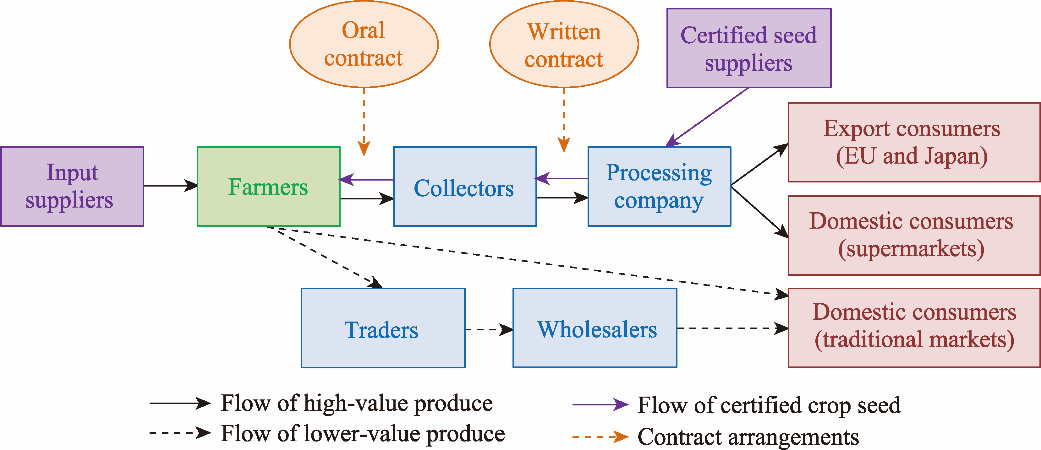
The baby corn value chain in An Giang (Fig. 1) featured on-going and stable market demand, including value-addition (via a processing company) and opportunities for diversification (e.g., using post-harvest by-products to feed cattle and cattle manure as a crop fertiliser). Supply of lower quality produce to traditional domestic markets only accounted for a small proportion of total demand within this value chain. This value chain can be described as relatively mature given that it featured significant vertical coordination amongst value chain stakeholders, including written contract between collectors and processing company to provide farmers with greater certainty around price and quantity, in-kind support from buyer and government, and a mature export market for processed goods.
Fig. 1. Baby corn value chain in An Giang Province. EU, the European Union.
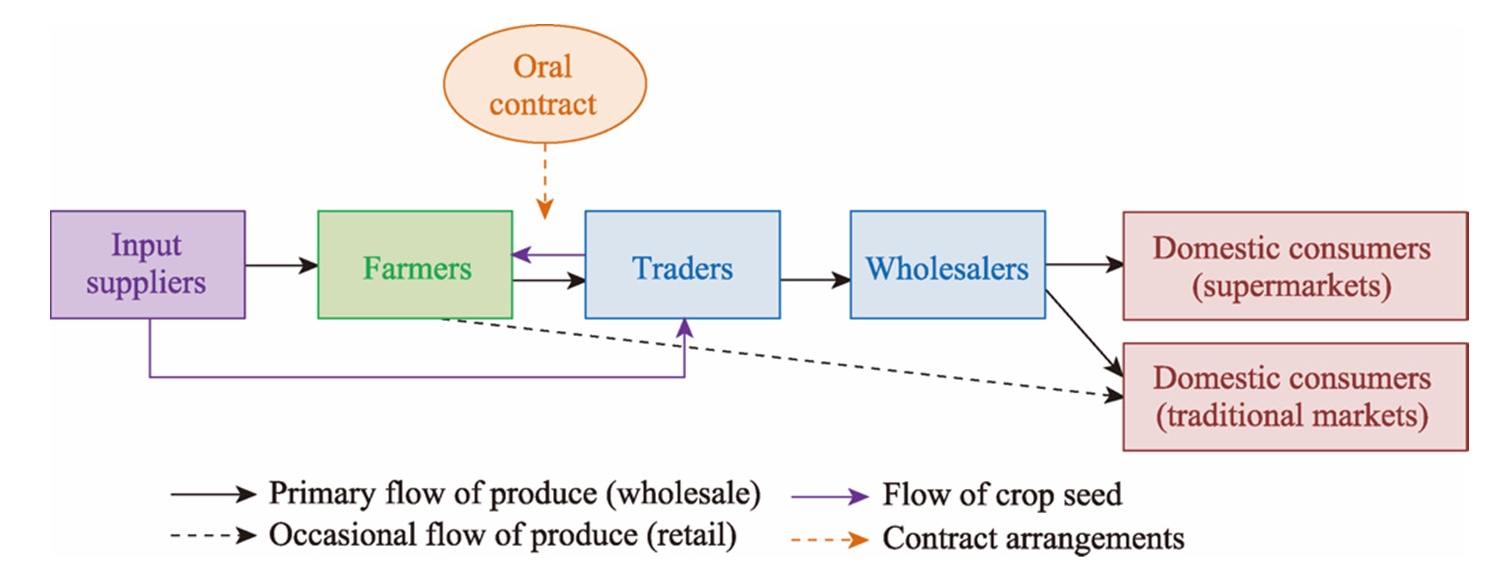
The less mature and more traditional honeydew melon value chain in Hau Giang (Fig. 2) featured farmers selling to traders and then having no further involvement in reaching domestic traditional and modern markets, reflecting less-developed vertical coordination. The informal oral contract between farmers and traders was mainly based on mutual trust, and relationships between farmers and traders tended to be relatively positive. Farmers were able to access inputs, including seeds and other inputs from local suppliers or seeds only from traders as a form of in-kind credit.
Fig. 2. Honeydew melon value chain in Hau Giang Province.

3.2. Constraints and opportunities for value chain engagement

Thematic analysis of the information on constraints and opportunities provided by the research participants resulted in creation of four categories: finance and economics, value chains and private sector engagement, human resources, and farming systems and crop agronomy. Each category is discussed in more detail below, and the information has been summarised in Table 1 (baby corn) and Table 2 (honeydew melon).
Table 1 Summary of constraints and opportunities related to the baby corn value chain in An Giang Province.
Value chain Constraint Opportunity
Finance and economics High or increasing input prices Low investment cost
Insufficient access to bank credit More profitable than rice
Crop income is sufficient and relatively stable.
Income diversification (corn-cow model)
Value chains and private sector engagement Technical barriers Contract specifications for price, quantity, and quality provide certainty.
Fragmented production area Low transportation costs
Uncertified product quality (e.g., global GAP or organics) Government facilitation
Monopsony by a company Reliable access to domestic and export markets
Heavy reliance on company for resources Reliable crop supply
Diversity in marketing information resources
Human resources Insufficient or scarce labour Many years of experience in production
Training available for corn production
Farming systems and crop agronomy Cost of farm infrastructure to support crop system In-kind support (seed) available from collectors
Inability to afford and lack of knowledge of new technologies Embankment, dikes, and sluice gate systems are well constructed.
Unpredictable and increasing diseases Easy to grow
Climate change and extreme weather Crop suited to local soils
Lacking modern technology application Could be integrated with cattle production to increase income

Note: GAP, good agricultural practice.

Table 2 Summary of constraints and opportunities related to the honeydew melon value chain in Hau Giang Province.
Value chain Constraint Opportunity
Finance and economics High or increasing input prices High profitability
High investment cost High and consistent demand
Lack of capital for farm investment Credit available from traders
Value chains and private sector engagement Scarcity of local buyers Prices, estimated quantity, and quality are negotiated before planting.
No linkage to premium buyers (company or processor) Positive relationships between farmers and traders
Oral purchase commitment rather than written contract Low transportation costs and good transport networks
Poor and uncertified quality limits access to premium domestic and export markets. Diversity in marketing information resources
Weak negotiation power for farmers due to fragmented production and reduced role for cooperatives
Human resources Insufficient or scarce labour General crop production experience and knowledge
Inexperience in honeydew melon production
Insufficient training available
Farming systems and crop agronomy Cost of farm infrastructure to support crop system In-kind support (seed) available from traders
Inability to afford and lack of knowledge of new technologies Appropriate transportation networks from farm to market
Susceptibility to extreme and unpredictable weather Embankment, dikes, and sluice gate systems are well constructed.
Susceptibility to pests and diseases Productive crop option
Lacking modern technology application Crop suited to local soils

3.2.1. Finance and economics

Both baby corn and honeydew melon farmer participants were constrained by high and increasing input prices, notably fertiliser and pesticide. Some honeydew melon farmers noted the high initial investment cost in shifting to production of this crop (e.g., paddock layout and planting bed establishment) as a financial constraint, with some finding it difficult to meet these costs. For baby corn producers, poor access to bank credit made it difficult to invest in farm system transformations where higher production standards and modern approaches may be required (e.g., different forms of mechanisation for crop management and irrigation and digital sensor technology) compared to traditional rice production, particularly to meet the quality requirements for higher quality domestic and export markets. Baby corn farmers were also required to invest in product quality certification (e.g., global GAP) to gain access to higher value markets for this crop.
Both case study crops were reported by research participants to be highly profitable relative to rice production. There was sufficient ongoing demand to ensure relative price stability and assurance of making a sale, despite the relatively small number of buyers compared to rice. Several economic opportunities specific to baby corn grower participants were noted, including the relatively low cost of initial investment in the crop and supporting infrastructure (in contrast to honeydew melon production). Corn production also offered farmers the opportunity to diversify their income by utilising corn by-products (stem and leaf) to feed cows held on the farm, with crops sown at different times across the season in part to facilitate a steady supply of cattle feed. Excess feed was provided to neighbouring farmers as needed. Those adopting this ‘corn-cow’ model also had the opportunity to sell cattle manure as a fertiliser product to neighbouring farmers.

3.2.2. Value chains and private sector engagement

The marketability of honeydew melon was considered somewhat constrained by the relative scarcity of local buyers for this crop in the value chain, as well as limited access to premium buyers with links to domestic and export markets. Low and uncertified crop quality for honeydew melon was also considered in some cases to further restrict access to premium markets. Lack of written contracts in this value chain was considered to place honeydew melon farmers at a disadvantage, with the theoretical potential that traders could break oral agreements relatively easily, particularly if price fluctuations favoured this approach. Farmers were hesitant to sign written contracts with buyers for the production of honeydew melon because they may be required to commit to complex contract requirements (for example, compliance with quality assurance protocols regarding production standards, fruit size, and quality), and because they were more familiar with traditional sale approaches such as sale to buyers at the farm gate (reliant on oral contracts), or direct to a local market. The fragmented nature of honeydew melon production across Hau Giang also reduced farmer negotiation power with traders, restricting the capacity for collective negotiations to take place. Despite these potential issues, farmer participants using oral agreements with traders considered they were supported by a solid foundation of mutual trust. Price, quantity, and quality requirements were negotiated orally at the time of crop planting between both parties.
For baby corn producers, better private sector engagement exists through written contracts in place between collectors and a processing company/buyer, and oral agreement between farmers and collectors. These contracts provided baby corn producers with more certainty than their honeydew melon producing counterparts. Price, quantity, and quality characteristics were agreed to by all parties before planting. Farmers producing under the contract system were granted access to certified crop seed. The price set in the oral contract between farmer and collector was established within a price range established by the buyer. Government facilitation of sales contract in this value chain contributed to this sense of certainty via a memorandum of understanding between DARD and the buyer. Government also assisted baby corn producers by providing support for production and sought to improve farmer participation in organic certification programs (e.g., global GAP). The buyer’s reliable access to both domestic and export markets and the relatively large (though fragmented) production area of corn indicated to research participants that demand and supply for the crop would remain high, ensuring a relatively stable market. Baby corn farmers primarily sold their produce at the farm gate to collectors, meaning that collectors paid for the cost of transport to the buyer rather than farmers. This reduced the effort needed for farmers to reach the buyer with their produce, though the cost of transport was built into the contracted price between farmers and the collector. On occasions where farmers may have sold via alternative means (e.g., to traders, wholesalers, and traditional markets), they paid transport costs themselves.
The fragmented nature of baby corn production, across the production region but also on-farm due to staggered sowing and harvest times, made effective value chain engagement difficult for farmer participants, by limiting closer co-operation amongst neighbouring producers. Fragmentation reduced collective capacity to meet buyer crop quality standards, made it difficult to share expensive farm machinery, and made it difficult to collectively meet the capacity of supply required by wholesalers.
Technical constraints, such as the need to control the size of baby corn to ensure quality standards required by the buyer were met, meant that baby corn farmers received a sub-optimal price when these standards were not met. Research participants considered that this problem was exacerbated by the purchasing company establishing strict quality standards and linking these to price. Lack of organic certification (for example, global GAP) made it more difficult for some participant farmers to sell their crop for a premium price. A single purchasing company held a local monopsony over baby corn purchase and processing in An Giang. Consequently, this company held a relatively large amount of power in terms of contract negotiation as farmers did not have an alternative buyer to approach, while farmers also relied heavily on the company for key inputs such as certified crop seed.
In both case studies, farmer participants relied primarily on market information available from the buyers of their crop: traders, in the case of honeydew melon production; and the buyer company and/or collectors, in the case of baby corn production. However, market information was also obtainable from a range of other sources, including the internet, government extension services, traditional markets, and other farmers.

3.2.3. Human resources

Some honeydew melon and baby corn farmers considered labour shortages to be an important production constraint and believed this was partly due to migration of local residents to larger cities seeking job opportunities and career pathways outside of agriculture. Staggering sowing and harvest times for baby corn crops across different parts of the farm throughout the growing season somewhat helped these farmers to address labour shortages.
Additionally, honeydew melon producers in Hau Giang noted that much of their available labour force had insufficient knowledge or experience in growing this crop, even though they had experience with rice cropping. They believed that training opportunities provided by local government for farmers and farm staff were insufficient to meet their needs. In contrast, baby corn growers in An Giang reported that the available labour pool had much more production experience and access to relevant training.

3.2.4. Farming systems and crop agronomy

Some of honeydew melon and baby corn producers involved in this research identified the cost of physical infrastructure as an important constraint in adopting these crops. This was particularly relevant to plastic mulch film, honeydew melon farmers had to purchase mulch film every three seasons, remove and re-lay every crop season to optimise moisture retention, reduce the burden of invasive weeds, and improve crop quality. Plastic mulch film was utilised for approximately three growing seasons before being repurposed to reinforce riverbanks. For both honeydew melon and baby corn farmers, other necessary up-front investments in physical infrastructure included establishing raised beds, constructing embankments around their paddocks, and purchasing irrigation infrastructure to drain fields post-flooding.
Both groups of farmers considered their inability to invest in non-standard or ‘innovative’ time- and labour- saving technologies suitable to improved production efficiency as an important constraint on production, including drip irrigation systems, drones, traceability systems, and digital farming technologies such as remote crop monitoring and management. Some farmers also considered that they lacked the skill to utilise these technologies effectively. Growing these alternative crops without effective access to such technologies, or the capacity to use them effectively, was considered to make it more difficult to maximise crop yield and therefore profitability and made it harder to access higher-value markets.
For both case study crops, traders and buyers provided in-kind support to farmers in the form of crop seeds. Farmers both in An Giang and Hau Giang considered that they benefited from a reliable transportation network, making transport of the crop from farm to market relatively straightforward, and making transport costs manageable for themselves and other actors responsible for getting produce to market. In addition, production of these alternative crops was considered to take place in a relatively secure environment, given that the land was considered to be relatively well protected from the impacts of salinity by well-constructed irrigation systems, dikes, and sluice gates.
Both honeydew melon and baby corn producers considered their crops to be susceptible to extreme and unpredictable weather that was perceived to be, in part, a consequence of climate change, for example, prolonged and heavy rainfall, flooding, and drought. However, soil types in both Hau Giang and An Giang were considered to be well suited to production of honeydew melon and baby corn crops, respectively. Production of both crops was thought to be constrained by prevalence of pests and diseases that differed from those found in rice production, with some farmers stating they were insufficiently equipped to address these issues given their experience was primarily based on rice crops.

4. Discussion

This study focused on transformative adaptations currently underway in two study areas, from rice monoculture supported by government policy (An Giang People’s Committee, 2021; Hau Giang DARD, 2023) to year-round production of alternative annual crops. While there is a wide demand for upscaling alternative crop production from different value chain actors (Kaveney et al., 2023), the pathways for such innovation are unclear (Weituschat et al., 2023).

4.1. Value chain characterisation

Value chain characterisation, carried out to provide context for the research into constraints and opportunities, suggested the presence of vertical coordination of the two marketing chains through implementation of sales contracts, or even oral contracts, compared to traditional marketing chains that have relatively poor vertical coordination and therefore less efficiency and higher transaction costs (Demont and Rutsaert, 2017; Khong, 2022). Vertical coordination was particularly well developed for the baby corn value chain, which featured written buyer-processor contracts that provided farmers with some certainty over price and production volume; however, project participants noted that the existence of a single buyer in this value chain still allowed for considerable potential for power imbalance in farmer-buyer relationships, particularly in terms of negotiation of contract conditions.
In traditional value chains, farmers may grow particular crops without fully accounting for market opportunities and risks (e.g., due to habit, established trust with buyers, and lack of access to information), and then opt to sell their produce at local wet markets (Poole, 2017). Such an approach does not involve an oral or written contract, and commonly entails little consideration of demand or buyer requirements (Collins et al., 2015; Ba et al., 2019). This gives traders more power in setting price, especially during peak harvesting season where farmers need to sell the perishable crop soon after harvest. Private vertical coordination (e.g., through sales contracts) can play a significant role in developing farm economies by helping farmers to enhance their productivity, income, and product quality while delivering flow-on benefits to rural communities (Swinnen and Maertens, 2007; Khan et al., 2019). However unlike in the baby corn case explored in this study, flow-on benefits for rural communities might be further enhanced if the existence of multiple buyers in the value chain facilitates competition amongst buyers, and therefore more favourable conditions for farmers (Sivramkrishna and Jyotishi, 2008).

4.2. Constraints and opportunities for adopting alternative crops

4.2.1. Climate change and salinity

The effects of climate change and salinity are making the intensive rice monoculture system increasingly untenable in parts of the VMRD (Jiang et al., 2019; Kaveney et al., 2023; van Aalst et al., 2023). The specific transformative adaptations that this study addresses had been implemented by farmers to address limitations of the rice monoculture system. One of their key perceived benefits was that these and other alternative crops have been considered better able to cope with saline conditions than rice (Kaveney et al., 2023), though our consultation with value chain stakeholders indicated that these two crops remained somewhat vulnerable to weather extremes in the VMRD, and that this may be an important constraint on their more widespread adoption.
Smallholder farmers in the VMRD face an adaptation deficit in changing to the production of alternative crops, whereby limitations in private and institutional resources limit adaptative capacity, particularly relative to developed economies (Neil et al., 2008; Fankhauser and McDermott, 2014; VCCI and UNDP, 2022). This is evident in many of the important constraints on adaptation outlined in our two case studies in areas other than climate change and natural resources, for example, lack of financial resources and insufficient access to credit, sub-optimal market linkages and market awareness, widespread use of non-binding oral agreements between sellers and buyers, skills and training deficits, and lack of product quality certification (van Aalst et al., 2023). On the other hand, alternative crops such as honeydew melon and baby corn may deliver various opportunities for farmers to improve their income and compensate for the reduced potential of triple-rice production under climate change and salinity impacts (Huong et al., 2013b; Kaveney et al., 2023).

4.2.2. Profitability and credit

One of the most significant opportunities related to production of the two case study crops was their profitability relative to rice production at the time of writing (Nguyen et al., 2020). This study suggests that crop profitability may be one of the main reasons why farmers decided to change from rice to alternative crop production, a finding that aligns with other studies in Vietnam and Bangladesh (Kabir et al., 2017; Thanh et al., 2021). The relative profitability of alternative crops versus rice, and potentially the continued viability of the ‘easy option’ of rice production (Nguyen et al., 2020) will be critical to continued engagement of farmers in production of alternative crops to help meet government production targets.
In our two case studies, financial credit generally involved private informal microcredit (Khoi et al., 2013) provided by buyers, collectors, or traders to farmers (e.g., provision of crop seed). However, this form of credit can be insufficient to allow investment in transformative actions and may also involve relatively high interest rates and short repayment durations. The alternative, formal credit, may be inaccessible to some farmers given their lack of collateral and savings, or due to demographic factors such as age and gender (Linh et al., 2019). Accessible, larger-scale credit or other forms of financial support may be required to support smallholder farmers in the VMRD in undertaking transformation towards production of alternative crops, particularly where establishment costs such as new practices, technologies, and farming system arrangements must be met (Bui et al., 2018; Mariyono, 2019; Weituschat et al., 2023).

4.2.3. Marketing: sales contracts and quality assurance

One of the differences identified between the two case studies was the use of written contracts between the processing company and collectors in the baby corn value chain, and the lack of written contracts in the honeydew melon value chain. Written contracts in developing countries provide farmers with greater certainty about market requirements and guarantee price, facilitate income stability, enhance productivity and crop quality, deliver benefits to other value chain actors in terms of greater investment and procurement certainty, and can reduce transaction costs and risk (Swinnen and Maertens, 2007; Ba et al., 2019; Khan et al., 2019). However, contract farming is not without its potential disadvantages, most notably loss of flexibility in decision-making, while smallholder farmers could be excluded from contract arrangements in favour of larger-scale commercial farming enterprises (Miyata et al., 2009; Tuyen et al., 2021).
Oral contracts (honeydew melon) leave farmers with relatively less of a sense of security than written contracts (baby corn) for farm business decision-making (Barrett et al., 2012). However, the monopsony scenario in which many baby corn producers consulted for this study ultimately sold their crop via a collector to a single buyer (with a written contract in place between these two parties) left these farmers exposed to the potential of demand and price controls being imposed by that buyer (Sivramkrishna and Jyotishi, 2008), or the buyer extracting an unfairly large proportion of the value of the trade. However, this study showed no evidence that this occurred in practice.
Lack of implementation of written farmer-buyer contracts across both case study crops was attributed in part to fragmentation of production, a scenario which increases transaction costs for farmers, collectors, and buyers (Ba et al., 2019) and many farmers taking part in this study (particularly those growing honeydew melon) were hesitant to negotiate collective written contracts. This may be due to the impracticality of farmers working collectively to produce and sell a crop where their land parcels do not necessarily adjoin. But it may also be due to lack of financial resources, uncertainty about future climate, uncertainty regarding demand for specific alternative crops (Fankhauser and McDermott, 2014; Kabir et al., 2017), and observed inefficiencies in agriculture production cooperatives in Vietnam that make some farmers reluctant to enter into such arrangements (Kaveney et al., 2023).
Nonetheless, collective rather than fragmented production and value chain engagement (horizontal coordination) could help farmers to access new markets on the basis of combined production volume (Huong et al., 2013b). Coordination through farmer organisations and cooperatives may also assist in strengthening contractual arrangements, while helping farmers to comply with food quality and safety standards built into contracts for high-value production through collective access to resources and economies of scale (Huong et al., 2013b; Vermeulen et al., 2018; Widadie et al., 2022). Participation in quality assurance programmes such as global GAP could similarly allow farmers greater access to premium local and export markets on the basis of quality. Though they were generally reluctant to act collectively to make participation in such programmes easier, many of the farmers consulted for this study were willing to change their current practices to meet quality assurance standards. However, the price obtainable for high-quality (and quality-assured) produce needs to be sufficient to incentivise farmers relative to the additional costs incurred to meet and achieve certification (Seufert et al., 2012).

4.2.4. Human resources and skills

Research participants indicated that transitioning from rice to alternative crops may require more intensive labour inputs for successful adoption. The increasing labour demand associated with alternative crop production may be fulfilled in part by household labour, with the option available to farming household members to return to working on the farm rather than seeking other forms of income, since alternative crops tend to be more profitable than rice (Huong et al., 2013b). However, labour shortages for agriculture are becoming more acute in many countries as a result of out-migration, particularly amongst younger generations (Nguyen, 2014; Bernzen et al., 2019), an issue that was also highlighted in this study. In addition to labour shortages, research participants indicated that the production of these crops required different knowledge and experience than that relevant to rice production, and that training and skills development would be required to overcome these deficiencies (particularly in the case of honeydew melon), delivered by government and private extension agencies and development projects (World Bank Group, 2016).

4.3. Differences in constraint and opportunity between case study crops

While the constraints and opportunities outlined above appeared to be common to many farmers involved in production of both crops that were the focus of this study, those growing each crop faced a somewhat different range of constraints, while the opportunities available to them to implement a successful adaptation also differed in some respects (Tables 1 and 2). This is a reflection not only of the different production systems required for each crop, but also of the differences in the operation of the value chains for each of the case study crop/region combinations (Figs. 1 and 2).
One example of difference was the opportunity available to baby corn producers in An Giang to further diversify their production base via livestock (the ‘corn-cow’ model), an opportunity not relevant to honeydew melon producers in Hau Giang. This opportunity may help to insulate baby corn farmers from price and demand fluctuations in the marketplace for agricultural commodities, ensure food security, and enhance their climate change resilience (Sekaran et al., 2021; Tacconi et al., 2022). Such value chain differences suggest that there is no ‘one size fits all’ approach to successful innovation in the VMRD, and that this is likely to be the case for other alternative crops in the VMRD (Yang et al., 2022), from one farm or region to the next, and in other deltaic systems where transformative adaptations in agricultural production are taking place (Jamal et al., 2022).

5. Conclusions

Crop diversification is becoming more important globally in response to climatic and socio-economic change. However, well-functioning value chains are needed to support the adoption of alternative crop production. This study found that successful value chain operation was associated with stable and on-going market demand, value-addition, reduced risk through written contracts, and access to practical and financial support. Importantly, both crops (baby corn and honeydew melon) had greater profitability compared with rice production. For baby corn growers in particular, the potential benefits of crop diversification included improved profitability, increased income diversification opportunities (e.g., the corn-cow model), and access to more reliable value chains due to the availability of technical training and the use of contracts. Crop diversification benefits for honeydew melon growers were less assured, but included high profitability, positive farmer-trader relationships, and utilization of existing infrastructure for water management and transport. Such benefits can contribute to more vibrant and sustainable rural communities, and a stronger agricultural sector nationally through value-addition, demand creation, access to export markets, and diversified diets. Key challenges for both crops included the cost and availability of labour, reliable market engagement, the need to address agronomic constraints, and access to modern technology. Value chain attributes for emerging alternative crops in Vietnam and globally may differ from the two cases covered in this study, including the constraints and opportunities for production and value chain engagement by farmers. Likewise, the types of support and the information required by farmers and other actors will be value chain-specific. Results of this study can inform policy-makers and facilitators to design targeted interventions for baby corn and honeydew melon in An Giang and Hau Giang provinces. More widely, this study offers useful lessons for other alternative crop value chains in Vietnam and around the world, particularly those are still maturing. Future research to enrich the findings of the case study approach presented in this study may focus on demand-side factors, such as consumer preferences, value chain infrastructure, and governance needs, quantifying the flow of information and materials in the value chain, and evaluating the relative impacts of different markets on household livelihoods.

Authorship contribution statement

Sang Thanh LE: funding acquisition, conceptualisation, investigation, data curation, formal analysis, methodology, writing - original draft, and writing - review & editing; Nhu Huynh MAO: investigation, data curation, formal analysis, methodology, and writing - original draft; Paul KRISTIANSEN: funding acquisition, conceptualisation, investigation, data curation, formal analysis, methodology, and writing - original draft; and Michael COLEMAN: investigation, data curation, formal analysis, methodology, and writing - original draft. All authors approved the manuscript.

Ethics statement

Ethics approval was obtained from the University of New England (HE22-166). In addition, the participants provided their informed consent in participating for this study.

Declaration of conflict of interest

The authors declare that they have no known competing financial interests or personal relationships that could have appeared to influence the work reported in this paper.

Acknowledgements

This research was funded by the 2022-2023 Australian Centre for International Agricultural Research (ACIAR) Alumni Research Support Facility (ARSF) programme: “Farmers’ adaptive capacity and agricultural transformation in the Vietnamese Mekong Delta: understanding and supporting value chain engagement”. The authors also acknowledge the contribution of the ACIAR-funded project “Farmer options for crops under saline conditions (FOCUS) in the Mekong River Delta, Vietnam” (SLaM/2018/144) to this study. We greatly appreciate the contribution of all participants to this study involved in the value chains for baby corn in An Giang Province, Vietnam, and honeydew melon in Hau Giang Province, Vietnam. We appreciate the support of Mr. Van Vu TRAN, Dr. Hong Viet LE, Ms. Thoai My TRUONG, and Ms. Thi Le NGUYEN in linking research team members with farmers and other value chain stakeholders in both study regions. Finally, we would like to thank the editors and the two anonymous reviewers, whose comments and suggestions greatly improved this paper.
[1]
Ackerl T., Weldemariam L.F., Nyasimi M., et al., 2023. Climate change risk, resilience, and adaptation among rural farmers in East Africa: A literature review. Reg. Sustain. 4(2), 185-193.

DOI

[2]
An Giang People’s Committee, 2021. Decision 1994 on the Approval of the Plan to Transition Crop Structures from Low-Effective Rice Land to Vegetables and Fruit for the 2021-2025 Period. [2024-02-20]. https://sonongnghiep.angiang.gov.vn/wps/portal/Home/2018/home/tin-chi-tiet/!ut/p/z0/fYwxD4IwFIR_DSPpe_VBy2hCooiLMTHQxSBpoEJakGL8-TYuxsXlcvfd5ZhiFVO2eZqu8cbZZgy5Vuk1y_ICSsKjLFKEE-V02Z1L2OecHZj6PwgP5j7PastU66zXL8-qxVlnO9v1Rk_xaG4R_JDFeB1QE3tj_dou62C0_YDvyD#gsc.tab=0.

[3]
Ba H.A., de Mey Y., Thoron S., et al., 2019. Inclusiveness of contract farming along the vertical coordination continuum: Evidence from the Vietnamese rice sector. Land Use Pol. 87, 104050, doi: 10.1016/j.landusepol.2019.104050.

[4]
Barrett C.B., Bachke M.E., Bellemare M.F., et al., 2012. Smallholder participation in contract farming: Comparative evidence from five countries. World Dev. 40(4), 715-730.

[5]
Bernzen A., Jenkins J.C., Braun B., 2019. Climate change-induced migration in coastal Bangladesh? A critical assessment of migration drivers in rural households under economic and environmental stress. Geosciences. 9(1), 51, doi: 10.3390/geosciences9010051.

[6]
Bogner A., Littig B., Menz W., 2009. Introduction:Expert interviews - An introduction to a new methodological debate. In: Bogner, A., Littig, B., Menz, W., (eds.). Interviewing Experts. Research Methods Series. London: Palgrave Macmillan, 1-13.

[7]
Braun V., Clarke V., 2006. Using thematic analysis in psychology. Qual. Res. Psychol. 3(2), 77-101.

[8]
Brown P.R., Hochman Z., Bridle K.L., et al., 2015. Participatory approaches to address climate change: perceived issues affecting the ability of South East Queensland graziers to adapt to future climates. Agric. Human Values. 32(4), 689-703.

[9]
Brown P.R., Tuan V.V., Nhan D.K., et al., 2018. Influence of livelihoods on climate change adaptation for smallholder farmers in the Mekong Delta Vietnam. Int. J. Agric. Sustain. 16(3), 255-271.

[10]
Bui B.B., Son N.H., Bo N.V., et al., 2018. Adaptation Options for Rice-Based Cropping Systems in Climate Risk-Prone Provinces in the Mekong River Delta:An Assessment Report. In: CGIAR Research Program on Climate Change, Agriculture and Food Security. Wageningen, Netherlands.

[11]
Collins R.C., Dent B., Bonney L.B., 2015. A Guide to Value-chain Analysis and Development for Overseas Development Assistance Projects. In: Australian Centre for International Agricultural Research. Canberra, Australia.

[12]
Datta P., Behera B., Rahut D.B., 2022. Climate change and Indian agriculture: A systematic review of farmers’ perception, adaptation, and transformation. Environental Challenges. 8, 100543, doi: 10.1016/j.envc.2022.100543.

[13]
Demont M., Rutsaert P., 2017. Restructuring the Vietnamese rice sector: Towards increasing sustainability. Sustainability. 9(2), 325, doi: 10.3390/su9020325.

[14]
Duyen T.N.L., Rañola R.F., Sander B.O., et al., 2021. A comparative analysis of gender and youth issues in rice production in North, Central, and South Vietnam. Clim. Dev. 13(2), 115-127.

[15]
Fankhauser S., McDermott T.K.J., 2014. Understanding the adaptation deficit: Why are poor countries more vulnerable to climate events than rich countries? Glob. Environ. Change-Human Policy Dimens. 27(1), 9-18.

[16]
Fedele G., Donatti C.I., Harvey C.A., et al., 2019. Transformative adaptation to climate change for sustainable social-ecological systems. Environ. Sci. Policy. 101, 116-125.

[17]
Global GAP (Good Agricultural Practices), 2023. Global GAP. [2024-02-11]. https://www.globalgap.org/.

[18]
GoV (Government of Vietnam), 2021. Decision 255 on Approval of Agricultural Restructure Plan for the 2021-2025 Period. [2024-02-22]. https://vanban.chinhphu.vn/default.aspx?pageid=27160&docid=202717.

[19]
GSO (General Statistics Office), 2021. Statistical Yearbook of Viet Nam 2020. [2024-02-20]. https://www.gso.gov.vn/du-lieu-va-so-lieu-thong-ke/2021/07/nien-giam-thong-ke-2021.

[20]
Guest G., Bunce A., Johnson L., 2006. How many interviews are enough: An experiment with data saturation and variability. Field Methods. 18(1), 59-82.

[21]
Guest G., Namey E., McKenna K., 2017. How many focus groups are enough? Building an evidence base for nonprobability sample sizes. Field Methods. 29(1), 3-22.

[22]
Harrell M.C., Bradley M.A., 2009. Data Collection Methods: Semi-Structured Interviews and Focus Groups. Santa Monica, USA: RAND Corporation.

[23]
Hau Giang DARD (Department of Agriculture and Rural Development), 2023. Plan 28 on Changing the Structure of Crops on Rice Land in 2023 in Hau Giang Province. [2024-02-22]. https://sonongnghiep.haugiang.gov.vn/xem-chi-tiet-tin/-/tin-tuc/Ve-Ke-hoach-Chuyen-oi-co-cau-cay-trong-tren-at-trong-lua-nam-2023-tren-ia-ban-tinh-Hau-Giang46217.

[24]
Hennink M., Kaiser B.N., 2022. Sample sizes for saturation in qualitative research: A systematic review of empirical tests. Soc. Sci. Med. 292, 114523, doi: 10.1016/j.socscimed.2021.114523.

[25]
Huong P.T.T., Everaarts A.P., Neeteson J.J., et al., 2013a. Vegetable production in the Red River Delta of Vietnam. I. Opportunities and constraints. NJAS-Wagen. J. Life Sci. 67(1), 27-36.

[26]
Huong P.T.T., Everaarts A.P., Neeteson J.J., et al., 2013b. Vegetable production in the Red River Delta of Vietnam. II. Profitability, labour requirement and pesticide use. NJAS-Wagen. J. Life Sci. 67(1), 37-46.

[27]
IFAD (International Fund of Agriculture Development), 2008. Climate change and the future of smallholder agriculture:How can rural poor people be a part of the solution on to climate change? In: United Nations Department of Economic and Social Affairs. New York, the USA.

[28]
Jamal M.R., Kristiansen P., Kabir M.J., et al., 2022. Cropping systems intensification and diversification: Risk, vulnerability and adaptation in southwest coastal Bangladesh. Int. J. Sustain. Dev. World Ecol. 29(8), 677-694.

[29]
Jiang Z., Raghavan S.V., Hur J., et al., 2019. Future changes in rice yields over the Mekong River Delta due to climate change - Alarming or alerting? Theor. Appl. Climatol. 137(1-2), 545-555.

DOI

[30]
Kabir M.J., Alauddin M., Crimp S., 2017. Farm-level adaptation to climate change in Western Bangladesh: An analysis of adaptation dynamics, profitability and risks. Land Use Pol. 64, 212-224.

[31]
Kaplinsky R., Morris M., 2001. A Handbook for Value Chain Research. Brighton: International Development Research Centre, University of Sussex.

[32]
Kates R.W., Travis W.R., Wilbanks T.J., 2012. Transformational adaptation when incremental adaptations to climate change are insufficient. Proc. Natl. Acad. Sci. U. S. A. 109(19), 7156-7161.

[33]
Kaveney B., Barrett-Lennard E., Minh K.C., et al., 2023. Inland dry season saline intrusion in the Vietnamese Mekong River Delta is driving the identification and implementation of alternative crops to rice. Agric. Syst. 207, 103632, doi: 10.1016/j.agsy.2023.103632.

[34]
Khan M.F., Nakano Y., Kurosaki T., 2019. Impact of contract farming on land productivity and income of maize and potato growers in Pakistan. Food Policy. 85, 28-39.

[35]
Khoi P.D., Gan C., Nartea G.V., et al., 2013. Formal and informal rural credit in the Mekong River Delta of Vietnam: Interaction and accessibility. J. Asian Econ. 26, 1-13.

[36]
Khong T.D., 2022. Vertical and horizontal coordination in developing countries’ agriculture: Evidence from Vietnam and implications. Asian Journal of Agriculture and Rural Development. 12(1), 40-52.

[37]
Kiger M.E., Varpio L., 2020. Thematic analysis of qualitative data: AMEE Guide No. 131. Med. Teach. 42(8), 846-854.

DOI PMID

[38]
Klein R.J.T., Midgley G.F., Preston B.L., et al., 2014. Adaptation opportunities, constraints, and limits. In: Field, C.B., Barros, V.R., Dokken, D.J., et al., (eds.). Climate Change 2014: Impacts, Adaptation, and Vulnerability. Part A: Global and Sectoral Aspects. Contribution of Working Group II to the Fifth Assessment Report of the Intergovernmental Panel on Climate Change. Cambridge: Cambridge University Press, 889-943.

[39]
Le T.H.L., Kristiansen P., Vo B., et al., 2024. Understanding factors influencing farmers’ crop choice and agricultural transformation in the Upper Vietnamese Mekong Delta. Agric. Syst. 216, 103899, doi: 10.1016/j.agsy.2024.103899.

[40]
Linh T.N., Long H.T., Chi L.V., et al., 2019. Access to rural credit markets in developing countries, the case of Vietnam: A literature review. Sustainability. 11(5), 1468, doi: 10.3390/su11051468.

[41]
MARD (Ministry of Agriculture and Rural Development), 2016a. Atlas Vietnam Agriculture 2016, An Giang Province. Ha Noi: Ministry of Agriculture and Rural Development, Vietnam.

[42]
MARD, 2016b. Atlas Vietnam Agriculture 2016, Hau Giang Province. Ha Noi: Ministry of Agriculture and Rural Development, Vietnam.

[43]
MARD, 2023. Decision 470 about Promulgating the Plan to Change Cropping Patterns on Rice Land Nationwide in 2023. Ha Noi: Ministry of Agriculture and Rural Development, Vietnam.

[44]
Mariyono J., 2019. Microcredit and technology adoption: Sustained pathways to improve farmers’ prosperity in Indonesia. Agric. Finance Rev. 79(1), 85-106.

[45]
Miyata S., Minot N., Hu D.H., 2009. Impact of contract farming on income: Linking small farmers, packers, and supermarkets in China. World Dev. 37(11), 1781-1790.

[46]
Mushtaq S., Kath J., Stone R., et al., 2020. Creating positive synergies between risk management and transfer to accelerate food system climate resilience. Clim. Change. 161(3), 465-478.

[47]
Neil L., James A., Vicente B., et al., 2008. Climate Change and Adaptation. London: Earthscan.

[48]
NESC (National Extension Service Center of Vietnam), 2021. Agricultural Extension Activities. [2024-02-11]. https://khuyennongvn.gov.vn/hoat-dong-khuyen-nong.

[49]
Nguyen D.L., 2014. Migration and Rural Development in Vietnam. PhD Dissertation. Hannover: Gottfried Wilhelm Leibniz Universität Hannover.

[50]
Nguyen V.K., Nguyen H.H., Rob C., 2020. Trends in rice-based farming systems in the Mekong Delta. In: Rob, C., (ed.). White Gold:The Commercialisation of Rice Farming in the Lower Mekong Basin. Singapore: Springer, 347-373.

[51]
Nyumba T.O., Wilson K., Derrick C.J., et al., 2018. The use of focus group discussion methodology: Insights from two decades of application in conservation. Methods Ecol. Evol. 9(1), 20-32.

[52]
Paik S.Y., Le D.T.P., Nhu L.T., et al., 2020. Salt-tolerant rice variety adoption in the Mekong River Delta: Farmer adaptation to sea-level rise. PLoS One. 15(3), e0229464, doi: 10.1371/journal.pone.0229464.

[53]
Poole N., 2017. Smallholder Agriculture and Market Participation. Rome: Food and Agriculture Organization of the United Nations.

[54]
Phuong L.T.H., Biesbroek G.R., Wals A.E.J., 2018. Barriers and enablers to climate change adaptation in hierarchical governance systems: The case of Vietnam. J. Environ. Pol. Plan. 20(4), 518-532.

[55]
Sekaran U., Lai L.M., Ussiri D.A.N., et al., 2021. Role of integrated crop-livestock systems in improving agriculture production and addressing food security - A review. J. Agric. Food Res. 5, 100190, doi: 10.1016/j.jafr.2021.100190.

[56]
Seufert V., Ramankutty N., Foley J.A., 2012. Comparing the yields of organic and conventional agriculture. Nature. 485, 229-232.

[57]
Sivramkrishna S., Jyotishi A., 2008. Monopsonistic exploitation in contract farming: Articulating a strategy for grower cooperation. J. Int. Dev. 20(3), 280-296.

[58]
Swinnen J.F.M., Maertens M., 2007. Globalization, privatization, and vertical coordination in food value chains in developing and transition countries. Agric. Econ. 37(Suppl. 1), 89-102.

[59]
Tacconi F., Waha K., Ojeda J.J., et al., 2022. Drivers and constraints of on-farm diversity. A review. Agron. Sustain. Dev. 42(1), 2, doi: 10.1007/s13593-021-00736-6.

[60]
Tease F., Gaither C.J., Yembilah R., et al., 2023. When will the tree grow for me to benefit from it?: Tree tenure reform to counter mining in southwestern Ghana. Soc. Nat. Resour. 36(3), 269-287.

[61]
Thanh B.N., Thuy T.L.V., Anh M.N., et al., 2021. Drivers of agricultural transformation in the coastal areas of the Vietnamese Mekong delta. Environ. Sci. Policy. 122, 49-58.

[62]
Tran T.A., 2019. Land use change driven out-migration: Evidence from three flood-prone communities in the Vietnamese Mekong Delta. Land Use Pol. 88, 104157, doi: 10.1016/j.landusepol.2019.104157.

[63]
Tuyen M.C., Sirisupluxana P., Bunyasiri I., et al., 2021. Rice contract farming in Vietnam: insights from a qualitative study. Engineering Proceedings. 9(1), 6, doi: 10.3390/engproc2021009006.

[64]
van Aalst M.A., Koomen E., Tran D.D., et al., 2023. The economic sustainability of rice farming and its influence on farmer decision-making in the upper Mekong delta, Vietnam. Agric. Water Manage. 276, 108018, doi: 10.1016/j.agwat.2022.108018.

[65]
VCCI (Vietnam Chamber of Commerce and Industry), UNDP (United Nations Development Programme), 2022. Agricultural Transformation Model Adapting to Climate Change in the Mekong Delta. [2024-02-22]. https://www.undp.org/vietnam/publications/agricultural-transformation-model-adapting-climate-change-mekong-delta.

[66]
Vermeulen S.J., Dinesh D., Howden S.M., et al., 2018. Transformation in practice: A review of empirical cases of transformational adaptation in agriculture under climate change. Front. Sustain. Food Syst. 2, 65, doi: 10.3389/fsufs.2018.00065.

[67]
Weituschat C.S., Pascucci S., Materia V.C., et al., 2023. Understanding the role of value chain formation in the scaling of crop diversification. Agron. Sustain. Dev. 43(2), 25, doi: 10.1007/s13593-023-00866-z.

[68]
Widadie F., Bijman J., Trienekens J., 2022. Alignment between vertical and horizontal coordination for food quality and safety in Indonesian vegetable chains. Agric. Food Econ. 10(1), 8, doi: 10.1186/s40100-022-00215-w.

[69]
World Bank Group, 2015. Vietnam - Sustainable Agriculture Transformation Project. Washington: World Bank Group.

[70]
World Bank Group, 2016. Transforming Vietnamese Agriculture:Gaining More for Less. Ha Noi: Hong Duc Publishing House.

[71]
Yang Y., Pham M.H., Yang B., et al., 2022. Improving vegetable supply chain collaboration: a case study in Vietnam. Supply Chain Manag. 27(1), 54-65.

Outlines

/