
Research article

Challenges and opportunities in the energy transition of agribusiness: A deep dive into the rebound effect in Latin America

  • Fábio DE OLIVEIRA NEVES , a, * ,
  • Eduardo Gomes SALGADO b ,
  • Mateus CURY b ,
  • Jean Marcel Sousa LIRA c ,
  • Breno Régis SANTOS b
Expand
  • aEnvironmental Science Department, Federal University of Alfenas, Alfenas, 37130-001, Brazil
  • bInstitute of Natural Sciences, Federal University of Alfenas, Alfenas, 37130-001, Brazil
  • cForest Engineering Department, Federal University of Viçosa, Viçosa, 36570-900, Brazil
* E-mail address: (Fábio DE OLIVEIRA NEVES).

Received date: 2024-11-14

  Accepted date: 2025-06-01

  Online published: 2025-08-13

Abstract

Growing climate change concerns have intensified the focus on agribusiness sustainability, driving an urgent energy transition to improve production efficiency and mitigate environmental harm. The complex interplay between energy efficiency and energy consumption highlights the essential role of strategic energy policies in ensuring sustainable development. This study used the Double-Log regression model with bootstrap resampling to examine the rebound effect in the energy transition of agribusiness focusing on five Latin American countries including Brazil, Argentina, Uruguay, Colombia, and Mexico based on the agricultural sector data during 2010-2022. The findings revealed that the rebound effect significantly influences energy transition, with varying degrees of impact across agricultural sectors. This study identified partial rebound effect across all five countries, with elasticity coefficient varying from 9.63% (Colombia’s coffee sector) to 89.12% (Brazil’s livestock sector). In Brazil’s sugarcane sector, non-renewable energy, agricultural employment, and irrigation efficiency were identified as key factors influencing energy consumption, while in livestock sector, energy consumption was affected by CH4 emissions, income and well-being of farmers, water consumption, and water conservation practices. In Mexico’s livestock sector, CH4 emissions, non-renewable energy, and water conservation practices were the key factors affecting energy consumption. In Argentina’s sugarcane sector, pesticides, NO2 emissions, renewable energy, and agricultural employment were the key factors affecting energy consumption, while renewable energy, income and well-being of farmers, and water consumption were the key factors affecting energy consumption in livestock sector. In Uruguay’s livestock sector, non-renewable energy, income and well-being of farmers, and irrigation efficiency were the key factors affecting energy consumption. In Colombia’ coffee sector, NO2 emissions and irrigation efficiency were identified as key factors influencing energy consumption. Finally, this study reinforces the importance of aligning energy transition with Sustainable Development Goals (SDGs), ensuring that energy efficiency gains do not inadvertently increase energy consumption or environmental degradation.

Cite this article

Fábio DE OLIVEIRA NEVES , Eduardo Gomes SALGADO , Mateus CURY , Jean Marcel Sousa LIRA , Breno Régis SANTOS . Challenges and opportunities in the energy transition of agribusiness: A deep dive into the rebound effect in Latin America[J]. Regional Sustainability, 2025 , 6(3) : 100225 . DOI: 10.1016/j.regsus.2025.100225

1. Introduction

Growing concern about climate change and its impact has prompted people to seek sustainable solutions to address future challenges. The Intergovernmental Panel on Climate Change (IPCC, 2023) has highlighted the urgency of limiting global temperature rise to within 2°C to prevent irreversible environmental disasters. In this context, energy transition, which refers to the replacement of fossil fuels with renewable energy and low-carbon energy, has become the foundation for achieving sustainable production and consumption (Gielen et al., 2019). This energy structural change is vital for reducing emissions, mitigating the impact of climate change, and fostering sustainable development (Rauter, 2022). However, the historical dependence on non-renewable energy remains a major barrier (Nikas et al., 2022). Despite advances in clean energy technologies, the utilization of these technologies in some developing countries is not balanced (Sovacool, 2021).
Energy transition can not only solve environmental pollution problems, but also bring economic development opportunities. Expanding investment in renewable energy, such as solar, wind, hydropower, and biomass, can create job opportunities, improve energy security, and diversify economies (Van Vuuren et al., 2018; Harichandan et al., 2022). Yet, challenges persist, including resistance from established industries, financial barriers, and regulatory constraints. In several emerging economies, fossil fuel subsidies distort energy markets, hamper the adoption of renewables, and undermine environment (Newell and Simms, 2021). Addressing these challenges requires policies that align economic incentives with sustainability, fostering a fair and inclusive transition.
One of the most critical phenomena in this process is the rebound effect, which describes how the improvement of energy efficiency can be offset by increased energy consumption (Birol and Keppler, 2000). Lower energy costs may incentivize more intensive energy use or reallocate saved energy to other energy-consuming activities (Truelove et al., 2014). This is particularly relevant in energy-intensive sectors such as agribusiness, where the improvement of energy efficiency frequently leads to the increases of production, energy demand, and emissions. Although the improvement of energy efficiency is seen as a pathway to decarbonization, empirical evidence suggests that it sometimes results in even higher energy use and emissions (Gillingham et al., 2014; Sorrell et al., 2020).
Latin American countries, such as Brazil, Argentina, Colombia, Uruguay, and Mexico, rely heavily on agribusiness for their economies. The production of soybean, coffee, sugarcane, and intensive livestock farming in these countries makes significant contribution to global greenhouse gas emissions (Hagen et al., 2022; Canabarro et al., 2023). Additionally, deforestation for the expansion of cultivated land, particularly in the Amazon, has been exacerbated the damage to the environment (de Oliveira Neves et al., 2024). Although energy efficiency has improved, the expansion of cultivated land driven by global food demand has offset much of the benefit brought about by an increase in energy efficiency. Understanding how the improvement of energy efficiency can translate into actual emission reduction is crucial for guiding future policy interventions (Garrett et al., 2018).
Studying the rebound effect in agribusiness is critical for formulating effective and sustainable public policies. Adopting regenerative agricultural practices—integrated crop management and agroforestry—can mitigate the negative impact on environment, while innovative technologies such as artificial intelligence and digital monitoring can optimize crop management processes and reduce greenhouse gas emissions. However, implementing these measures requires overcoming economic and human resource constraints, especially in developing countries with limited infrastructure and investment. Therefore, this study used the Double-Log regression model to analyze the rebound effect in the energy transition of agribusiness and its role in mitigating the impact of climate change. The model was combined with bootstrap resampling, allowing for the incorporation of uncertainties in variables. Unlike traditional econometric models, this approach can enhance statistical robustness and take into account the non-linear relationship and variability in the energy consumption of agribusiness (Schwerhoff et al., 2022). By integrating a high-precision estimation model, this study provides new empirical insights into the complex interactions among energy efficiency, energy consumption, and environmental impact.
In light of this context, this study aims to answer the following questions: (i) how does the rebound effect influence energy consumption and greenhouse gas emissions in the agribusiness of Latin American countries? (ii) what are the key driving factors of energy consumption in the agribusiness of Latin American countries? and (iii) how can policy and technological innovation mitigate the rebound effect of energy transition and enhance the effectiveness of energy transition?

2. Literature review

Energy efficiency is commonly promoted as a key strategy for achieving environmental sustainability and reducing greenhouse gas emissions. However, the rebound effect can undermine these efficiency by increasing energy consumption. This section reviews the main theoretical and empirical approaches of the rebound effect, emphasizing its impact on the agribusiness of Latin America. Additionally, this section discusses the role of policies designed to mitigate the impact of the rebound effect.

2.1. Impact of the rebound effect on the energy efficiency of agribusiness

A rebound effect occurs when the improvement of energy efficiency leads to an increase in energy consumption, thereby mitigating or nullifying expected environmental benefits (Birol and Keppler, 2000). It can manifest as a partial rebound, that is, only a fraction of energy saving is achieved, or as the total backfire, that is, energy saving is entirely reversed (Castro et al., 2022). The rebound effect is particularly obvious in energy-intensive sectors such as agribusiness (Liu et al., 2022).
Historically, the rebound effect was first recognized by Jevons (1865), who observed that the improvement of steam engine efficiency led to an increase in coal demand rather than a reduction in coal consumption. Since then, this effect has been extensively analyzed in various sectors. Khazzoom (1980) and Saunders (2008) further developed the theoretical basis of the rebound effect, identifying mechanisms such as substitution effect and scale effect. These studies suggest that the rebound effect frequently offsets a significant portion of projected energy saving. In highly energy-intensive sectors, such as manufacturing in the USA, empirical estimates based on time series data from 1949 to 1999 indicated that the rebound effect ranged from 24.00% to over 125.00% (Bentzen, 2004; Saunders, 2013), demonstrating great variability (Sorrell et al., 2020). In emerging economies, such as those in Latin America, sectoral and macroeconomic factors shape the intensity of the rebound effect, particularly in agribusiness.
Latin American agribusiness is highly energy-intensive and key activities such as irrigation, food processing, and transportation are heavily reliant on fossil fuels (Lin and Xie, 2015). In dominant grain and livestock sectors in Brazil, Argentina, and Mexico, more efficient irrigation systems have promoted the expansion of cultivated land, leading to an increase in the total energy consumption (Lin and Li, 2014). Similarly, advancements in refrigeration and food storage have reduced operational costs, expanded production capacity, increased energy consumption, and ultimately offset part of the anticipated environmental benefits (Saunders, 2013). The indirect effect of improving energy efficiency is particularly important in Latin America. Font Vivanco et al. (2021) found that the improvement of the transportation efficiency of agricultural exports increased the export volume of agricultural products, thereby increasing the average driving distance and total energy consumption, which in turn offset the expected energy savings. Saunders (2008) found that the rebound effect of sugar and ethanol production in Brazil exceeded 50.00%, confirming that the rebound effect was especially pronounced in high-energy agricultural sectors.
Understanding the rebound effect in Latin American agribusiness requires a comprehensive consideration of its direct, indirect, and macroeconomic dimensions. While improving energy efficiency remains a critical tool for achieving sustainable development, unintended consequences of the improving energy efficiency must be accounted for to maximize its benefits at a regional scale.

2.2. Role of public policies in mitigating the rebound effect

Public policies play a vital role in mitigating the rebound effect, particularly in energy-intensive sectors such as agribusiness (Gielen et al., 2019). However, their effectiveness depends on overcoming economic barriers, infrastructure limitations, and market distortions caused by fossil fuel subsidies (Huntzinger and Eatmon, 2009). Regulatory strategies such as efficiency standards, carbon taxes, and financial incentives have achieved varying degrees of success. Freire-González (2021) found that carbon taxation in Spain helped reduce emissions, but did not fully eliminate the rebound effect. Similarly, D’Haultfoeuille et al. (2021) observed that incentives for fuel-efficient vehicles in France had an indirect rebound effect of 35.00%, as lower operational costs encouraged an increase in travel demand.
In Latin America, where agriculture is closely tied to transportation and logistics, the rebound effect is more complex. Lin and Xie (2015) found that modernized irrigation systems in Mexico led to an expansion of cultivated land, increasing the total energy demand. Similarly, Saunders (2013) demonstrated that advances in food refrigeration and storage in Brazil facilitated production growth, partially negating expected environmental benefits. To counteract these trends, Font Vivanco et al. (2021) emphasized the need for integrated policies combining regulation, behavioral incentives, and technological innovation. Steren et al. (2022) highlighted that targeted subsidies for efficient agricultural equipment must be carefully designed to avoid excessive energy consumption and ensure that the improvement in energy efficiency can translate into an absolute reduction in energy consumption.
Thus, addressing the rebound effect of agribusiness requires a multi-faceted policy that aligns economic incentives with Sustainable Development Goals (SDGs). In Latin America, where agriculture plays a central role in economic development and food security, incorporating the rebound effect into policy frameworks is essential for maximizing the benefits of energy efficiency and ensuring sustainable development.

3. Materials and methods

3.1. Study area

Five Latin American countries, including Argentina, Brazil, Colombia, Uruguay, and Mexico, were selected in this study because of their relevance in agribusiness and the availability and dependability of data. These countries present diverse climatic conditions directly influencing agricultural yield, resource availability, and energy efficiency strategies. Agribusiness plays a major economic role in these countries, significantly contributing to Gross Domestic Product (GDP) and employment. However, it also poses environmental challenges, including deforestation, soil degradation, high water consumption, and greenhouse gas emissions. Given these factors, it is essential to understand the impact of energy transition on crop yield, sustainability, and economic development in these countries.

3.2. Data collection

This study assessed the rebound effect in Latin American agribusiness during 2010-2022, particularly in response to energy transition policies. Data were collected from the World Bank (2024a-k), the Economic Commission for Latin America and the Caribbean (2024), the national government agencies, and specialized institutes. The dataset included information on agricultural production, energy consumption, greenhouse gas emissions, and socioeconomic indices, ensuring a comprehensive analysis of the impact of the rebound effect on energy transition. In this study, energy consumption was considered the dependent variable. Table 1 presents the adjusted independent variables that capture the key factors influencing energy consumption and energy efficiency.
In Brazil, sugarcane and livestock sector data were collected from the Brazilian Institute of Geography and Statistics (2024) and the National Supply Company (2024), covering yield, cultivated land, herd size, energy consumption, and greenhouse gas emissions. In Mexico, livestock sector data were obtained from the Agri-Food and Fisheries Information Service (2024), including herd size, meat production, energy consumption, and greenhouse gas emissions. In Argentina, soybean and livestock sector data were collected from the Ministry of Agriculture, Livestock, and Fisheries (2024), including production, exports, energy consumption, and energy inputs. In Colombia, coffee sector data were collected from the National Federation of Coffee Growers (2024), covering production, exports, energy consumption, and energy inputs. In Uruguay, livestock sector data were collected from the National Meat Institute of Uruguay (2024), encompassing production, exports, energy consumption, and greenhouse gas emissions.
Table 1 Data source of the selected variables.
Independent variable Unit Description Period Database
CO2 emissions (CO2) 103 kg/a Analysis of CO2 emissions from agribusiness 2010-2022 World Bank (2024a)
CH4 emissions (CH4) 103 kg/a Assessing the impact of livestock waste management 2010-2022 World Bank (2024b)
NO2 emissions (NO2) 103 kg/a Understanding the impact of agricultural practices on greenhouse gas emissions 2010-2022 World Bank (2024c)
Non-renewable energy (EnR) kJ/(106 kW•h) Understanding the impact of traditional energy on the sector 2010-2022 World Bank (2024d)
Renewable energy (ER) kJ/(106 kW•h) Understanding the progress of the transition to cleaner and more sustainable energy 2010-2022 World Bank (2024e)
Pesticides (PS) kg/hm2 Understanding how improving energy efficiency reduces the application of these chemical products and its impact on the environment 2010-2022 World Bank (2024f)
Water consumption (WV) Identification of crops with high water consumption 2010-2022 World Bank (2024g)
Water conservation practices (WC) % Understanding how energy transition promotes more efficient water management measures 2010-2022 World Bank (2024h)
Income and well-being of
farmers (IWF)
USD or % Evaluating the impact of energy transition of agribusiness on the income and well-being of farmers 2010-2022 World Bank (2024i)
Agricultural employment (EA) Number of
workers or %
Evaluating the impact of energy transition of agribusiness on rural employment 2010-2022 World Bank (2024j)
Irrigation efficiency (IF) L/hm2 or % Evaluating the effect of water resource utilization in the irrigation system 2010-2022 World Bank (2024k)

3.3. Research methods

Several approaches have been used to assess the rebound effect, each with advantages and limitations. Structural models, such as those proposed by Lin and Abudu (2020) and Feng et al. (2023), were used to analyze energy substitution elasticity, but they frequently lack empirical validation in real consumption patterns. Input-output models can examine macroeconomic energy consumption and price interaction (Colmenares et al., 2019), but assume fixed proportionality, limiting adaptability to dynamic markets. Production function-based models, such as Cobb-Douglas and Logarithmic Mean Divisia Index (Wang et al., 2018; Omondi et al., 2023), can disaggregate technological progress effects while require detailed sectoral data, making them less applicable in data-limited contexts. Dynamic simulations and artificial intelligence techniques (Jin and Kim, 2019; Ghaedi et al., 2024) can offer flexibility, however, they rely on subjective assumptions, potentially reducing interpretability.
The Double-Log regression model was chosen for its ability to estimate energy consumption and the direct rebound effect while avoiding rigid functional assumptions. This approach can effectively capture elasticity coefficient, clarifying the impact of energy efficiency on energy consumption (Lange and Berner, 2022; Li et al., 2023). The model was combined with bootstrap resampling, which increases statistical robustness and captures variability. Unlike structural models and production function-based models, which require extensive data and assume proportional relationship, the Double-Log regression model provides a flexible yet rigorous framework for analyzing energy efficiency dynamics. Moreover, bootstrap resampling can refine estimates and generated reliable confidence intervals, ensuring methodological precision, and can improve result reliability by addressing data uncertainties and variability. Comparative tests including analysis of variance (ANOVA) test can identify significant differences among groups.

3.3.1. Double-Log regression model

The elasticity coefficient between energy consumption and energy efficiency is a key factor in understanding the rebound effect, as it quantifies the variation in energy consumption resulted from the improvement of energy efficiency. This concept is particularly relevant in agribusiness, where energy is a critical input for activities such as irrigation, mechanization, and transportation. In this study, the elasticity coefficient between energy consumption and energy efficiency is expressed as follows:
$E=\frac{\partial Q}{\partial \eta }\times \frac{\eta }{{{Q}_{\text{total}}}}\times 100\%$,
where E represents the elasticity coefficient (%); Qtotal is the total energy consumption (kJ); and η denotes the energy efficiency. A positive elasticity coefficient indicates the presence of the rebound effect, meaning that the improvement of energy efficiency may not result in a proportional reduction in energy consumption, thus compromising part of the expected benefits. In some cases, this increase can even exceed the projected energy savings, characterizing the backfire effect.
The Double-Log regression model is a widely used approach to capture the nonlinear relationship between energy efficiency and energy consumption. The model is calculated as follows:
ln(Qi)=β+Eln(ηi)+εi,
where i means the sector; β is the intercept; and εi is the error term of the ith sector. Moreover, the elasticity coefficient quantifies the impact of changes in energy efficiency on energy consumption, allowing for the decomposition of the rebound effect.
This study focused on the direct rebound effect, which measures the proportion of expected energy savings that are offset by increased energy consumption due to reduced operational costs. The direct rebound effect is calculated as follows:
${{R}_{D}}=\frac{{{Q}_{\text{real}}}-{{Q}_{\operatorname{expected}}}}{{{Q}_{\operatorname{expected}}}}\times 100\%$,
where RD is the direct rebound effect (%), ranging from 0.00% (full energy savings retention) to 100.00% (no net energy savings); Qreal is the observed energy consumption (kJ) after the improvement of energy efficiency; and Qexpected represents the expected energy consumption (kJ) after the improvement of energy efficiency. If RD>100.00%, the backfire effect occurs, indicating that energy consumption has exceeded its initial level before the improvement of energy efficiency.
Although this study focused exclusively on the direct rebound effect, the indirect rebound effect is presented for comparative purposes. The indirect rebound effect occurs when energy savings from the improvement of energy efficiency are reallocated to other goods and services, leading to increased energy consumption in other sectors. The indirect rebound effect can be calculated as follows:
${{R}_{I}}=\frac{{{Q}_{\text{total}}}-{{Q}_{\text{real}}}}{{{Q}_{\text{real}}}}\times 100\%$,
where RI is the indirect rebound effect (%). From these definitions, the total rebound effect (RT) can be expressed as the sum of the direct rebound effect and indirect rebound effect, indicating the total impact of the improvement of energy efficiency on energy consumption.
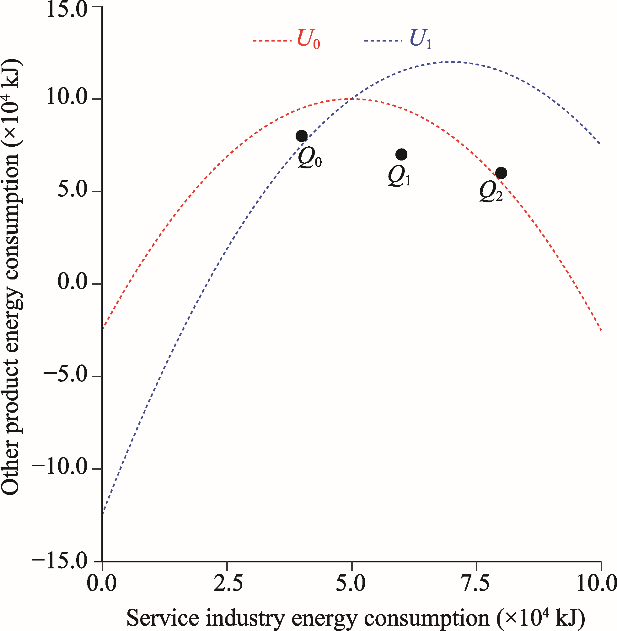
The direct rebound effect is essential for assessing the real impact of energy efficiency policies on agribusiness. As highlighted by Bansal and Dua (2022), the energy intensity of sector can amplify the rebound effect, especially in sectors where energy represents a significant share of operational costs. Figure 1 illustrates the changes in energy consumption before and after the improvement of energy efficiency.
Fig. 1. Relationship between service industry energy consumption and other product energy consumption. U0, initial energy consumption curve; U1, final energy consumption curve; Q0, initial energy consumption in the service industry before the improvement of energy efficiency; Q1, expected energy consumption after the improvement of energy efficiency; Q2, actual observed energy consumption after the improvement of energy efficiency. The negative values on the Y-axis (other product energy consumption) represent theoretical outcomes of the utility curves used in the model. These values do not reflect actual negative energy consumption, which would be physically implausible.
The initial energy consumption curve (U0) represents the equilibrium between service industry energy consumption (Q0(service)) and other product energy consumption (Q0(other)) before the improvement of energy efficiency, while the final energy consumption curve (U1) reflects the new energy consumption equilibrium between service industry energy consumption (Q1(service)) and other product energy consumption (Q1(other)) after the improvement of energy efficiency. The two curves can be determined as follows:
U0=Q0(service)×Q0(other),
U1=Q1(service)×Q1(service).

3.3.2. Bootstrap resampling

Bootstrap sample was generated by replacing and resampling the original dataset (D), producing 1000 samples while maintaining the statistical properties of the original data. This method enhances the estimation of variability of model parameters and confidence intervals, improving the robustness of statistical inference. Bootstrap resampling refined these estimates, ensuring methodological precision (Fávero, 2009), which is represented as Equation 7:
${{D}^{*}}=\{x_{1}^{*},x_{2}^{*},\cdots,x_{n}^{*}\}$,
where D* is the bootstrap sample; x represents an individual observation within the sample; and n denotes the total sample size and it is equal to the number of observations in the original dataset, ensuring that each bootstrap sample maintains the same statistical structure as the original dataset. Specifically, bootstrap resampling includes the following steps.
(a) Model fitting: the regression coefficients of each bootstrap sample were calculated using the Double-Log regression model.
(b) Calculation of model metrics: various metrics were calculated for each bootstrap sample.
(c) Result aggregation: mean values of the intercept (β) and slope coefficient (E) were derived from all bootstrap samples:
$\overline{\beta _{{}}^{*}}=\frac{1}{\omega }\sum\limits_{l=1}^{\omega }{\beta _{l}^{*}}$,
$\overline{E_{{}}^{*}}=\frac{1}{\omega }\sum\limits_{l=1}^{\omega }{E_{l}^{*}}$,
where ω is the total number of bootstrap samples, ensuring statistical robustness; l is the lth bootstrap sample; $\overline{\beta _{{}}^{*}}$ represents the mean value of the intercept; $\overline{E_{{}}^{*}}$ represents the mean value of the slope coefficient; β* l refers to the estimated intercept obtained from each bootstrap sample l; and E* l refers to the estimated slope coefficient obtained from each bootstrap sample l. These estimates were used to assess the central tendency and variability of model parameters, contributing to the evaluation of the stability and reliability of the regression model.
(d) Calculation of confidence intervals: confidence intervals for the intercept β and slope coefficient E were calculated using the quantiles of the bootstrap distribution:
$\text{IC}(\beta )=[{{q}_{\frac{\alpha }{2}}},{{q}_{1-\frac{\alpha }{2}}}]$,
$\text{IC}(E)=[{{q}_{\frac{\alpha }{2}}},{{q}_{1-\frac{\alpha }{2}}}]$,
where IC(β) represents the confidence interval for the intercept; IC(E) represents the confidence interval for the slope coefficient, indicating the range where the estimated values are likely to; ${{q}_{\frac{\alpha }{2}}}$ and ${{q}_{1-\frac{\alpha }{2}}}$ are the quantiles of the bootstrap distribution, defining the lower and upper bounds of the confidence intervals; and α represents the significance level, which was set at α=0.05, corresponding to a 95% confidence level. Thus, confidence intervals provide an assessment of the precision and uncertainty of the model parameters. A narrow confidence interval suggests higher precision in the estimates, while a wider confidence interval indicates greater variability.
(e) Analysis of bootstrap distribution: standard error (SE) values of the intercept β and slope coefficient E are computed as follows:
$\text{SE}(\beta )=\sqrt{\frac{1}{\omega -1}}\sum\limits_{i=1}^{\omega }{(\beta _{i}^{*}-}\overline{\beta _{{}}^{*}}{{)}^{2}}$,
$\text{SE}(E)=\sqrt{\frac{1}{\omega -1}}\sum\limits_{i=1}^{\omega }{(E_{i}^{*}-}\overline{E_{{}}^{*}}{{)}^{2}}$.
P-values for significance testing of β and E were calculated as follows:
$P(\beta)=\frac{\text { Number of bootstrap samples with }\left|\beta^{*}\right| \geq|\beta|}{\omega}$,
$P(E)=\frac{\text { Number of bootstrap samples with }\left|E^{*}\right| \geq|E|}{\omega} $.

3.3.3. Validation of the Double-Log regression model

Statistical tests were applied to validate to ensure the robustness of the Double-Log regression model. The Durbin-Watson test can assess residual independence, with values near 2.00 confirming the absence of autocorrelation. The Shapiro-Wilk and Anderson-Darling tests were used to verify normality, with the Anderson-Darling test being more sensitive to tail deviations, essential for identifying potential biases. The Levene test was used to evaluate homoscedasticity, ensuring variance stability across groups, while the Dixon test was used to detect outliers that may distort parameter estimates. Variance Inflation Factor (VIF) was used to assess multicollinearity, where values exceeding 10.00 suggest redundant variables requiring adjustments. The Akaike Information Criterion (AIC) was applied to compare model specifications, selecting the most parsimonious alternative. Comparative validation was conducted using the ANOVA test, identifying significant mean differences across countries (P≤0.05). Bonferroni-adjusted Post Hoc test can reinforce these differences by confirming statistically significant variations between country pairs. By integrating the bootstrap resampling with the Double-Log regression model, the bias can be reduced, ensuring more reliable estimates in assessing the rebound effect in agribusiness.

4. Results and discussion

4.1. Model test results

To provide a comprehensive understanding of the rebound effect in the energy transition, we explored the magnitude and implication of the rebound effect in different agricultural sectors in Brazil, Argentina, Uruguay, Colombia, and Mexico. Table 2 presents the types of the rebound effects.
Table 2 Types of the rebound effect.
Type Rebound effect value Implication
Backfire effect >100.00% Unintended consequences that occur when the initial action leads to an effect contrary to expectations
Total rebound effect 100.00% Full rebound effect after an intervention
Partial rebound effect 0.00%-99.00% Partial recovery effect
Zero rebound effect 0.00% Absence of recovery effect
Super conservation effect <0.00% Exaggerated reaction that amplifies the initial effect
Error estimation and robust P-value were conducted for bootstrap samples (Table 3) to validate the Double-Log regression model. The application of bootstrap resampling ensured that the statistical significance of estimated rebound effect is not merely an artifact of sample variability. The results confirmed statistical significance in all cases, reinforcing the presence of the direct rebound effect in the studied agricultural sectors. The high test statistics suggested a robust model fit, particularly in livestock and sugarcane sectors, where energy-intensive processes may exacerbate the rebound effect. The consistently low P-values (<0.0001) across all models provided a strong statistical support for the existence of the rebound effect in each sector.
Table 3 Bootstrap resampling validation results for the five countries.
Country Sector t-statistic value P-value
Brazil Sugarcane 32.25 <0.0001
Livestock 45.62 <0.0001
Mexico Livestock 23.78 <0.0001
Argentina Soybean 12.84 <0.0001
Livestock 29.83 <0.0001
Colombia Coffee 24.84 <0.0001
Uruguay Livestock 67.84 <0.0001
To further assess the reliability of the Double-Log regression model, was applied multiple statistical tests, including the F-test, χ2, AIC, VIF, and coefficient of determination (R2) (Table 4). These tests collectively assessed model robustness, explanatory power, and potential multicollinearity issues. The results indicated strong model fit across all agricultural sectors, with R2 values higher than 0.85 for most sectors, suggesting that the model explains a significant portion of the variance in energy consumption and the rebound effect. However, the high VIF values in Mexico’s livestock sector suggested potential multicollinearity, which requires further examination to ensure unbiased coefficient estimates.
Table 4 Reliability of the Double-Log regression model for five countries.
Country Sector F-value χ2 AIC VIF R2
Brazil Sugarcane 3.23 89.43 231.23 5.78 0.97
Livestock 4.92 96.24 134.65 1.83 0.95
Mexico Livestock 3.92 82.92 112.72 10.23 0.61
Argentina Soybean 5.23 70.23 149.82 3.92 0.90
Livestock 9.46 81.98 201.52 6.57 0.86
Colombia Coffee 7.39 87.94 169.49 7.34 0.77
Uruguay Livestock 7.48 76.94 201.03 5.67 0.89

Note: AIC, Akaike Information Criterion; VIF, Variance Inflation Factor; R2, coefficient of determination.

We further performed residual diagnosis to validate model assumptions and detect potential violations (Table 5). The tests included the evaluation of independence, normality, homoscedasticity, and outliers. These checks ensured that estimated rebound effect is not biased due to data anomalies or incorrectly specified relationship. The residual diagnosis confirmed that assumptions are satisfied, with acceptable normality and independence of the model. The Durbin-Watson test indicated no severe autocorrelation, while the Dixon test identified potential outliers, requiring further robustness tests.
Table 5 Residual diagnosis results for five countries.
Country Sector Levene test Durbin-Watson test Shapiro-Wilk test Anderson-Darling test Dixon test
Brazil Sugarcane 20.12 30.19 22.14 43.02 12.83
Livestock 9.32 25.81 72.91 56.13 34.20
Mexico Livestock 54.23 53.90 16.42 9.23 42.10
Argentina Soybean 62.45 24.83 33.68 12.90 43.87
Livestock 12.32 12.93 9.54 32.01 28.35
Colombia Coffee 37.21 32.84 11.72 23.45 6.12
Uruguay Livestock 8.29 77.01 13.63 76.56 31.63

4.2. Rebound effect of five countries

This study analyzed the Double-Log regression model that accounts for the rebound effect in the energy transition of agribusiness in the five countries. The elasticity coefficients for each agricultural sector in the five countries are presented in Table 6.
Table 6 Elasticity coefficients of different sectors in the five countries.
Country Sector Elasticity coefficient (%)
Brazil Sugarcane 79.50
Livestock 89.12
Mexico Livestock 67.32
Argentina Soybean 34.92
Livestock 72.16
Colombia Coffee 9.63
Uruguay Livestock 42.59

4.2.1. Rebound effect in Brazil

The Double-Log regression model results for analysing the rebound effect of energy transition in Brazil’s agribusiness are shown in Table 7. Four key variables including CH4 emissions, income and well-being of farmers, water consumption, and water conservation practices significantly influenced energy consumption in the livestock sector of Brazil. An increase in energy efficiency in this sector was correlated with a decrease in energy consumption, aligning with previous findings (Balcombe et al., 2018; Liu et al., 2021).
Table 7 Double-Log regression model results in the sugarcane and livestock sectors of Brazil.
Sector Dependent variable Independent variable LLC test ADF-Fisher test PP-Fisher test
Sugarcane Energy consumption ln(EnR)*** -21.94 103.12 142.35
ln(EA)*** -24.32 101.56 276.03
ln(IF)*** -17.83 136.73 156.23
Livestock Energy consumption ln(CH4)*** -12.45 104.23 345.21
ln(IWF)*** -21.94 89.54 89.03
ln(WV)*** -13.92 104.83 194.83
ln(WC)*** -9.73 110.76 201.84

Note: LLC, Levin, Lin & Chu; ADF-Fisher test, Augmented Dickey-Fuller Fisher; PP-Fisher, Phillips-Perron Fisher. ***, P<0.01 level, indicating that these variables are statistically significant in the previous regression analysis.

These findings highlighted the impact of CH4 emissions on the necessity of improving livestock management (Stevens et al., 2022). Similarly, the identification of crops with high water consumption and water conservation practices can mitigate environmental impact (de Mello et al., 2020; Dos Santos et al., 2021). However, such improvements may inadvertently trigger the rebound effect, such as the expansion of cultivated land, which can counteract environmental benefits.
For sugarcane sector in Brazil, key variables including non-renewable energy, agricultural employment, and irrigation efficiency had an impact on energy consumption, with an elasticity coefficient of 79.50%. These findings emphasized that reducing reliance on fossil fuels is vital for lowering greenhouse gas emissions, but associated energy savings could incentivize the expansion of cultivated land, contributing to a partial rebound effect (Frizzone et al., 2021; Solaymani, 2021). Additionally, while enhanced irrigation efficiency results in sustainability, it may also facilitate the expansion of cultivated land, as noted by García et al. (2020).
The rebound effect of sugarcane and cattle farming has further placed Brazil’s energy against the backdrop of broader challenges (Danelon et al., 2023). To effectively mitigate these challenges, the integration of agroecological practices and sustainable policies is essential, ensuring that the improvement of energy efficiency do not inadvertently exacerbate energy consumption or environmental degradation (Gonçalves et al., 2021). The findings emphasized that addressing the rebound effect in sugarcane and livestock sectors of Brazil requires the formulation of policies that can protect environment resource, reduce greenhouse gas emissions, and prioritize biodiversity protection. These insights underlined the necessity of a balanced approach to ensure sustainable transition in both sugarcane and livestock sectors in Brazil (Cherubin et al., 2021).

4.2.2. Rebound effect in Mexico

Table 8 shows that CH4 emissions, non-renewable energy, and water conservation practices had significantly impact on the energy consumption in the livestock sector of Mexico. These findings revealed that although gains in energy efficiency can be achieved, they are frequently accompanied by unintended increase in the overall energy consumption. From a policy standpoint, the dependence on non-renewable energy to operate machinery and equipment remains a critical challenge. Incorporating renewable energy offers a viable pathway to reducing greenhouse gas emissions of agribusiness (González-Quintero et al., 2021). However, the application of the saved energy for expanded animal husbandry may increase the total energy consumption (Mujtaba et al., 2022).
Table 8 Double-Log regression model results in the livestock sector of Mexico.
Sector Dependent variable Independent variable LLC test ADF-Fisher test PP-Fisher test
Livestock Energy consumption ln(CH4)*** -21.84 102.92 239.12
ln(EnR)*** -9.32 106.82 238.64
ln(WC)*** -11.93 89.03 110.93

Note: ***, P<0.01 level, indicating that these variables are statistically significant in the previous regression analysis.

CH4 emissions had a significant impact on energy consumption in the livestock sector of Mexico. As CH4 is a potent greenhouse gas with substantial short-term climate impact, efficient management practices, such as dietary supplementation and advanced livestock techniques, are crucial for reducing CH4 emissions (Bonilla et al., 2022). However, the absence of complementary mitigation measures could result in a partial rebound effect, where the increase of livestock offsets the reduction of CH4 emissions (Mahlknecht et al., 2020). Water conservation practices also play a pivotal role in mitigating environmental impact. As livestock sector demands substantial water resources, particularly in irrigated regions, the adoption of efficient irrigation and sustainable water management practices becomes essential (Naeem et al., 2023). Yet, without stringent oversight, water conservation practices may inadvertently facilitate the expansion of livestock, thereby increasing the total water use and negating the intended benefits brought by the improvement of energy efficiency. This phenomenon aligns with observations in Brazil, where similar challenges have been documented (Lin and Li, 2014).
These findings reinforced the interconnectedness of technological, environmental, and economic factors in shaping the rebound effect in Latin American agribusiness (Birol and Keppler, 2000; Sorrell, 2005). This underscores the need for integrated policies that combine renewable energy adoption, sustainable water management, and CH₄ emission mitigation to align agricultural productivity with SDGs.

4.2.3. Rebound effect in Argentina

Table 9 shows that energy consumption in the livestock sector of Argentina is influenced by renewable energy, income and well-being of farmers, and water consumption, with an elasticity coefficient of 72.16%. These findings indicated that energy transition and sustainable development are crucial to Argentina’s economic growth. Expanding the use of renewable energy is essential for reducing livestock-related emissions (Arrieta et al., 2020), but it may also increase the total energy consumption if it incentivizes the growth of livestock. Water consumption is another key variable, significantly shaping the rebound effect. Enhancing water efficiency is critical for addressing water scarcity (Canabarro et al., 2023). However, excessive water conservation may expand cultivated land and thereby increase the total water consumption, as seen in Mexico. Similarly, CH4 emissions played a pivotal role in the rebound effect of Argentina’s livestock sector. Advanced management practices can reduce CH4 emissions (Chojnacka et al., 2021), but these gains may be offset if production expansion compensates for absolute reduction (Bolaño-Ortiz et al., 2020), reinforcing the need for integrated mitigation strategies. Income and the well-being of farmers are critical socio-economic factor influencing the rebound effect. Improvements in renewable efficiency could reduce labor demand and improve the production of livestock sector to sustain employment levels and rural livelihoods (Karmakar and Halder, 2019). This underscores the necessity of inclusive energy transition strategies that integrate both environmental and socio-economic impacts.
Table 9 Double-Log regression model results in the soybean and livestock of Argentina.
Sector Dependent variable Independent variable LLC test ADF-Fisher test PP-Fisher test
Soybean Energy consumption ln(PS)*** -34.12 62.29 329.54
ln(NO2)*** -5.32 80.54 283.53
ln(ER)*** -10.85 105.23 157.28
ln(EA)*** -8.92 81.94 245.83
Livestock Energy consumption ln(ER)*** -10.23 67.82 100.81
ln(IWF)*** -17.42 90.10 102.83
ln(WV)*** -9.85 78.02 219.28

Note: ***, P<0.01 level, indicating that these variables are statistically significant in the previous regression analysis.

In soybean sector, pesticides, NO2 emissions, renewable energy, and agricultural employment had an impact on energy consumption, with an elasticity coefficient of 34.92%. The use of pesticides poses environmental risks, such as soil and water contamination (Phélinas and Choumert, 2017), so sustainable pest management practices must be adopted. However, reducing the use of pesticides could incentivize the expansion of cultivated land, triggering a partial rebound effect. NO2 emissions, driven by nitrogen-based fertilizers, represent another key challenge. Controlled fertilizer use and emission-reduction technologies can effectively mitigate environmental impact (Herrera et al., 2016). However, the increase of soybean cultivation can offset energy savings (Cassman and Dobermann, 2022). This interconnection underscores the complexity of addressing environmental issues in soybean farming. Adopting organic manure in soybean cultivation can reduce greenhouse gas emissions and strengthen sustainability (Nepstad et al., 2019). Energy savings may stimulate soybean expansion, increasing the total energy consumption. Similarly, agricultural employment plays a dual role in energy transition. Argentine case highlights the need for policies that address both emission reduction and socio-economic stability, ensuring that energy transition strategies is consistent with the sustainability of agribusiness.

4.2.4. Rebound effect in Uruguay

Table 10 presents the results of the Double-Log regression model in Uruguay. The analysis of the livestock sector in Uruguay revealed that non-renewable energy, irrigation efficiency, and income and well-being of farmers have an impact on energy consumption, with an elasticity coefficient of 42.59%, indicating a modest reduction in energy consumption. These variables highlighted the complexity of energy transition in the livestock sector of Uruguay, where dependence on non-renewable energy poses significant challenges to mitigate the impact of energy consumption on environment. Non-renewable energy is heavily used for essential activities, including agricultural machinery, transportation, and food processing (Zhang et al., 2022). As noted by Amin et al. (2022), transitioning from non-renewable energy to renewable energy is crucial but fraught with challenges, particularly in highly energy-intensive industries like livestock sector.
Table 10 Double-Log regression model results in the livestock sector of Uruguay.
Sector Dependent variable Independent variable LLC test ADF-Fisher test PP-Fisher test
Livestock Energy consumption ln(EnR)*** -11.92 102.83 117.02
ln(IWF)*** -12.05 98.19 312.83
ln(IF)*** -10.92 104.29 110.93

Note: ***, P<0.01 level, indicating that these variables are statistically significant in the previous regression analysis.

Irrigation efficiency was a key factor. Similar to findings in Brazil, improvements in irrigation efficiency could help preserve water resources and reduce the water footprint of livestock sector (Ran et al., 2016). However, ensuring that these improvements do not lead to an increase in the total water consumption remains a critical challenge. If water conservation practices lead to the expansion of livestock sector, partially environmental benefits may be offset. The income and well-being of farmers are also integral to the energy transition of Uruguay. As highlighted by Zabaloy and Viego (2022), the improvement of energy efficiency could inadvertently reduce labor demand, impacting the income and well-being of farmers. The pressure to sustain employment and income levels may incentivize the expansion of livestock sector, triggering a partial rebound effect.
The case of Uruguay showed that there is an urgent need to formulate strategies to mitigate the rebound effect, including the use of renewable energy and sustainable water resource governance. These strategies enable Uruguay to transition its livestock sector toward sustainable development while preserving its economic viability. These insights emphasize the interplay of energy efficiency, socio-economic impact, and energy transition in agribusiness (Amin et al., 2022; Zhang et al., 2022). Moreover, this case provides a valuable model for countries facing similar challenges, illustrating how tailored policies can address regional agribusiness dynamics while contributing to global sustainability efforts.

4.2.5. Rebound effect in Colombia

Table 11 shows the Double-Log regression model results in Colombia. The rebound effect in Colombia was relatively minor compared to other countries, with an elasticity coefficient of 9.63%, indicating that the total energy consumption loss of the coffee sector in Colombia is relatively small. The energy consumption of Colombia’s coffee sector was directly related to NO2 emissions and irrigation efficiency. From a policy perspective, the widespread use of nitrogen-based fertilizers in coffee cultivation, similar to the soybean sector of Argentina, underscores the need for organic fertilizers that minimize nitrogen consumption. Reducing NO2 emissions is essential, given its global warming potential is nearly 300 times that of CO2 emissions (Ramirez-Contreras and Faaij, 2018). However, emission reduction strategies must prevent the uncontrolled expansion of coffee farm, as the resulting increase in output may offset the improvement in energy efficiency.
Table 11 Double-Log regression model results in the coffee sector of Colombia.
Sector Dependent variable Independent variable LLC test ADF-Fisher test PP-Fisher test
Coffee Energy consumption ln(NO2)*** -5.07 71.29 173.92
ln(IF)*** -19.18 90.31 194.03

Note: ***, P<0.01 level, indicating that these variables are statistically significant in the previous regression analysis.

Irrigation efficiency is another critical factor influencing the energy consumption in Colombia’s coffee sector, as it directly influences coffee yield. Improving irrigation efficiency can protect water resources and reduce the water footprint of agribusiness. This is a crucial climate change adaptation strategy, especially considering the risk of long-term drought (Gallo Corredor et al., 2021). However, the saved water resources should not be used to expand coffee plantation, as this could increase the total consumption of water and energy (García et al., 2020).
Comparison with previous studies confirmed the relevance of these strategies in mitigating the rebound effect. Ramirez-Contreras and Faaij (2018) emphasized integrated approaches for managing NO2 emissions and irrigation efficiency, while Gallo Corredor et al. (2021) highlighted the role of climate adaptation policies. The findings underscores the necessity of public policies that systematically incorporate sustainable technologies and efficient farming methods, thereby guaranteeing an effective and sustainable energy transition in agribusiness that concurrently preserves natural resources and mitigates greenhouse gas emissions.

4.3. Comparative analysis of the adjusted variables

The above-mentioned results highlighted the complexity of the rebound effect in the energy transition of agribusiness in Latin America and revealed the significant variation between countries and sectors analyzed. The ANOVA test results identified statistically significant differences in adjusted mean values across countries, indicating the distinct dynamics of the rebound effect in each country (Table 12). These findings underscored the specific driving factors of the rebound effect (Birol and Keppler, 2000; Sorrell et al., 2020). The Bonferroni-adjusted Post Hoc test in Table 13 confirmed significant variation between country pairs identified in Table 12, highlighting the need for a more detailed comparison. These differences underscored the necessity of tailored policies to mitigate the rebound effect in agribusiness.
Table 12 Analysis of variance (ANOVA) test results for the common independent variables in each country pair.
Country pair Common independent variable P-value Country pair Common independent variable P-value
Brazil-Mexico ln(IF) and ln(EnR) 0.03 Mexico-Uruguay ln(IF) and ln(EnR) 0.02
Brazil-Argentina ln(IF) and ln(EnR) 0.02 Mexico-Colombia ln(IF) 0.03
Brazil-Uruguay ln(IF) and ln(EnR) 0.04 Argentina-Uruguay ln(IF) and ln(EnR) 0.04
Brazil-Colombia ln(IF) 0.01 Argentina-Colombia ln(IF) and ln(EnR) 0.02
Mexico-Argentina ln(IF) and ln(EnR) 0.05 Uruguay-Colombia ln(IF) 0.01
Table 13 Bonferroni-adjusted Post Hoc test results for independent variables.
Independent variable F-value P-value Independent variable F-value P-value
ln(PS) 7.12 <0.001 ln(WV) 5.34 0.002
ln(NO2) 8.34 <0.001 ln(EnR) 8.56 <0.001
ln(ER) 6.78 0.002 ln(IF) 7.23 <0.001
ln(EA) 7.89 <0.001 ln(CH4) 6.45 <0.001
ln(IWF) 6.45 0.003
To enhance clarity, this analysis explicitly detailed the most relevant country-pair differences, ensuring a structured interpretation of the results. The results indicated that Brazil and Argentina exhibited strong differences in the use of pesticides, suggesting that the improvement of energy efficiency in Argentina’s soybean sector has led to increased chemical input application. Mexico and Brazil showed significant contrasts in CH4 emissions, indicating higher rebound effect in the livestock sector. Argentina and Uruguay diverged in income and well-being of farmers, suggesting Uruguay’s energy transition is more labor-oriented while Argentina’s energy transition is production-intensive. Colombia and Mexico exhibited differences in water consumption, reinforcing the need for water preservation policies. Brazil and Uruguay showed significant discrepancies in non-renewable energy consumption, reflecting higher dependency on fossil-based energy sources.
Specific contributions of each country to the rebound effect are graphically represented in Table 14, highlighting the relative differences across sectors. This visual representation reinforced the significant variation identified in Tables 13 and 14, offering a comprehensive perspective on regional disparities affected by the rebound effect. In Brazil, livestock sector exhibited a high elasticity coefficient (89.12%), indicating that the improvement of energy efficiency may lead to increased energy consumption. CH4 emissions and water consumption emerged as the critical factors. Given that CH4 emissions has a much greater impact on the environment than CO2 emissions, it is crucial to adopt more effective management measures to reduce CH4 emissions (Balcombe et al., 2018; Liu et al., 2021). However, the increase of energy consumption brought about by the expansion of grasslands will offset some environmental benefits (Stevens et al., 2022). Additionally, efficient water use, represented by water consumption and water conservation practices, is crucial to preventing an increase in the total energy consumption (Dos Santos et al., 2021).
Table 14 Direct rebound effects of different sectors in the five countries.
Sector Rebound effect (%)
Brazil Mexico Argentina Colombia Uruguay Total
Coffee - - - 13.00 - 13.00
Livestock 9.00 16.00 13.00 - 10.00 48.00
Soybean - - 13.00 3.00 - 16.00
Sugarcane 11.00 - - - - 11.00

Note: - means no rebound effect.

While energy efficiency improvements are indispensable for sustainability, they must be paired with policies and practices that mitigate the rebound effect. Key measures include controlling CH4 and NO2 emissions, optimizing water and energy use, fostering agroecological practices, and encouraging the transition to renewable energy. These actions are essential to ensure that energy transition efforts effectively contribute to reducing greenhouse gas emissions and achieving sustainability in Latin American agribusiness.

5. Conclusions and recommendations

This study used the Double-Log regression model to analyze the rebound effect in agribusiness within the context of energy transition in five Latin American countries including Brazil, Argentina, Uruguay, Colombia, and Mexico during 2010-2022. The findings indicated that the rebound effect remained a significant challenge, as the improvement of energy efficiency in agribusiness does not necessarily lead to proportional reduction in energy consumption or environmental impact. Instead, the improvement of energy efficiency frequently resulted in increasing energy consumption, partially offsetting the expected benefits of energy transition.
The estimation of elasticity coefficient confirmed that there is a partial rebound effect in the five countries. In Brazil, the improvement of energy efficiency in livestock sector resulted in an increase in energy consumption, with the elasticity coefficient of 89.12%, while sugarcane sector exhibited an elasticity coefficient of 79.50%. Moreover, CH4 emissions, income and well-being of farmers, water consumption, and water conservation practices highlighted the strong impact on energy consumption in the sugarcane sector. In Mexico, livestock sector exhibited an elasticity coefficient of 67.32%, underscoring the persistent challenges associated with CH4 emissions, non-renewable energy, and water conservation practices. In Argentina, the elasticity coefficient of soybean and livestock sectors were 34.92% and 72.16%, respectively, with pesticides, NO2 emissions, renewable energy, and agricultural employment playing a crucial role in influencing energy consumption. In Uruguay, non-renewable energy, irrigation efficiency, and the income and well-being of farmers were identified as key variables affecting energy consumption in livestock sector, with an elasticity coefficient of 42.59%. In Colombia, NO2 emissions and irrigation efficiency were identified as key variables affecting energy consumption in coffee sector, with a smaller elasticity coefficient of 9.63%. These findings reinforced the importance of addressing sector-specific driving factors of the rebound effect to develop effective policies that can balance the improvement of energy efficiency with SDGs.
While this study provides valuable insights into the relationship between energy transition and the rebound effect in agribusiness, some limitations should be acknowledged. The complexity of the rebound effect stems from its dependence on multiple interrelated factors, which can make challenges to its evaluation. Although the Double-Log regression model used in this study effectively identifies key factors influencing energy consumption, it may not capture the full complexity of the phenomenon, particularly in cases where the indirect effect plays a significant role. Another limitation relates to the potential constraints of causality analysis. Although the Double-Log regression model establishes correlations between energy efficiency and energy consumption, it does not directly determine causal relationship. External variables not included in the model could influence the results, requiring further research to explore additional driving factors of the rebound effect. The time range of this study is limited. Future research should explore the rebound effect of agricultural integrated enterprises in the longer term.
This study also proposes key policy implications that should be considered to mitigate the rebound effect in agribusiness. One crucial aspect is the implementation of regulations that prevent the uncontrolled expansion of cultivated land, particularly in countries such as Brazil and Argentina, where the improvement of energy efficiency could lead to the increases of cultivated land and energy consumption. Ensuring that yield improvements do not result in excessive environmental degradation requires stricter land use regulations and monitoring mechanisms. Additionally, policies need to be formulated with the aim of promoting the adoption of sustainable agricultural practices and renewable energy. Financial incentives and technological support are needed to accelerate the transition from non-renewable energy to renewable energy.
Water conservation practices emerge as another critical priority, especially in Uruguay, Colombia, and Mexico, where the interaction between water use efficiency and the rebound effect is evident. Policies should ensure that improvements in water management do not lead to an increase in energy consumption, maintaining water sustainability. Similarly, policies aimed at ensuring income and well-being of farmers play a vital role in maintaining socio-economic stability, while mitigating the unintended consequences of energy efficiency-driven expansions. Employment and income must be safeguarded to prevent the imbalance of economic development caused by the improvement of energy efficiency, particularly in rural areas.
Climate adaptation policies should also be incorporated into the planning of agribusiness to address the challenges posed by extreme weather events. Finally, fostering knowledge exchange among Latin American countries can strengthen energy transition efforts by facilitating the adaptation of better practices across different agricultural and economic contexts. By sharing policy experiences, technological innovations, and regulatory frameworks, countries can enhance the effectiveness of their energy efficiency strategies while addressing the specific challenges associated with the rebound effect.

Authorship contribution statement

Fábio DE OLIVEIRA NEVES: conceptualization, data curation, formal analysis, investigation, methodology, project administration, resources, software, validation, visualization, writing - original draft, and writing - review & editing; Eduardo Gomes SALGADO: supervision and writing - review & editing; Mateus CURY: methodology and writing - original draft; Jean Marcel Sousa LIRA: methodology and visualization; and Breno Régis SANTOS: methodology and supervision. All authors approved the manuscript.

Declaration of conflict of interest

The authors declare that they have no known competing financial interests or personal relationships that could have appeared to influence the work reported in this paper.
[1]
Agri-Food and Fisheries Information Service, 2024. Historical Record of Sowing and Harvest Progress. [2024-09-30].https://www.gob.mx/siap/acciones-y-programas/produccion-agricola-33119.

[2]
Amin, S., Mehmood, W., Sharif, A., 2022. Blessing or curse: The role of diversity matters in stimulating or relegating environmental sustainability—A global perspective via renewable and non-renewable energy. Renew. Energy. 189, 927-937.

[3]
Arrieta, E.M., Cabrol, D.A., Cuchietti, A., et al., 2020. Biomass consumption and environmental footprints of beef cattle production in Argentina. Agric. Syst. 185, 102944, doi: 10.1016/j.agsy.2020.102944.

[4]
Balcombe, P., Speirs, J.F., Brandon, N.P., et al., 2018. Methane emissions: Choosing the right climate metric and time horizon. Environmental Science: Processes and Impacts. 20(10), 1323-1339.

[5]
Bansal, P., Dua, R., 2022. Fuel consumption elasticities, rebound effect and feebate effectiveness in the Indian and Chinese new car markets. Energy Econ. 113, 106192, doi: 10.1016/j.eneco.2022.106192.

[6]
Bentzen, J., 2004. Estimating the rebound effect in US manufacturing energy consumption. Energy Econ. 26(1), 123-134.

[7]
Birol, F., Keppler, J.H., 2000. Prices, technology development and the rebound effect. Energy Policy. 28(6-7), 457-469.

[8]
Bonilla, D., Arias Soberon, H., Galarza, O.U., 2022. Electric vehicle deployment & fossil fuel tax revenue in Mexico to 2050. Energy Policy. 171, 113276, doi: 10.1016/j.enpol.2022.113276.

[9]
Brazilian Institute of Geography and Statistics, 2024. Dataset. [2024-09-20].https://Dados.Gov.Br/Dados/Organizacoes/Visualizar/Instituto-Brasileiro-de-Geografia-e-Estatistica-Ibge.

[10]
Canabarro, N.I., Silva-Ortiz, P., Nogueira, L.A.H., et al., 2023. Sustainability assessment of ethanol and biodiesel production in Argentina, Brazil, Colombia, and Guatemala. Renew. Sust. Energ. Rev. 171, 113019, doi: 10.1016/j.rser.2022.113019.

[11]
Cassman, K.G., Dobermann, A., 2022. Nitrogen and the future of agriculture: 20 years on. Ambio. 51(1), 17-24.

[12]
Castro, C.G., Trevisan, A.H., Pigosso, D.C.A., et al., 2022. The rebound effect of circular economy: Definitions, mechanisms and a research agenda. J. Clean Prod. 345, 131136, doi: 10.1016/j.jclepro.2022.131136.

[13]
Cherubin, M.R., Carvalho, J.L.N., Cerri, C.E.P., et al., 2021. Land use and management effects on sustainable sugarcane-derived bioenergy. Land. 10(1), 1-24.

[14]
Colmenares, G., Löschel, A., Madlener, R., 2019. The rebound effect representation in climate and energy models. Environ. Res. Lett. 15(12), 123010, doi: 10.1088/1748-9326/abc214.

[15]
Danelon, A.F., Spolador, H.F.S., Bergtold, J.S., 2023. The role of productivity and efficiency gains in the sugar-ethanol industry to reduce land expansion for sugarcane fields in Brazil. Energy Policy. 172, 113327, doi: 10.1016/j.enpol.2022.113327.

[16]
de Mello, K., Taniwaki, R.H., Paula, F.R., et al., 2020. Multiscale land use impacts on water quality: Assessment, planning, and future perspectives in Brazil. J. Environ. Manage. 270, 110879, doi: 10.1016/j.jenvman.2020.110879.

[17]
de Oliveira Neves, F., Salgado, E.G., Lira, J.M.S., 2024. Energetic sustainability in the Amazon region: Exploring impacts, environmental solutions, and rebound effect analysis. Environ. Dev. 51, 101043, doi: 10.1016/j.envdev.2024.101043.

[18]
D’Haultfoeuille, X., Gaillac, C., Maurel, A., 2021. Rationalizing rational expectations: Characterizations and tests. Quant. Econ. 12(3), 817-842.

[19]
Dos Santos, J.S., Miziara, F., Fernandes, H., et al., 2021. Technification in dairy farms may reconcile habitat conservation in a Brazilian savanna region. Sustainability. 13(10), 5606, doi: 10.3390/su13105606.

[20]
Economic Commission for Latin America and the Caribbean, 2024. Data and Statistics. [2024-09-21]. https://www.cepal.org/en.

[21]
Fávero, L.P.L., Belfiore, P.P., Silva, F.L., et al., 2009. Data Analysis:Multivariate Modeling for Decision-Making. Amsterdam: Elsevier, 638-650.

[22]
Feng, Y.C., Zhang, J., Geng, Y., et al., 2023. Explaining and modeling the reduction effect of low-carbon energy transition on energy intensity: Empirical evidence from global data. Energy. 281, 128276, doi: 10.1016/j.energy.2023.128276.

[23]
Font Vivanco, D., Nechifor, V., Freire-González, J., et al., 2021. Economy-wide rebound makes UK’s electric car subsidy fall short of expectations. Appl. Energy. 297, 117138, doi: 10.1016/j.apenergy.2021.117138.

[24]
Freire-González, J., 2021. Governing Jevons’ Paradox: Policies and systemic alternatives to avoid the rebound effect. Energy Res. Soc. Sci. 72, 101893, doi: 10.1016/j.erss.2020.101893.

[25]
Frizzone, J.A., Lima, S.C.R.V., Lacerda, C.F., et al., 2021. Socio-economic indexes for water use in irrigation in a representative basin of the tropical semiarid region. Water. 13(19), 1-20.

[26]
Gallo Corredor, J.A., Vargas González, G.L., Velasco Granados, M., et al., 2021. Use of the gray water footprint as an indicator of contamination caused by artisanal mining in Colombia. Resour. Policy. 73, 102197, doi: 10.1016/j.resourpol.2021.102197.

[27]
García, V.R., Gaspart, F., Kastner, T., et al., 2020. Agricultural intensification and land use change: Assessing country-level induced intensification, land sparing and rebound effect. Environ. Res. Lett. 15(8), 085007, doi: 10.1088/1748-9326/ab8b14.

[28]
Garrett, R.D., Koh, I., Lambin, E.F., et al., 2018. Intensification in agriculture-forest frontiers: Land use responses to development and conservation policies in Brazil. Glob. Environ. Change. 53, 233-243.

[29]
Ghaedi, M., Foukolaei, P.Z., Alizadeh Asari, F., et al., 2024. Pricing electricity from blue hydrogen to mitigate the energy rebound effect: A case study in agriculture and livestock. Hydrog. Energy. 84, 993-1003.

[30]
Gielen, D., Boshell, F., Saygin, D., et al., 2019. The role of renewable energy in the global energy transformation. Energy Strateg. Rev. 24, 38-50.

DOI

[31]
Gillingham, K., Rapson, D., Wagner, G., 2014. The rebound effect and energy efficiency policy. Rev. Env. Econ. Policy. 10(1), doi: 10.1093/reep/rev017.

[32]
Gonçalves, F., Perna, R., Lopes, E., et al., 2021. Strategies to improve the environmental efficiency and the profitability of sugarcane mills. Biomass Bioenerg. 148, 106052, doi: 10.1016/j.biombioe.2021.106052.

[33]
González-Quintero, R., Bolívar-Vergara, D.M., Chirinda, N., et al., 2021. Environmental impact of primary beef production chain in Colombia: Carbon footprint, non-renewable energy and land use using Life Cycle Assessment. Sci. Total Environ. 773, 145573, doi: 10.1016/j.scitotenv.2021.145573.

[34]
Hagen, I., Huggel, C., Ramajo, L., et al., 2022. Climate change-related risks and adaptation potential in Central and South America during the 21st century. Res. Lett. 17(3), 033002, doi: 10.1088/1748-9326/ac5271.

[35]
Harichandan, S., Kar, S.K., Bansal, R., et al., 2022. Energy transition research: A bibliometric mapping of current findings and direction for future research. Cleaner Production Letter. 3, 100026, doi: 10.1016/j.clpl.2022.100026.

[36]
Herrera, J.M., Rubio, G., Häner, L.L., et al., 2016. Emerging and established technologies to increase nitrogen use efficiency of cereals. Agronomy. 6(2), 11-18.

[37]
Huntzinger, D.N., Eatmon, T.D., 2009. A life-cycle assessment of Portland cement manufacturing: Comparing the traditional process with alternative technologies. J. Clean Prod. 17(7), 668-675.

[38]
IPCC International, Panel on Climate Change, 2023. AR6 Synthesis Report: Climate Change 2023. In:Sixth Assessment Report during the Panel’s 58th Session. Interlaken, Switzerland.

[39]
Jevons, W.S., 1865. On the variation of prices and the value of the currency since 1782. Journal of the Statistical Society of London. 28(2), 294-320+1-4.

[40]
Jin, T., Kim, J., 2019. A new approach for assessing the macroeconomic growth energy rebound effect. Appl. Energy. 239, 192-200.

[41]
Karmakar, B., Halder, G., 2019. Progress and future of biodiesel synthesis: Advancements in oil extraction and conversion technologies. Energy Conv. Manag. 182, 307-339.

[42]
Khazzoom, J.D., 1980. Economic implications of mandated efficiency standards for household appliances. The Energy Journal. 1(4), 21-40.

[43]
Lange, S., Berner, A., 2022. The growth rebound effect: A theoretical-empirical investigation into the relation between rebound effects and economic growth. J. Clean Prod. 371, 133158, doi: 10.1016/j.jclepro.2022.133158.

[44]
Li, G.H., Niu, M.M., Xiao, J., et al., 2023. The rebound effect of decarbonization in China’s power sector under the carbon trading scheme. Energy Policy. 177, 113543, doi: 10.1016/j.enpol.2023.113543.

[45]
Lin, B., Abudu, H., 2020. Can energy conservation and substitution mitigate CO2 emissions in electricity generation? Evidence from Middle East and North Africa. J. Environ. Manage. 275, 111222, doi: 10.1016/j.jenvman.2020.111222.

[46]
Lin, B.Q., Li, J.L., 2014. The rebound effect for heavy industry: Empirical evidence from China. Energy Policy. 74, 589-599.

[47]
Lin, B.Q., Xie, X., 2015. Factor substitution and rebound effect in China’s food industry. Energy Conv. Manag. 105, 20-29.

[48]
Liu, H.Y., Alharthi, M., Atil, A., et al., 2022. A non-linear analysis of the impacts of natural resources and education on environmental quality: Green energy and its role in the future. Resour. Policy. 79, 102940, doi: 10.1016/j.resourpol.2022.102940.

[49]
Liu, S., Proudman, J., Mitloehner, F.M., 2021. Rethinking methane from animal agriculture. CABI Agriculture Biosci. 2(1), 1-13.

[50]
Mahlknecht, J., González-Bravo, R., Loge, F.J., 2020. Water-energy-food security: A nexus perspective of the current situation in Latin America and the Caribbean. Energy. 194, 1-17.

[51]
Ministry of Agriculture, Livestock, and Fisheries, 2024. Open Data. [2024-09-20].https://datos.magyp.gob.ar/sataset.

[52]
Mujtaba, A., Jena, P.K., Bekun, F.V., et al., 2022. Symmetric and asymmetric impact of economic growth, capital formation, renewable and non-renewable energy consumption on environment in OECD countries. Renew. Sust. Energ. Rev. 160, 112300, doi: 10.1016/j.rser.2022.112300.

[53]
Naeem, K., Zghibi, A., Elomri, A., et al., 2023. A literature review on system dynamics modeling for sustainable management of water supply and demand. Sustainability. 15(8), 1-24.

[54]
National Federation of Coffee Growers, 2024. Indicators. [2024-09-25].https://federaciondecafeteros.org/wp/federation/about-us/?lang=en.

[55]
National Meat Institute of Uruguay, 2024. Data. [2024-09-22].https://www.inac.uy/.

[56]
National Supply Company, 2024. Publications. [2024-09-20].https://www.conab.gov.br/institucional/publicacoes.

[57]
Nepstad, L.S., Gerber, J.S., Hill, J.D., et al., 2019. Pathways for recent Cerrado soybean expansion: Extending the soy moratorium and implementing integrated crop livestock systems with soybeans. Environ. Res. Lett. 14(4), 044029, doi: 10.1088/1748-9326/aafb85.

[58]
Newell, P., Simms, A., 2021. How did we do that? Histories and political economies of rapid and just transitions. New Polit. Econ. 26(6), 907-922.

[59]
Nikas, A., Koasidis, K., Köberle, A.C., et al., 2022. A comparative study of biodiesel in Brazil and Argentina: An integrated systems of innovation perspective. Renew. Sust. Energ. Rev. 156, 112022, doi: 10.1016/j.rser.2021.112022.

[60]
Omondi, C., Njoka, F., Musonye, F., 2023. An economy-wide rebound effect analysis of Kenya’s energy efficiency initiatives. J. Clean Prod. 385, 135730, doi: 10.1016/j.jclepro.2022.135730.

[61]
Phélinas, P., Choumert, J., 2017. Is GM soybean cultivation in Argentina sustainable? World Dev. 99, 452-462.

[62]
Ramirez-Contreras, N.E., Faaij, A.P.C., 2018. A review of key international biomass and bioenergy sustainability frameworks and certification systems and their application and implications in Colombia. Renew. Sust. Energ. Rev. 96, 460-478.

[63]
Ran, Y., Lannerstad, M., Herrero, M., et al., 2016. Assessing water resource use in livestock production: A review of methods. Livest. Sci. 187, 68-79.

[64]
Rauter, A.R.K.K., 2022. Elite energy transitions: Leaders and experts promoting renewable energy futures in Norway. Energy Res. Soc. Sci. 88, 102509, doi: 10.1016/j.erss.2022.102509.

[65]
Saunders, H., 2013. Is what we think of as “rebound” really just income effects in disguise? Energy Policy. 57, 308-317.

[66]
Saunders, H.D., 2008. Fuel conserving (and using) production functions. Energy Econ. 30(5), 2184-2235.

[67]
Schwerhoff, G., Edenhofer, O., Fleurbaey, M., et al., 2022. Equity and Efficiency Effects of Land Value Taxation. [2024-09-10].https://www.imf.org/en/Publications/WP/Issues/2022/12/17/Equity-and-Efficiency-Effects-of-Land-Value-Taxation-527079.

[68]
Solaymani, S., 2021. A review on energy and renewable energy policies in Iran. Sustainability. 13(13), 7328, doi: 10.3390/su13137328.

[69]
Sorrell, S., 2005. The rebound effect:Definition and estimation.In: Evans, J., Hunt, L.C., (eds.). Northampton: Edward Elgar Publishing, 199-233.

[70]
Sorrell, S., Gatersleben, B., Druckman, A., 2020. The limits of energy sufficiency: A review of the evidence for rebound effects and negative spillovers from behavioural change. Energy Res. Soc. Sci. 64, 101439, doi: 10.1016/j.erss.2020.101439.

[71]
Sovacool, B.K., 2021. Who are the victims of low-carbon transitions? Towards a political ecology of climate change mitigation. Energy Res. Soc. Sci. 7, 101916, doi: 10.1016/j.erss.2021.101916.

[72]
Steren, A., Rubin, O.D., Rosenzweig, S., 2022. Energy-efficiency policies targeting consumers may not save energy in the long run: A rebound effect that cannot be ignored. Energy Res. Soc. Sci. 90, 102600, doi: 10.1016/j.erss.2022.102600.

[73]
Stevens, N., Bond, W., Feurdean, A., et al., 2022. Grassy ecosystems in the Anthropocene. Annu. Rev. Environ. Resour. 47, 261-289.

[74]
Truelove, H.B., Carrico, A.R., Weber, E.U., et al., 2014. Positive and negative spillover of pro-environmental behavior: An integrative review and theoretical framework. Glob. Environ. Change. 29, 127-138.

[75]
Van Vuuren, D.P., Stehfest, E., Gernaat, D.E.H.J., et al., 2018. Alternative pathways to the 1.5°C target reduce the need for negative emission technologies. Nat. Clim. Chang. 8(5), 391-397.

[76]
Wang, Y., Zhao, M., Chen, W., 2018. Spatial effect of factors affecting household CO2 emissions at the provincial level in China: A geographically weighted regression model. Carbon Manag. 9(2), 187-200.

[77]
World, Bank, 2024a. Indicators. [2024-09-20].https://data.worldbank.org/indicator?tab=all.

[78]
World, Bank, 2024b. Carbon Dioxide Emissions from Agriculture. [2024-09-20].https://data.worldbank.org/indicator/EN.GHG.CO2.AG.MT.CE.AR5?View=chart.

[79]
World, Bank, 2024c. Methane Emissions from Agriculture. [2024-09-20].https://data.worldbank.org/indicator/EN.GHG.CH4.AG.MT.CE.AR5?View=chart.

[80]
World, Bank, 2024d. Fertilizer Comsuption. [2024-09-20]. https://data.worldbank.org/indicator/AG.CON.FERT.ZS?View=chart.

[81]
World, Bank, 2024e. Renewable Energy Comsuption. [2024-09-20]. https://data.worldbank.org/indicator/EG.FEC.RNEW.ZS?View=chart.

[82]
World, Bank, 2024f. Agricultural Irrigated Land. [2024-09-20]. https://data.worldbank.org/indicator/AG.LND.IRIG.AG.ZS?View=chart.

[83]
World, Bank, 2024g. Fossil Fuel Energy Comsuption. [2024-09-20]. https://data.worldbank.org/indicator/EG.USE.COMM.FO.ZS?View=chart.

[84]
World, Bank, 2024h. Annual Freshwater Withdrawals, Agriculture. [2024-09-20].https://data.worldbank.org/indicator/ER.H2O.FWAG.ZS?View=chart.

[85]
World, Bank, 2024i. Renewable Internal Freshwater Resources, Total. [2024-09-20].https://Data.Worldbank.Org/Indicator/ER.H2O.INTR.K3?View=chart.

[86]
World, Bank, 2024j. Adjusted Net National Income per Capita. [2024-09-20]. https://data.worldbank.org/indicator/NY.ADJ.NNTY.PC.CD?View=chart.

[87]
World, Bank, 2024k. Nitrous Oxide from Emissions Agriculture. [2024-09-20].https://data.worldbank.org/indicator/EN.GHG.N2O.AG.MT.CE.AR5?View=chart.

[88]
Zabaloy, M.F., Viego, V., 2022. Household electricity demand in Latin America and the Caribbean: A meta-analysis of price elasticity. Util. Policy. 75, 101334, doi: 0.1016/j.jup.2021.101334.

[89]
Zhang, Z., Hu, G.W., Mu, X.Z., et al., 2022. From low carbon to carbon neutrality: A bibliometric analysis of the status, evolution and development trend. J. Environ. Manage. 322, 116087, doi: 10.1016/j.jenvman.2022.116087.

Outlines

/