
Research article

Exploring the transformation mechanism of modern agricultural villages in the loess hilly and gully regions using actor-network theory

  • ZHANG Tianyang ,
  • LI Linna , *
Expand
  • Faculty of Geographical Science, Beijing Normal University, Beijing, 100875, China
*E-mail address: (LI Linna).

Received date: 2024-08-06

  Revised date: 2025-02-21

  Accepted date: 2025-05-06

  Online published: 2025-05-21

Copyright

2666-660X/© 2025 Xinjiang Institute of Ecology and Geography, Chinese Academy of Sciences. Publishing services by Elsevier B.V. on behalf of KeAi Communications Co. Ltd. This is an open access article under the CC BY-NC-ND license (http://creativecommons.org/licenses/by-nc-nd/4.0/).

Abstract

As urbanization accelerates, rural regions in China are experiencing transformative changes. This study examines the transformation mechanism of modern agricultural villages in the loess hilly and gully regions, using Zhaojiawa Village in Shannxi Province of China as a case study. In this study, we explored the village’s evolution amid China’s rural revitalization efforts, highlighting the transition from a traditional agricultural village to a modern agricultural village in the context of rapid urbanization. This study employed actor-network theory (ANT) to investigate the complex interactions among diverse actors that drive rural transformation. ANT interlinks spatial relationships with intricate social networks. We utilized Google Earth remote sensing images in 2015 and 2021 and interview data to construct ANT. Three key dimensions of rural transformation are identified: economic structure transformation, social relationship reorganization, and spatial layout reconstruction. The transformation mechanism in Zhaojiawa Village is underpinned by a network of diverse actors, both human and non-human, aligned around two pivotal stages of agricultural village development (i.e., construction stage and development stage). In the initial construction stage, the Suide County government led a complex actor network to enhance rural living and production spaces. In the development stage, the village committee emerged as a central actor, with increased participation from villagers and external enterprises, facilitating the creation of a multifunctional space. The evolving goals and roles of these key actors contributed to the reconfiguration of the actor network, promoting rural transformation. These insights are applicable to other ecologically vulnerable and economically challenged rural areas in the loess hilly and gully regions, suggesting that collaboration among stakeholders can effectively facilitate the transition to specialized and integrated industries, thereby fostering rural revitalization.

Cite this article

ZHANG Tianyang , LI Linna . Exploring the transformation mechanism of modern agricultural villages in the loess hilly and gully regions using actor-network theory[J]. Regional Sustainability, 2025 , 6(2) : 100212 . DOI: 10.1016/j.regsus.2025.100212

1. Introduction

In the context of rapid globalization and urbanization, rural regions are undergoing significant transformations that have reshaped their economic structures, spatial landscapes, organizational frameworks, and social dynamics (Zhang and Pan, 2022). However, this transformation also brings challenges, such as a widening urban-rural divide, rural depopulation, and inefficient land use, which are central issues in the discussion of rural decline (Liu and Li, 2017; Long and Qu, 2018). To address these challenges, rural transformation has emerged as a vital process driven by government, community, and social forces (Woods, 2011). China has experienced an increase in its urbanization rate from 17.92% in 1978 to 66.16% in 2023 (National Bureau of Statistics of China, 2024). This shift has reconfigured regional developmental factors and reshaped rural structures, leading to a complex array of rural functions (Long et al., 2016; Yang et al., 2022). However, China’s distinctive urban-rural dual structure casts a long shadow, with rural development lagging significantly behind urban development (Zhan et al., 2023), facing challenges such as youth outmigration, land abandonment, and inadequate public infrastructure (Liu and Zhou, 2015). In response, the Chinese government has implemented policies aimed at rural revitalization and urban-rural integration, including “New Rural Construction” and “Beautiful Rural Construction” (Long et al., 2016; Yang et al., 2018). These initiatives have facilitated the emergence of diverse village types, including agricultural, industrial, tourism, and e-commerce villages, signaling a new paradigm of rural revitalization (Li et al., 2019).
Since the early 21st century, rural transformation has become a central theme in rural studies and is essential for sustainable regional governance (Ma et al., 2018; Wang et al., 2023a). It involves adjustments in economic forms, social organizations, and spatial structures, alongside changes in the lifestyles and consumption patterns of farmers, driven by internal and external factors such as population mobility and industrial development (Long et al., 2011; Zang et al., 2024). Spatial restructuring is a key aspect of rural transformation, with a focus on optimizing production, living, and ecological spaces (Long, 2014). Internationally, rural reconstruction emphasizes changes in production pattern, labor force composition, and spatial multifunctionality (Terluin, 2003; Holmes, 2006; Braun and McLees, 2012). The advent of postmodern and poststructural philosophies has further expanded the scope of rural transformation research to include nonmaterial domains, particularly the concept of rurality, which has gained significant scholarly attention (Yang et al., 2018). Rurality is recognized as the core characteristic of rural areas, collectively embodied by rural residents, migrants, landowners, workers, policymakers, scientific researchers, tourists, geographical environments, and so on (Cloke, 2006; Woods, 2010). Villages are thus understood as heterogeneous spaces shaped by the aspirations of various participants, with rural evolution reflecting the multidimensional spatial transformation driven by these participants (Liu et al., 2021).
In contrast to international approaches, which often focus on a single aspect of rural transformation, China’s perspective emphasizes holistic development, particularly the shift of rural spaces from “homogeneity and isomorphism” to “heterogeneity and diversity” (Zang et al., 2019). Research has shifted from evaluating to identifying the influencing factors and mechanisms of rural transformation (Long et al., 2011; Ge et al., 2020; Wu et al., 2022; Zhang et al., 2022b). Scholars have analyzed these mechanisms through various theoretical and policy frameworks (Hu et al., 2019; Sun, 2023). Prior theoretical research has focused on exogenous models, which often resulted in the loss of economic and cultural independence in rural areas, contributing to rural hollowing and marginalization (Zhang et al., 2021). Furthermore, scholars have revisited the dynamic mechanisms of rural development and proposed endogenous development theory, which emphasizes mobilizing internal resources to promote rural development (Liu and Wang, 2013; Zhang et al., 2021). However, owing to the lack of practical feasibility, endogenous development theory has remained largely idealized (Barke and Newton, 1997). Ray (2001) introduced a new endogenous development theory that stresses the synergistic effects of internal and external resources, transforming external interventions into internal drivers of development to foster sustainable rural development. The neo-endogenous development theory is particularly relevant for understanding local actions in the context of rural transformation. Research has shown that sustainable villages capitalize on local resource endowments while effectively utilizing external resources for industrial development (Li and Shao, 2024). With the advancement of urbanization, regional functions have undergone a transformation, expanding from being production-centered to encompassing multiple aspects such as modern agriculture, tourism, leisure, and ecological protection, meanwhile the rural production pattern has increasingly changed to a consumption-oriented model (Ramos-Tumanan and Ryan, 2019).
While existing research has deepened our understanding of the complex processes involved in rural transformation, it often overlooks the dynamic interaction between material spaces and social relations. There is a need for a comprehensive analytical framework that integrates different dimensions. Recent studies have predominantly utilized village-scale case studies to explore spatial characteristics and evolutionary pathways (Yang, 2022; Wang et al., 2023d). Actor-network theory (ANT), with its focus on the interaction of social and material processes within complex networks, offers a novel perspective for analyzing spatial relationships and networks, revealing the roles of various actors in rural transformation. ANT provides robust theoretical support for analyzing the internal and external linkage mechanisms of rural transformation (Chen et al., 2022). ANT has been applied in empirical studies on rural development models and processes, such as reconstruction, transformation, and agglomeration (Li and Shao, 2024; Qu et al., 2024). Scholars have explored the equivalence of human and non-human factors by closely observing the construction of actor networks in rural development and aligning these observations with rural policy and planning implementation (Liu and Wang, 2013). Nonetheless, most existing studies focused on ecologically resilient and developed regions, with little attention given to ecologically fragile and economically impoverished areas such as the loess hilly and gully regions (Yang et al., 2018; Li and Shao, 2024). The loess hilly and gully regions, characterized by ecological fragility and economic impoverishment, are critical agricultural development zones. These regions display significant variability in agricultural production layouts, with a clear trend toward modern multifunctional agriculture (Qu et al., 2023; Zhang et al., 2023).
This study investigates the complex relationships among various elements in the process of rural transformation from a traditional agricultural village to a modern agricultural village. It also examines the network structures, key nodes, direction and impact, and the roles played by the government, village committee, villagers, and enterprises. Taking Zhaojiawa Village in a loess hilly and gully region of China as a typical case, we used ANT to elucidate the evolution stages and patterns of the modern agricultural village, analyze the spatial transformation process and mechanism influenced by multiple actors, and explore the planning implications of rural industrial upgrading as a catalyst for rural transformation. This study aims to provide a theoretical foundation for sustainable development in rural areas, especially for ecologically fragile and economically impoverished regions.

2. Theoretical framework

2.1. Concept of actor-network theory (ANT)

This study employs ANT to analyze the construction and transformation of the actor network in the transformation process of Zhaojiawa Village, and explores the transformation characteristics and underlying mechanisms of rural change. ANT serves as a robust analytical tool that combines spatial relationships with intricate social networks, offering a novel perspective for interpreting spatial reconfiguration (Callon, 1986; Latour, 1987; Law, 1992). The core concepts of ANT are actors, translation, and networks. ANT combines elements of the social and material realms into a cohesive analytical framework, underscoring the need for diverse stakeholders to contribute to scientific endeavors (Sovacool and Hess, 2017). ANT adheres to the principle of symmetry, recognizing that actors include both human and non-human entities (Qu et al., 2024). Within this framework, each actor is considered a translator, actively shaping rather than passively conveying the network’s development (Liu and Wang, 2013). The process of translation is pivotal, enabling disparate actors to engage collectively and foster dynamic and stable networks. This process encompasses five fundamental phases: problematization, interest, enrollment, mobilization, and dissidence (Felski, 2016). In the problematization phase, key actors define the objects of concern for all actors and regard the problems of core actors as the obligatory passage points for achieving the goals of other actors. Interest refers to the process of strengthening problems through various devices and strategies to define the roles of actors. Enrollment, being a member of the alliance, is the result of the previous stage, and its forms are more diverse. Mobilization involves designating the proposer as the network’s spokesperson and assigning tasks to various actors to take action to maintain the stability of the network. The stability of the network depends on the continuous translation of the interest of various actors, but the role that all actors play in shaping obligatory passage points is not always positive. When some actors raise dissidences, it may lead to the disintegration or reconstruction of the network (Müller, 2015).

2.2. Transformation mechanism of modern agricultural village through ANT

As an integrative research approach that bridges macrostructural and microlevel effects, ANT is extensively utilized in rural geography to explain the intricate processes of rural transformation and sustainable development (Liu and Wang, 2013). It provides a comprehensive analysis framework for examining industrial progression, spatial reconfiguration, and multi-actor participation and coordination mechanisms (Su et al., 2022). In the process of rapid rural transformation, villages are progressively evolving into different specialized villages because of their regional attributes and historical narratives. Amidst the stark urban-rural divide, rural depopulation, and the emergence of agricultural industrialization, the formation of modern agricultural village depends on agricultural transformation and upgrading. This process drives the adjustment of rural structure, thereby engendering rural revitalization (Huang et al., 2023).
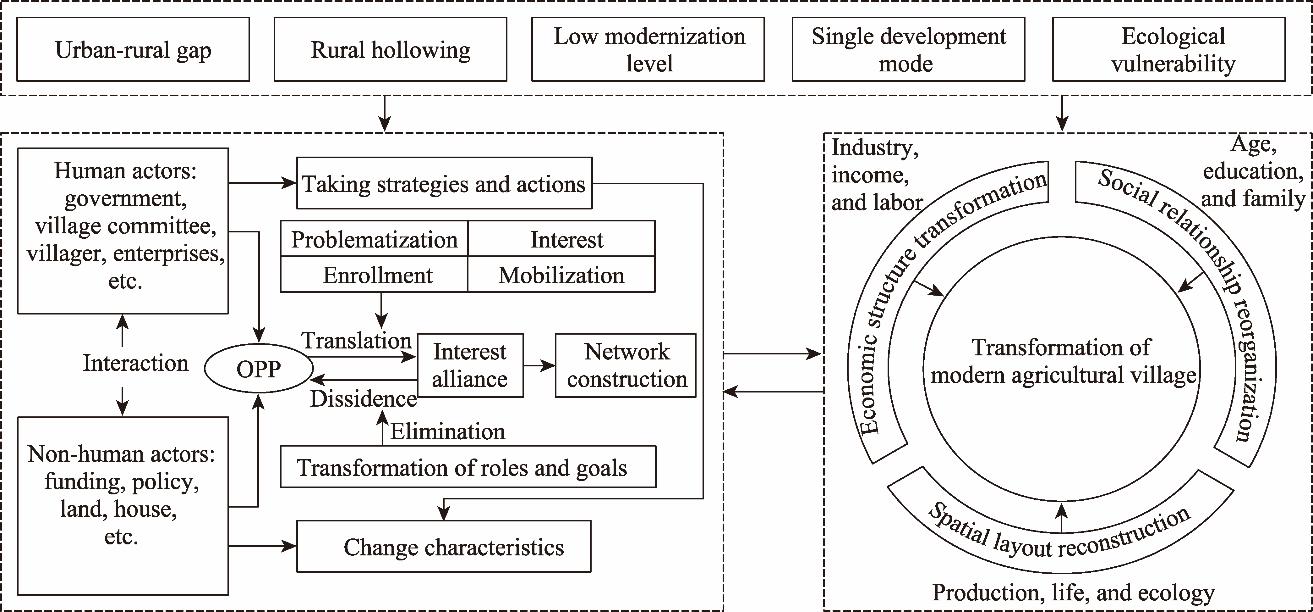
As shown in Figure 1, the transformation of modern agricultural village is contingent upon the synergistic actions of multiple agents. External catalysts such as government, businesses, and academic experts coalesce with local forces such as village committee, cooperatives, and residents to foster rural network creation and revitalization. Key actors, driven by a profound desire for transformation, influence the network’s objectives and redefine the roles of other participants (Wang et al., 2023c). In the process of translation, different problems of various actors converge into obligatory passage points to achieve goals. Through the processes of interest, enrollment, mobilization, etc., the various actors form an interest alliance and establish a network of actors. In this process, when dissidence is raised, it is necessary to transform the roles and goals of the actors to eliminate objections and form a new actor network. Human actors adopt strategies and actions to change the characteristics of non-human actors such as land and house. In turn, non-human actors further promote human actors’ adaptation. The two interact to jointly promote the construction and development of the actor network of modern agricultural village. Furthermore, the interaction changes industrial structures, reconfigures social relationships, and spatially reimagines rural areas, thereby promoting the transformation of modern agricultural village. In the process of transformation, with changes in the problems and interests of modern agricultural village, the role and transfer mechanism of actors in the actor network will be further changed. Key actors enable other actors to form alliances of interest and participate in the actor network through administrative, regional, and market mechanisms, thereby optimizing the collective interests of all stakeholders. Furthermore, shifts in the objectives of modern agricultural village and the role evolution of actors not only propel the development of modern agricultural village but also enhance the stability of the actor network (Li et al., 2023).
Fig. 1. Framework of the transformation of modern agricultural village based on actor-network theory (ANT). OPP, obligatory passage point.

3. Data and methods

3.1. Study area

This study focuses on Zhaojiawa Village, which is located in a loess hilly and gully region. It is an administrative village governed by Mingzhou Town, Suide County, Yulin City, Shaanxi Province of China. Zhaojiawa Village spans 5.7 km2, with over 75.00% of its land dedicated to agriculture. The village’s plantation industry is constrained by slopes with a steepness greater than 25°, leading to significant land abandonment. The semi-arid climate characteristic of the temperate continental zone exacerbates soil erosion, which is a critical impediment to economic progress. The lack of employment opportunities has further fueled a mass exodus, with over 47.00% of the workforce having migrated by 2010, leaving the village grappling with depopulation and hollowing.
Since 2017, Zhaojiawa Village has embraced the transformative approach of the “Three Changes Reform” (including the transformation of resources into assets, funds into shares, and farmers into shareholders), leveraging a “party branch+cooperative+poor households” development model. Zhaojiawa Village has successfully executed land transfers and cultivated a variety of modern agricultural products, such as apples, on a large scale, tailored to local conditions. This transformation of management rights and production modes has culminated in the establishment of a city-level modern agricultural demonstration park that integrates planting, aquaculture, processing, and ecological tourism. Driven by rural revitalization policies, the infrastructure of Zhaojiawa Village has been markedly enhanced, and the living environment has been notably improved, earning it the distinction of being a provincial-level beautiful and livable rural village. The village committee has established a collective economic cooperative and a farmers’ professional cooperative, achieving a dual increase in both collective and farmer incomes. Through these concerted efforts, Zhaojiawa Village has undergone profound transformation and reconstruction, leading to a diversified development trajectory in rural areas.

3.2. Data sources and methods

The land use data were compiled from Google Earth remote sensing images captured in August 2015 and September 2021, with a spatial resolution of 0.5 m. The visual interpretation was based on extracted vector data for cultivated land, forest land, grassland, water body, countryside homestead, transportation land, and construction land, which provided insights into land use evolution in Zhaojiawa Village. Administrative boundary data were sourced from the National Platform for Common GeoSpatial Information Services (https://www.tianditu.gov.cn/), and complemented by the adjustment plans of Suide County’s administrative villages. We also conducted field surveys in May and August 2023, and used unmanned aerial vehicles to capture remote sensing imageries. This approach enabled a more precise delineation of the village’s land use patterns. The socioeconomic data and the village’s evolution description were gathered through in-depth interviews with 10 participants (including 6 village officials and 4 villagers) using random sampling method during the same period, highlighting the transformation in agricultural development and the impact of rural revitalization policies. The interviews covered topics such as population structure, income, leading industries, infrastructure, living conditions, existing challenges, measures implemented, and rural planning. The villagers’ perspectives on family structure, pillar industries, income and expenditures, and the assessment regarding village infrastructure and the living environment were also gathered. Furthermore, the collected socioeconomic data were cross-referenced with the statistical communiqué of Suide County on the national economic and social development in 2020 (Suide County People’s Government, 2021a) and publicly available government documents through a rigorous validation process to verify their reliability and accuracy. Through a web search, in this study, we used three work reports and media news related to Zhaojiawa’s industrial development (Suide County People’s Government, 2021b, 2023a, b). This information is crucial for understanding the processes and mechanisms of rural transformation.
Based on these data, in this study, we applied ANT and regarded the transformation of Zhaojiawa Village into a modern agricultural village as the result of the dynamic change process of the actor network. Actors, translation, and network are the three core concepts of ANT. Among them, the transformation of the identities of actors was used to analyze the translation process, and the translation process was used to explain the formation mechanism of the actor network in the construction and development process of the modern agricultural village.

4. Results

4.1. Transformation characteristics of Zhaojiawa Village

4.1.1. Economic structure transformation

Before 2017, Zhaojiawa Village’s economy was predominantly agrarian and dependent on traditional farming. Despite its proximity to the county town, the village was classified as impoverished, experiencing significant population outflow and land abandonment. However, after the Suide County government prioritized modern agriculture, Zhaojiawa Village gradually adopted the “Three Changes Reform”, facilitating comprehensive land transfers. Specifically, the transformation of resources into assets refers to converting the right to legally use collective resources in shares within a new business entity, allowing the village to share in profits. The transformation of funds into shares means that financial investments from various government departments were converted into shared capital held by village collectives or farmers, in line with relevant policies. The transformation of farmers into shareholders means that villagers participated in profit distribution as shareholders, with the village collective and shareholders distributing earnings according to a set ratio. This reform enabled the successful reallocation of 466.47 hm2 of abandoned land to the village committee, which was entrusted to 24 local farmer cooperatives for ecological large-scale cultivation. The establishment of the Modern Ecological Agriculture Demonstration Park in Zhaojiawa Village has played an important role in promoting the apple industry, triggering a threefold transformation: resources into assets, funds into shares, and farmers into shareholders. After land transfer and consolidation, over 88.67 hm2 of land remained under village collective cooperatives, serving as shares for villager investment. Project investment funds were partly channeled into these cooperatives, with land valued at an average of 825 CNY/hm2 annually during 2017-2037, becoming villagers’ share capital. When farmers transform into shareholders, they are able to receive dividends, with profits distributed to the village collective and shareholders at a ratio of 3:7. Capitalizing on the ecological potential and developmental needs of the apple industry, the local government collaborated with Northwest A&F University, China to establish an experimental demonstration station focusing on new apple varieties and agricultural technologies, positioning the park as a model of “Gaoxigou in the new era” and a “Loess Plateau Ecological Civilization Demonstration Zone”. The village’s success in apple cultivation has paved the way for the expansion of animal husbandry and broader development of the primary, secondary, and tertiary sectors. Currently, the village’s economic structure is further evolving with the emergence of the photovoltaic industry, a folk culture exhibition hall, and an art sketch base, integrating leisure agriculture with cultural and tourism elements. These developments signify the diversification of the village’s economic foundation. The survey results indicate that the growing apple industry has significantly increased villagers’ incomes. The average annual net income per hectare of orchard now exceeds 7500 CNY, whereas the annual income for villagers employed in the park can surpass 25,000 CNY. Furthermore, the integrated development model has not only created diverse local employment opportunities but also attracted a considerable number of young and middle-aged villagers to return to their hometowns for entrepreneurial ventures or employment, which marks a successful transition from a traditional farming economy to a migrant labor economy.

4.1.2. Social relationship reorganization

The impetus of industrial development has driven the transformation of the economic structure in Zhaojiawa Village and catalyzed a reconfiguration of the community. Previously marked by an exodus of young workers and an aging population, the village’s demographic and employment structures have since been revitalized. The burgeoning apple industry has drawn locals back to their roots, increasing the resident population from over 120 to more than 460 and lowering the average age from above 65 years old to below 55 years old. This demographic shift has introduced a more balanced age distribution within the community. To promote modern ecological agriculture, developing scientific knowledge and skilled professionals has become essential. Suide County government has proactively addressed this need by engaging experts and professors through a “inviting experts in to teach and sending personnel out for training” strategy, recruiting 20 academicians to share knowledge in the park and conducting extensive training sessions at municipal and county educational institutions. In 2019, the government furthered its commitment by sponsoring nine locals for a two-year study program at Northwest A&F University, preparing them for roles in agricultural technology. This initiative has increased the educational level of the village’s population, fostering a community enriched with higher-educated talent. The village committee has played a key role in shaping social relationships within Zhaojiawa Village. As a grassroots body, the village committee has aligned with higher-level government policies, contributing to new rural development plans. The village committee has played a pivotal role in optimizing infrastructure and industrial layouts and supporting the rural economy. In engaging with villagers, the committee has led the fair allocation of village land and the integration of enterprises as innovative management entities. As rural industries have entered a new phase of development driven by a productive and comprehensive growth model, the village committee has shifted from playing a central leading role to mediating relationships among enterprises, villagers, and in-migrants. The village committee has created a collaborative interest model of “village committee+leading enterprises+community”, significantly reshaping social relations within the village. This social relationship reorganization has not only redefined communal dynamics but also paved the way for a more cohesive and collaborative future, where collective interests are harmonized and communal development is propelled forward.

4.1.3. Spatial layout reconstruction

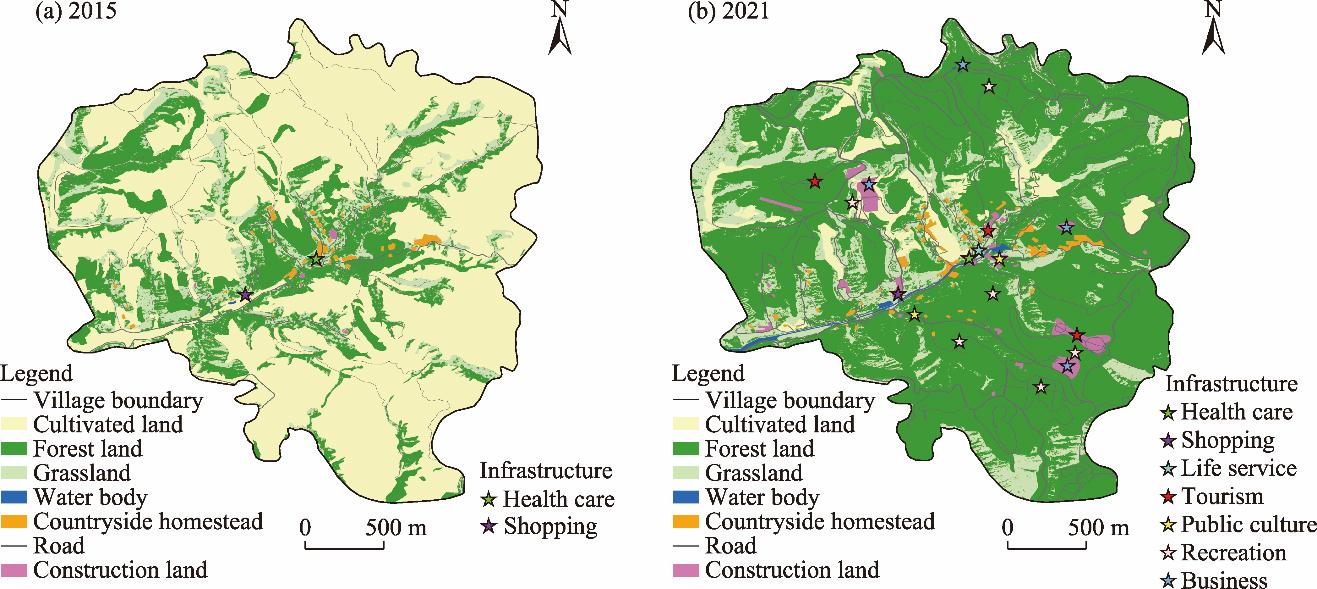
The spatial configuration of Zhaojiawa Village has experienced a significant transformation, with the dominant land use type shifting from cultivated land in 2015 to forest land in 2021 (Fig. 2). The forest land now exceeds 70.00% of the total land in the village, effectively optimizing the synergy between productive and ecological spaces. Additionally, the road network has undergone substantial development, particularly in village’s southern region, which has achieved nearly full coverage across the village, highlighting the importance of accessibility for the daily lives and work of rural residents in the loess hilly and gully region.
Fig. 2. Characteristics of spatial layout reconstruction in Zhaojiawa Village from 2015 (a) to 2021 (b).
The functional structure of rural spaces in Zhaojiawa Village has rapidly evolved, mainly due to the implementation of rural revitalization policies, which have encouraged spatial production activities among multiple stakeholders, including village committees, enterprises, and villagers. On the one hand, the collective renovation project has led to infrastructure development in Zhaojiawa Village. The collective renovation project includes the renovation of old homes, the addition of various catering, leisure, and sports facilities, the improvement of access and village roads, and the installation of numerous water supply and drainage systems, greatly improving villagers’ living and working conditions. On the other hand, the execution of land improvement projects, land transfers, and external enterprise involvement have collectively facilitated the transformation of hilly terrain into terraced fields. The integrated development model of the agricultural demonstration parks has diversified village functions. Whereas the village was initially focused on a single production function, it has now embraced modern agriculture, leisure and entertainment, ecological restoration, and other complex roles. Furthermore, to expand the cultural tourism dimension of the countryside, the addition of service facilities, including a folk customs exhibition hall, an art sketch base, and a film and television shooting base, has accelerated the transformation of traditional production spaces into consumption areas. This transformation has enriched the village’s economic landscape, endowed it with a distinctive cultural identity, and significantly bolstered its attractiveness to both tourists and residents.

4.2. Dynamic mechanism of rural transformation from the actor network perspective

4.2.1. Modern agricultural village construction stage: actor network construction

Zhaojiawa Village, once a typical impoverished village in Suide County before 2017, was constrained by a lack of industrial activity despite its favorable location. In 2017, Zhaojiawa Village began constructing modern agricultural village, driven by a coalition of diverse actors aiming to achieve rural transformation and development. This stage involved initiatives aimed at modernizing and upgrading traditional industries, enhancing infrastructure, and improving the living environment. The key actors included both human and non-human entities. The human actors were the Suide County government, the Mingzhou Town government, the village committee, villagers, and enterprises, whereas the non-human actors were the land, house, and natural and cultural landscapes of Zhaojiawa Village. As a combination of natural and social factors, these actors redefined their roles and operations through a network to facilitate the translation process.
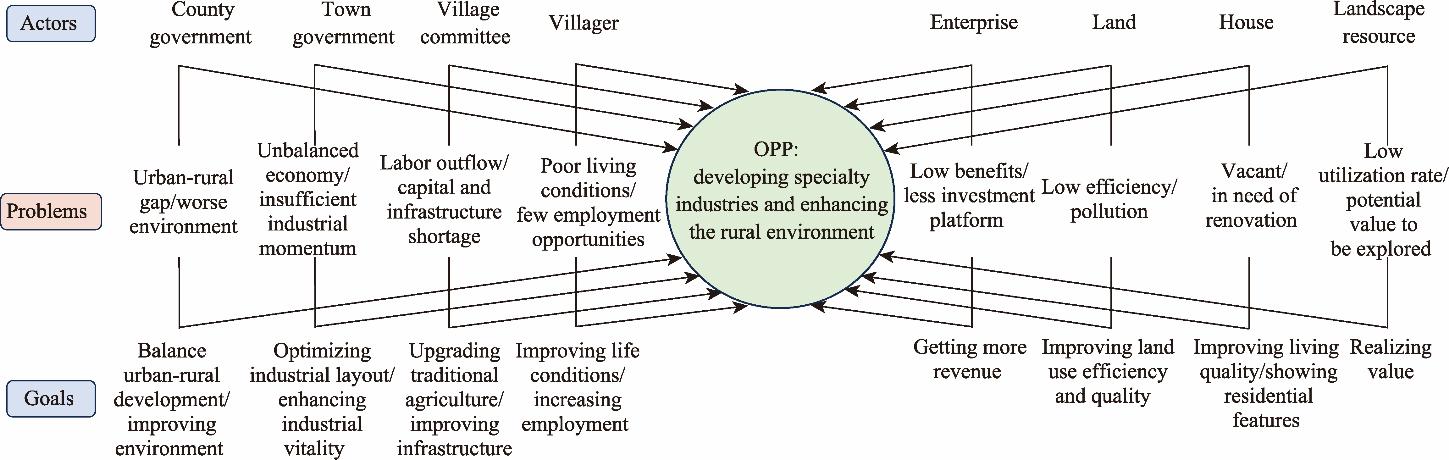
Prior to the initiation of the translation process, each actor was confronted with distinct issues. The Suide County government was tasked with addressing the significant urban-rural divide and the subpar quality of the rural environment, aspiring to foster holistic urban-rural development and establish a robust agricultural county by channeling investments into rural construction, integrating rural resources, and leveraging agricultural strengths. The Mingzhou Town government grappled with uneven rural economic development and insufficient industrial dynamism, necessitating the optimization of the rural industrial layout to invigorate industrial development. Moreover, Zhaojiawa Village, plagued by the outmigration of youth and middle-aged population, financial constraints, and protracted infrastructure, was devoid of collective industries and enduring public revenue streams, and was beset by environmental pollution issues. The village committee was eager to stimulate the modernization of traditional agriculture, bolster supporting infrastructure, and enhance the village environment to reverse the migration of populace. Villagers, enduring substandard living conditions and scarce employment opportunities, yearned for an enhanced quality of life and expanded job prospects. Enterprises, facing the reality of low income and limited investment platforms, aspired to engage in new rural construction to reconfigure production resources and secure greater profits. Non-human actors, such as land, house, and natural and cultural resources, required improvements to their existing conditions of poor quality and inefficient use with the help of human actors’ actions, exemplified by land consolidation and circulation, house renovation, and dredging and reinforcement of irrigation channels. These diverse issues and objectives were synthesized into the core goal of “developing specialty industries and enhancing the rural environment”, serving as the obligatory passage point for transformation and development in Zhaojiawa Village (Fig. 3).
Fig. 3. Actors, problems, goals, and OPP in the construction stage of modern agricultural village.
The transformational development of Zhaojiawa Village is a complex endeavor that necessitates aligning the interests of a multitude of heterogeneous actors. This alignment is achieved through the translation process within the actor network, where benefits are conferred upon these diverse actors to overcome numerous challenges and obstacles. As the pivotal actor in this stage, the Suide County government has taken on the responsibility of issuing concerns for other actors and entrusting them with benefits. To further develop the actor network alliance, the Suide County government has employed a variety of recruitment and mobilization strategies, thereby fostering the actor network construction of modern agricultural village. In this process, the Suide County government has primarily engaged in four types of recruitment strategies targeting various heterogeneous actors: administrative recruitment, environmental recruitment, land recruitment, and talent recruitment (Table 1).
Table 1 Main recruitment methods used by the Suide County government in the construction stage of modern agricultural village.
Mode of recruitment Primary recruitment actor Main method
Administrative recruitment Town government and committee Project implementation and fund allocation by relevant departments and town government.
Environmental
recruitment
Committee Implementation of livable environment projects, including house refurbishment, road improvement, sewage treatment, and power system upgrades.
Land recruitment Committee, cooperative, and enterprise Reform of property rights, land transfer to cooperatives, and establishment of apple orchards.
Talent
recruitment
Specialist and talent Hiring of experts for lectures and training in agronomy and agricultural services.
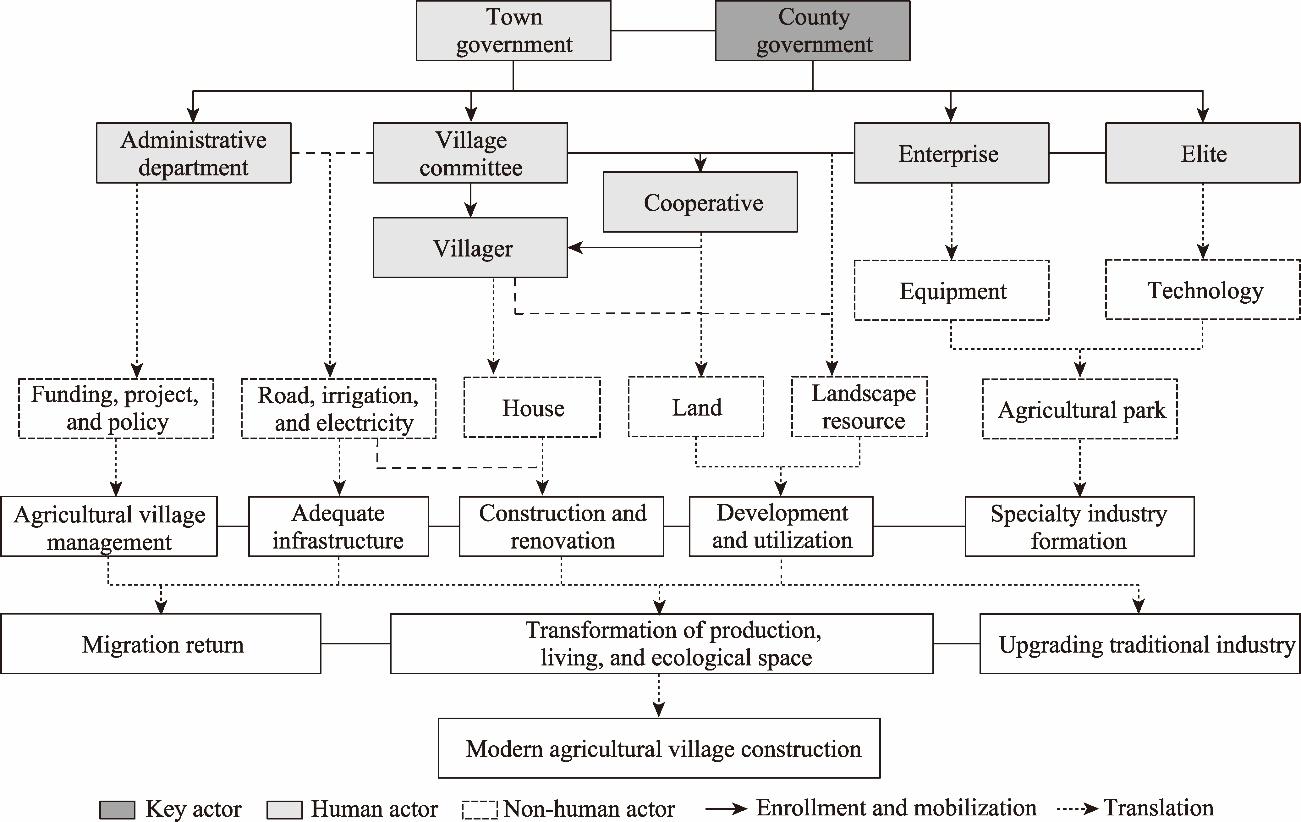
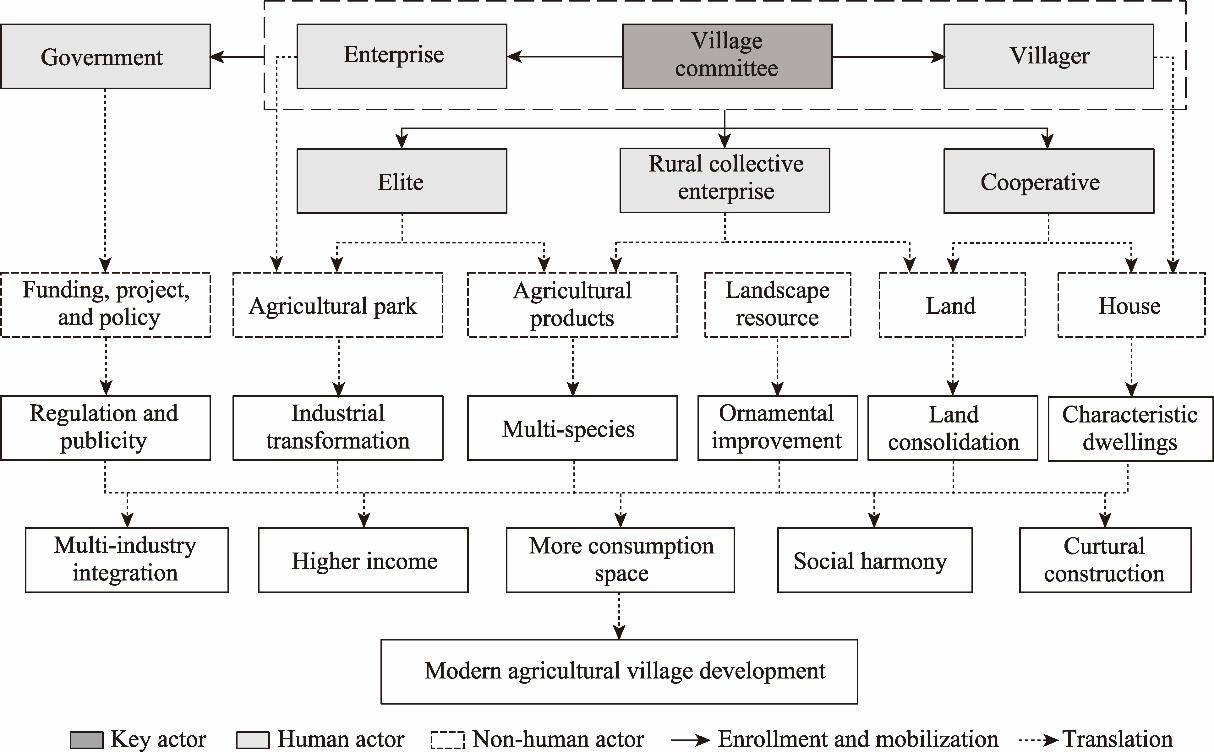
In the construction stage of modern agricultural village, the transformation of Zhaojiawa Village has predominantly been propelled by “top-down” external forces, with the Suide County government at the helm. With the support of national policies and the rural revitalization strategy of Yulin City, the Suide County government, as a central actor, has played an important role in guiding financial resources and project initiatives. This strategic investment has facilitated the engagement of a diverse array of actors, each entrusted with specific roles and responsibilities, culminating in the emergence of a multifaceted and robust actor network (Fig. 4). The government acts as a significant provider of resources, including funding, projects, and talent, and coordinates the collective construction efforts of diverse actors in modern agricultural village development. In addition, the synergy with the endogenous forces of the village also played a key role in realizing the initial improvement of the industrial base of the village and the spatial reorganization. This collaboration has catalyzed the transformation from a conventional agrarian community to a modern agricultural village. The burgeoning development has not only enticed a substantial number of villagers, who were previously seeking employment elsewhere, to return, but also stimulated new residential construction within the village. The transitions in land use and the modalities of production, coupled with the advent of large-scale operations and bolstered infrastructure, have set the stage for a comprehensive transformation of the village’s production, living, and ecological spaces. Essentially, leveraging land consolidation strategies, the collective of actors has fostered the spatial reconfiguration of Zhaojiawa Village, spurred by the evolution from traditional to modern industries, thereby nurturing an actor network conducive to the development of modern agricultural village. The actor network is inherently dynamic and subject to fluctuations with the ebbs and flows of policy directives and market demands. The engagement, disengagement, and role shifts of actors within this network are catalysts for change, reflecting the adaptive and responsive nature of the community’s development paradigm. Understanding these dynamics is crucial for the sustainable progression of Zhaojiawa Village and similar rural communities in terms of their journey toward modernization within the framework of regional sustainability.
Fig. 4. Actor network in the construction stage of modern agricultural village.

4.2.2. Modern agricultural village development stage: actor network reconstruction

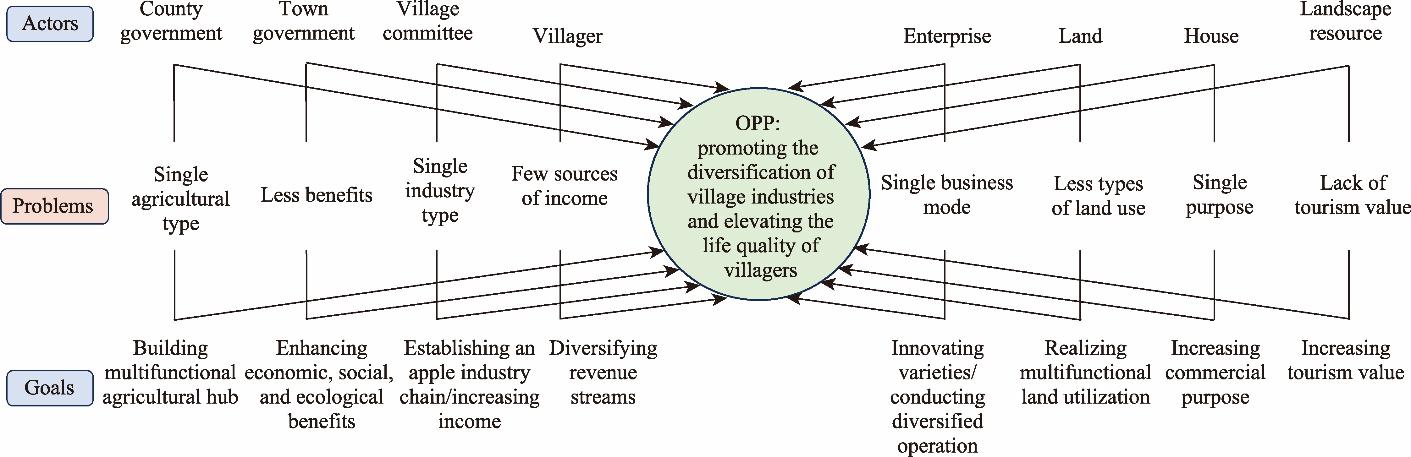
By 2020, with the establishment of modern agricultural infrastructure, Zhaojiawa Village has achieved milestone achievements in comprehensive rural environmental management and industrial upgrading. However, the village continued to face challenges in terms of industrial structure and sustainable development. Therefore, the key question remained: how could the apple industry be leveraged as a leading sector to create a distinctive development model that integrates multiple industries, paving the way for a new transformation trajectory for Zhaojiawa Village? In the development stage of modern agricultural village, the interests of various stakeholders transformed, leading to an evolution within the actor network. The Suide County government and town administration aimed to transform Zhaojiawa Village into a multifunctional agricultural hub, integrating operations in planting, processing, and leisure tourism to maximize the economic, social, and ecological benefits. The Zhaojiawa Village committee sought to increase the income of both the village and residents by establishing a comprehensive apple industry chain. Villagers aimed to diversify their revenue streams and secure returns on investment, whereas enterprises sought to innovate in science and technology, cultivate new varieties, and develop a range of agricultural products centered on distinctive leading industries. As these diverse interests converged, the objectives of the actor network shifted toward promoting diversified development of village industries and elevating the quality of life for villagers, indicating a transition from the actor network of modern agricultural construction to that of modern agricultural development (Fig. 5).
Fig. 5. Actors, problems, goals, and OPP in the development stage of modern agricultural village.
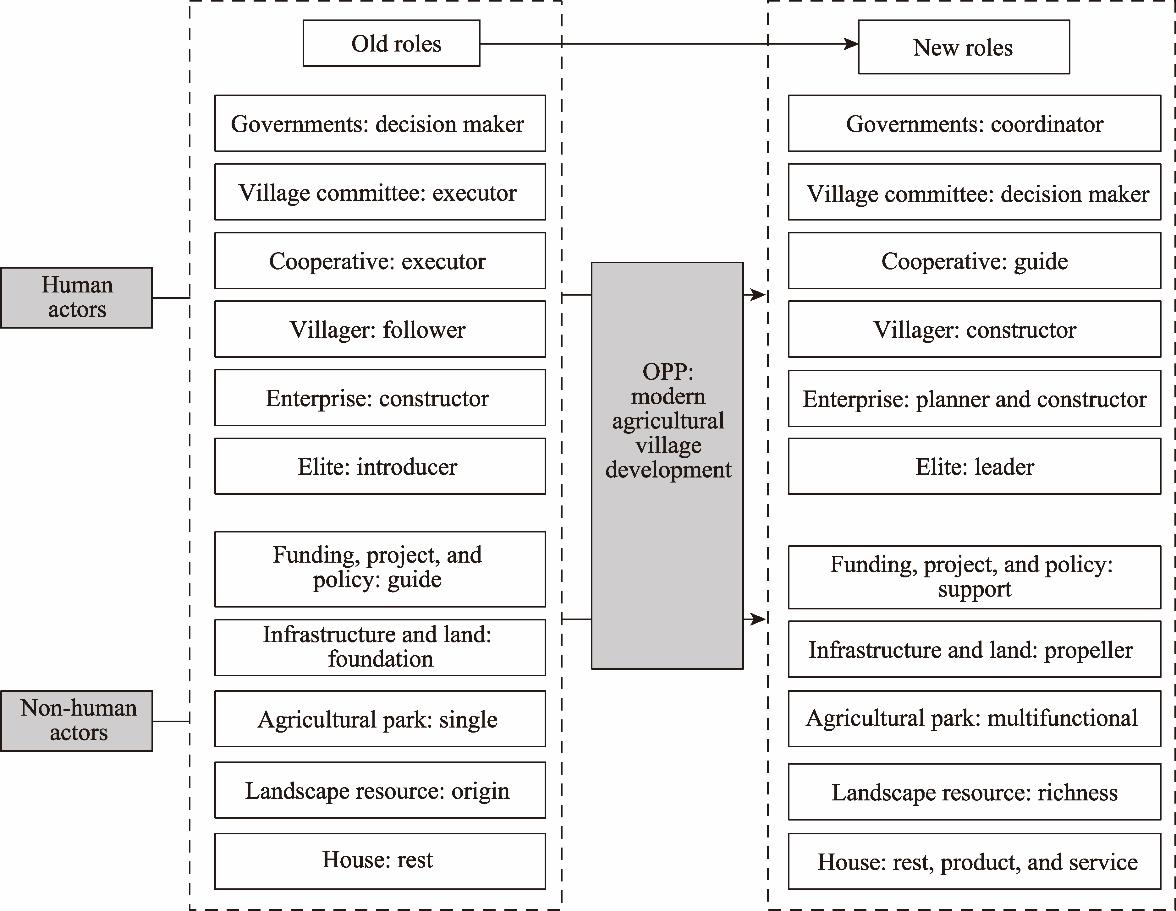
The reconfiguration of the actor network is most evident in the role transformations of certain actors. The Suide County government, the dominant force in the construction stage, gradually diminished in its leading role in the development stage. The village committee shifted from executing higher governmental directives to becoming a comprehensive decision-maker in village planning and management and a mediator between enterprises and villagers. Additionally, enterprises and villagers began to leverage the village’s unique advantages to explore suitable development avenues for village industries, gaining a more influential voice. In the process of actor-network translation, non-human actors also took on more consumer-oriented roles. Houses and lands were converted into exhibition halls, rural restaurants, convenience stores, agricultural markets, and processing plants for products such as roses and soybeans. The development of artistic and cultural assets, including sketching sites and film locations, further integrated the village’s natural and cultural resources into attractions.
In order to achieve the sustainable development of the modern agricultural village, the village committee has implemented various strategies, including market recruitment, employment recruitment, talent recruitment, and publicity recruitment, so that different actors can participate in the development of multiple industries in Zhaojiawa Village (Table 2). The aim of this study was to integrate the interests and objectives of all stakeholders into the actor network of modern agricultural village development. By delineating the roles of various actors, the village committee facilitated their active participation in the modern agricultural development network, establishing new and relatively stable relationships (Fig. 6).
Table 2 Main recruitment methods used by the Zhaojiawa Village committee in the development stage of modern agricultural village.
Mode of recruitment Primary recruitment actor Main method
Market recruitment Enterprise and villager Collaboration with enterprises to develop apple farming, aquaculture, solar power, and tourism.
Employment recruitment Villager Establishment of companies for apple planting, greenhouse management, and agricultural product marketing.
Talent recruitment Talent Recruitment of talent for apple variety experiments and promotion of new agricultural models.
Publicity recruitment County and township government Promotion and standardization of policies for the village’s new development model.
Fig. 6. Actor network in the development stage of modern agricultural village.
In the development stage of modern agricultural village, the transformation of Zhaojiawa Village was driven by a synergy of external and internal forces, primarily led by the village committee. This has resulted in an integrated development model that positions the apple industry as the economic focus. In the development stage of modern agricultural village, the villagers—the primary constituents of Zhaojiawa Village—have yet to take on key roles. This suggests that the evolution of modern agricultural village remains in a transitional phase and has not yet fully matured. In addition to the skilled elites trained by the county government, the secretary of Zhaojiawa Village—who is highly educated and committed to community service—collaborates with village leaders and other governing elites, playing a crucial role in driving rural transformation through collective action. Rural cooperatives, organized and supervised by political elites, reduce information barriers between farmers and enterprises, thus advancing rural modernization. With the transformation of Zhaojiawa Village from a single economic structure to a diversified industrial base, Zhaojiawa Village has undergone a transformation and reconstruction of production, living, and ecological spaces. The reduction in cultivated land is counterbalanced by the expansion of other land use types, indicating a strategic optimization of land resources. Although the spatial functions of Zhaojiawa Village are still mainly based on production and habitation, they are also constantly evolving. Driven by the growing long-term tourism industry, areas originally designated as production and residential spaces are being transformed into higher-quality consumption spaces. This shift highlights the increasing importance of the service industry in the village’s economy. Additionally, the enhancement and consolidation of living spaces and public areas increase resident satisfaction and foster a stronger sense of community. These social dynamics are crucial for the development of modern agricultural village. Overall, the transition from the construction stage to the development stage involves significant economic, social, and spatial transformations. Multi-industry integrated development, spearheaded by modern industries, is the pivotal pathway for achieving sustainable rural development and realizing the vision of rural revitalization. This transition revitalizes the local economy, enriches the social fabric, and enhances the quality of life for rural communities, in line with regional sustainable development goals.

5. Discussion

5.1. Transformation mechanism of modern agricultural village

The rural regional system is a complex structure centered on the population‒land‒industry nexus (Liu, 2018). Under the impact of urbanization, the backward living conditions in traditional agricultural production have led to a long-term outflow of population and disrupted the harmonious relationship between humans and the environment, thereby accelerating rural decline. As urbanization progresses, rural areas are transitioning from a state of closure to one of openness, marking a critical transformation phase (Liu and Li, 2017). The regional functions and economic, social, and natural attributes of rural areas vary widely as they undergo distinct transformation processes (Wang et al., 2023b). We found that industrial transformation can not only attract villagers to return and new villagers to join, thereby reshaping social networks, but also promote the diversified development of rural economic structures, thus facilitating rural transformation. This is consistent with the research findings of Zheng and Chou (2024). The development trajectory of most villages is a sequential transformation from a traditional agricultural village to a village with concurrent business activities, then to a specialized village integrating agriculture, industry, and service industry, and finally to a modern agricultural village or a village with integrated development of three industries. However, due to the influence of internal and external rural factors, some villages may experience rapid development (Zhang et al., 2022a). In the context of rural revitalization, villages in ecologically fragile and impoverished areas can potentially emulate the development model of modern agricultural village such as Zhaojiawa Village, which is propelled by urbanization and information technology. It is imperative to delve deeper into the mechanism of rural transformation, with a focus on the unique role of social networks in rural transformation based on ANT, beyond the traditional material level, and in conjunction with the behaviors and motivations of various actors.
From the ANT perspective, Zhaojiawa Village is more than a rural space with production, life, and ecological functions; it is a dynamic actor-network space comprising many heterogeneous actors that interact through cooperation, competition, and conflict (Qu et al., 2022). The rural transformation process involves establishing and renewing heterogeneous networks. As the central object of rural transformation, the evolution of non-human actors is an outcome of the actor network shaped by the intervention of human actors and other external and internal forces (Zou et al., 2019). Structural forces are pivotal in the process of transforming Zhaojiawa Village into a modern agricultural hub. Leveraging its location advantages and resource endowments, the village has transitioned from a “top-down” drive mechanism dominated by the Suide County government to a “top-down combination” drive mechanism led by the Zhaojiawa Village committee. This shift has driven the transformation from traditional industries to specialized agriculture and then to multi-industry integration.
In the construction stage of modern agricultural village, external forces, primarily the Suide County government, played a crucial role. The local government, which relies on national strategies and regional realities, has formulated plans and policies tailored for local rural development and has emerged as a key leader in Zhaojiawa Village. The successful transformation of Zhaojiawa Village, as a showcase of modern agriculture, is intertwined with the macro goals of poverty eradication, agricultural modernization, and enhancement of the local government’s governance capabilities and image (Tang et al., 2015). By reforming land property rights, the Suide County government has restructured the industrial layout of Zhaojiawa Village, introduced market mechanisms for large-scale industrial production and organization, and facilitated the transition from traditional agriculture to long-term agriculture, realizing the fundamental shift from a traditional agricultural village to a modern agricultural village (Li et al., 2024).
In the development stage of modern agricultural village, the roles of some actors undergo a transformation (Fig. 7). The government transitions from being a decision-maker to being a service provider. The village committee evolves into the decision-maker for rural development and becomes the core of a diversified actor network. The role of the committee is multidimensional. It establishes and operates cooperatives and village collective economic organizations, and recruits different actors, including local governments, villagers, and enterprises, to promote the integration and circulation of rural resources, stimulating the integrated development of multiple rural industries. The collective economy is a vital force in promoting rural economic structural adjustment and provides robust support for rural transformation and healthy economic growth (Peng et al., 2023). The village committee also plays a leading role in the transformation and development of rural areas, forming new communities of interest by coordinating the interests of investment enterprises, villagers, and village committees (Qu et al., 2023). As a bridge linking villagers and enterprises, the village committee enhances agricultural production efficiency, promotes employment, and increases the income of villagers and collectives, thereby fostering social capital accumulation and strengthening rural cohesion.
Fig. 7. Role transformation of human and non-human actors.
With the development of rural resources, non-human actors such as land and house acquire new identities through human intervention, resulting in distinctive regional characteristics and further changes in rural functions. It is evident that, in line with the study conducted by Chen and Zhang (2015), in the transformation process of modern agricultural village, Zhaojiawa Village has been led primarily by local government and village committee, with villagers not yet holding the primary decision-making power. Under the strict regulations of the multilevel administrative management system, these organizational structures possess absolute decision-making power, enabling organic coordination and transition. Villagers, constrained by land contracts and agreements and limited by their single economic source and underdeveloped rural educational resources, have a restricted status and voice in rural transformation. The restricted status and voice indicates that Zhaojiawa Village has not yet reached the advanced stage of a modern agricultural village. However, the translation and transformation process of the actor network offers valuable insights for village transitioning to modern agricultural status. In conclusion, the transformation of modern agricultural village is a multifaceted and dynamic process influenced by a myriad of factors, including the geographical environment, social economy, history, culture, and human and non-human actors. In the context of rural revitalization, the transformation of modern agricultural village should be pragmatic, following the path of traditional industry‒specialty industry‒industry convergence influenced by multiple stakeholders. The study area is a modern agricultural village developed in an ecologically fragile region, and the transformation pathways of different villages will exhibit distinct variations. Future research should delve deeper into the mechanisms of rural transformation across different regions and village types, such as tourism villages, to construct a more comprehensive theoretical framework for rural transformation and provide robust theoretical support for rural revitalization.

5.2. Policy recommendations

On the basis of insights from ANT, the analysis results of Zhaojiawa Village highlight the complex dynamics involved in rural transformation. It is crucial to recognize the structural forces from local government and village committee and the agency of villagers and talent, whose contributions to self-driven development are equally significant (Li et al., 2024). Local governments should maintain a guiding and regulatory role in rural transformation. Despite a gradual reduction in decision-making authority, their influence remains pivotal in fostering, overseeing, and assessing rural development through strategic planning, policy-making, and regulatory frameworks. As a grassroots self-governing entity, the village committee must harness the potential of the collective economy and facilitate the integration and circulation of rural resources. Especially as rural development gradually enters a mature phase, it is imperative to empower villagers, talented individuals, and other key stakeholders by facilitating extensive participation and democratic decision-making, thereby promoting harmonious and sustainable development in rural transformation. For villagers, the mere inclusion in land contracts and limited employment opportunities does not sufficiently address the complexities of rural transformation or foster sustainable development (Huang, 2020). The establishment of democratic and transparent decision-making procedures is the basis for increasing the participation of villagers. Village planning, project selection, and fund allocation should refer to and respond to villagers’ opinions (Tebboth and Locke, 2023). Encouraging villagers to participate in rural tourism development and leverage their unique resources and advantages can enhance their initiative and sense of agency. The rural talent gap poses a significant challenge to the sustainability of rural transformation. The urban-rural divide in economic standards and educational opportunities often drives young talent to urban areas in search of better living conditions and job prospects (Kvartiuk et al., 2020). To address this, the government should implement policies and financial incentives to attract talent back to rural areas. Furthermore, increasing investment and reforming rural education are essential to improve the cultural and skill levels of rural residents. Establishing platforms and mechanisms for urban-rural talent exchange can create a sustainable talent pool for rural development.
Additionally, the influence of non-human actors on rural transformation should not be overlooked. The integration of new technologies in rural areas is hindered by inadequate network infrastructure and farmers’ lack of technological literacy, limiting their ability to harness the benefits of new technologies for rural transformation (Peng et al., 2023). Traditional culture, as a vital carrier of community identity and heritage, directly impacts the revitalization of rural industries, culture, and ecology. Efforts should be made to prevent the erosion of traditional culture and leverage its positive role in rural transformation. Therefore, under the rapid development of e-commerce and logistics, it is imperative to leverage the inherent resource advantages of villages, integrate promotional efforts through media platforms, and deepen the convergence of multiple industries—including agriculture, cultural heritage, and tourism—through technological innovation, improved logistics infrastructure, and e-commerce platforms, thereby fostering a sustainable rural economy. The transformation of modern agricultural village necessitates the dynamic participation of multiple actors, strengthening government policy guidance, consolidating the village collective’s role in the economy, and enhancing villagers’ decision-making power. This facilitates the restructuring of industrial frameworks and operational mechanisms, driving integrated economic, social, and spatial transformations in rural areas to achieve comprehensive revitalization.

6. Conclusions

This study examines the transformation mechanism of modern agricultural village, using Zhaojiawa Village—an ecologically vulnerable and economically disadvantaged region—as a case study, and employing ANT as a conceptual framework. This study explores the patterns and planning implications of rural transformation driven by industrial upgrading in rural areas, with the goal of establishing a theoretical foundation for the sustainable development of rural areas in ecologically sensitive regions. First, rural transformation is marked by shifts in economic structure, social relationships, and spatial organization. In Zhaojiawa Village, a network of various human and non-human actors drived the transformation mechanism around two key stages of modern agricultural village development, i.e., construction stage and development stage. Second, in the construction stage of modern agricultural village, the transformation was primarily influenced by “top-down” external forces from the Suide County government. Regarding internal forces, the village has shifted from traditional industries to specialty industries, restructured its production, living, and ecological environments, and transitioned from a traditional agricultural village to a modern one. As the obligatory passage point progressed, the modern agricultural village moved into the development stage, driven mainly by a mix of external and internal forces. Third, through the ongoing influence of actor network in the construction and development stage of modern agricultural village, Zhaojiawa Village’s industry evolved from traditional industry to specialty industry, and then to industry integration. However, the villagers, who are the main agents of this change, have not yet become key actors, suggesting that while significant progress in transformation has been made, Zhaojiawa Village has not yet reached the advanced stage of a modern agricultural village. The changing concepts and models of development keep rural transformation in a state of continuous change.

Authorship contribution statement

ZHANG Tianyang: methodology, validation, formal analysis, investigation, data curation, visualization, writing - original draft, and writing - review & editing; and LI Linna: conceptualization, methodology, investigation, writing - original draft, writing - review & editing, supervision, project administration, and funding acquisition. All authors approved the manuscript.

Ethics statement

Ethics approval was obtained from the Ethics Committee of Research and Community Services, Beijing Normal University. In addition, the participants provided their informed consent to participate in this study.

Declaration of conflict of interest

The authors declare that they have no known competing financial interests or personal relationships that could have appeared to influence the work reported in this paper.

This work was supported by the National Natural Science Foundation of China (42293272, 42071227). In addition, we are grateful to the editors and the reviewers for their valuable comments and suggestions.

[1]
Barke, M., Newton, M., 1997. The EU LEADER initiative and endogenous rural development: The application of the programme in two rural areas of Andalusia, Southern Spain. J. Rural Stud. 13(3), 319-341.

[2]
Braun, Y.A., McLees, L.A., 2012. Space, ownership and inequality: Economic development and tourism in the highlands of Lesotho. Camb. J. Regions Econ. Soc. 5(3), 435-449.

[3]
Callon, M., Law, J., Rip, A., 1986. Mapping the Dynamics of Science and Technology. London: Palgrave Macmillan.

[4]
Chen, C., Gao, J.L., Chen, J.L., 2022. Behavioral logics of local actors enrolled in the restructuring of rural China: A case study of Haoqiao Village in northern Jiangsu. J. Rural Stud. 93, 223-233.

[5]
Chen, P.P., Zhang, M., 2015. From beautiful village to urban residents’ consumption space: Actor-network theory and the social space reconstruction of Dashiao village. Geographical Research. 34(8), 1435-1446 (in Chinese).

[6]
Cloke, P., Marsden, T., Mooney, P., 2006. Conceptualizing Rurality. The Handbook of Rural Studies. London: Sage.

[7]
Felski, R., 2016. Comparison and translation: A perspective from Actor-Network Theory. Comp. Lit. Stud. 53(4), 747-765.

[8]
Ge, D.Z., Zhou, G.P., Qiao, W.F., et al., 2020. Land use transition and rural spatial governance: Mechanism, framework and perspectives. J. Geogr. Sci. 30(8), 1325-1340.

DOI

[9]
Holmes, J., 2006. Impulses towards a multifunctional transition in rural Australia: Gaps in the research agenda. J. Rural Stud. 22(2), 142-160.

[10]
Hu, X.L., Li, H.B., Zhang, X.L., et al., 2019. Multi-dimensionality and the totality of rural spatial restructuring from the perspective of the rural space system: A case study of traditional villages in the ancient Huizhou region, China. Habitat Int. 94, 102062, doi: 10.1016/j.habitatint.2019.102062.

[11]
Huang, H., 2020. Learning from exploratory rural practices of the Yangtze River Delta in China: New initiatives, networks and empowerment shifts, and sustainability. J. Rural Stud. 77, 63-74.

[12]
Huang, Z., Zhang, J.P., Hu, Y.T., et al., 2023. The process and mechanism of rural industrial integration from the perspective of the actor network: A case study of Shicha village in Haikou city. Geographical Research. 42(10), 2759-2778 (in Chinese).

[13]
Kvartiuk, V., Petrick, M., Bavorova, M., et al., 2020. A brain drain in Russian agriculture? Migration sentiments among skilled Russian rural youth. Eur.-Asia Stud. 72(8), 1352-1377.

[14]
Latour, B., 1987. Science in Action:How to Follow Scientists and Engineers Through Society. Cambridge: Harvard University Press.

[15]
Law, J., 1992. Notes on the theory of the actor-network: Ordering, strategy, and heterogeneity. Syst. Pract. 5, 379-393.

[16]
Li, S.M., Yang, R., Long, H.L., et al., 2024. Rural spatial restructuring in suburbs under capital intervention: Spatial construction based on nature. Habitat Int. 150, 103112, doi: 10.1016/j.habitatint.2024.103112.

[17]
Li, Y.R., Fan, P.C., Liu, Y.S., 2019. What makes better village development in traditional agricultural areas of China? Evidence from long-term observation of typical villages. Habitat Int. 83, 111-124.

[18]
Li, Y.R., Qin, X.F., Sullivan, A., et al., 2023. Collective action improves elite-driven governance in rural development within China. Hum. Soc. Sci. Commun. 10, 600, doi: 10.1057/s41599-023-02089-9.

[19]
Li, Y.Y., Shao, L., 2024. Reconstruction process and transformation mechanism of ecological characteristic rural space based on Actor-Network Theory: A case study of Lianhu Village in the Qingpu District, Shanghai. Scientia Geographica Sinica. 44(1), 30-39 (in Chinese).

DOI

[20]
Liu, H.Y., Weng, D.L., Liu, H.G., 2021. Decoding rural space reconstruction using an Actor-Network methodological approach: A case study from the Yangtze River Delta, China. Land. 10(11), 1110, doi: 10.3390/land10111110.

[21]
Liu, X., Wang, X.Y., 2013. A review on the application of Actor Network Theory to human geography. Progress in Geography. 32(7), 1139-1147 (in Chinese).

DOI

[22]
Liu, Y.S., Zhou, Y., 2015. Challenges and countermeasures for beautiful countryside construction in China. Journal of Agricultural Resources and Environment. 32(2), 97-105 (in Chinese).

[23]
Liu, Y.S., Li, Y.H., 2017. Revitalize the world’s countryside. Nature. 548(7667), 275-277.

[24]
Liu, Y.S., 2018. Research on the urban-rural integration and rural revitalization in the new era in China. Acta Geographica Sinica. 73(4), 637-650 (in Chinese).

DOI

[25]
Long, H.L., Zou, J., Pykett, J., et al., 2011. Analysis of rural transformation development in China since the turn of the new millennium. Appl. Geogr. 31(3), 1094-1105.

[26]
Long, H.L., 2014. Land consolidation: An indispensable way of spatial restructuring in rural China. J. Geogr. Sci. 24(2), 211-225.

[27]
Long, H.L., Tu, S.S., Ge, D.Z., et al., 2016. The allocation and management of critical resources in rural China under restructuring: Problems and prospects. J. Rural Stud. 47(B), 392-412.

[28]
Long, H.L., Qu, Y., 2018. Land use transitions and land management: A mutual feedback perspective. Land Use Pol. 74, 111-120.

[29]
Ma, W.Q., Jiang, G.H., Zhang, R.J., et al., 2018. Achieving rural spatial restructuring in China: A suitable framework to understand how structural transitions in rural residential land differ across peri-urban interface? Land Use Pol. 75, 583-593.

[30]
Müller, M., 2015. Assemblages and actor-networks: Rethinking socio-material power, politics and space. Geogr. Compass. 9(1), 27-41.

[31]
National Bureau of Statistics of China, 2024. Statistical Communiqué of the People’s Republic of China on the 2023 National Economic and Social Development. [2024-05-29]. http://www.stats.gov.cn/

[32]
Peng, Y., Peng, X.B., Li, X., et al., 2023. Effectiveness in rural governance: Influencing factors and driving pathways—based on 20 typical cases of rural governance in China. Land. 12(7), 1452, doi: 10.3390/land12071452.

[33]
Qu, L.L., Li, Y.R., Wang, J.Y., 2023. Simulation and optimization of agricultural production scenarios in loess hilly and gully region. Geographical Research. 42(6), 1647-1662 (in Chinese).

[34]
Qu, Y.B., Zhao, W.Y., Zhao, L.J., et al., 2022. Research on hollow village governance based on action network: Mode, mechanism and countermeasures—comparison of different patterns in plain agricultural areas of China. Land. 11(6), 792, doi: 10.3390/land11060792.

[35]
Qu, Y.B., Dong, X.Z., Ma, W.Q., et al., 2024. New rural community construction or retention development: A comparative analysis of rural settlement transition mechanism in plain agriculture area of China based on Actor Network Theory. Chin. Geogr. Sci. 34(3), 436-452.

[36]
Ramos-Tumanan, M.A., Ryan, C., 2019. Chinese rural tourism seeking a Chinese perspective from an emic stance, or a case of post hoc reflection? Tourism Manage. 75, 284-292.

DOI

[37]
Ray, C., 2001. Culture Economies: A Perspective on Local Rural Development in Europe. Newcastle: Centre for Rural Economy, Newcastle University.

[38]
Sovacool, B.K., Hess, D.J., 2017. Ordering theories: Typologies and conceptual frameworks for sociotechnical change. Soc. Stud. Sci. 47(5), 703-750.

DOI PMID

[39]
Su, K.C., Wu, J., Yan, Y., et al., 2022. The functional value evolution of rural homesteads in different types of villages: Evidence from a Chinese traditional agricultural village and homestay village. Land. 11(6), 903, doi: 10.3390/land11060903.

[40]
Suide County People’s Government, 2021a. Statistical Communiqué of Suide County on the National Economic and Social Development in 2020. [2024-06-29]. https://www.sxsd.gov.cn/zfxxgk/fdzdgknr/tjxx/ndsj/202104/t20210428_1329754.htmlin Chinese).

[41]
Suide County People’s Government, 2021b. These Four Places in Suide have been Named as the First Batch of Film and Television Shooting Locations in Yulin City. [2024-07-01]. https://www.sxsd.gov.cn/xwzx/xzbm/202012/t20201222_544168.htmlin Chinese).

[42]
Suide County People’s Government, 2023a. Zhaojiawa Village in Suide County Designated as Provincial-Level Rural Revitalization Practice and Exchange Base. [2024-07-01]. https://www.sxsd.gov.cn/xwzx/xzbm/202312/t20231215_544985.htmlin Chinese).

[43]
Suide County People’s Government, 2023b. Zhaojiawa Village: Generating “Gold” from Green to Promote Rural Revitalization. [2024-07-01]. https://www.sxsd.gov.cn/xwzx/xzbm/202404/t20240426_1623148.htmlin Chinese).

[44]
Sun, Q.H., 2023. The reconstruction strategy of rural public space in Zhaoqing under the background of rural revitalization. Academic Journal of Humanities & Social Sciences. 6(18), 142-147.

[45]
Tang, Y., Mason, R.J., Wang, Y.B., 2015. Governments’ functions in the process of integrated consolidation and allocation of rural-urban construction land in China. J. Rural Stud. 42, 43-51.

[46]
Tebboth, M.G.L., Locke, C., 2023. Rural modernization and the remaking of the rural citizen in China: Village redevelopment, migration and precarity. J. Int. Dev. 36(2), 1129-1149.

[47]
Terluin, I.J., 2003. Differences in economic development in rural regions of advanced countries: An overview and critical analysis of theories. J. Rural Stud. 19(3), 327-344.

[48]
Wang, D., Chen, C.L., Findlay, C., 2023a. A review of rural transformation studies: Definition, measurement, and indicators. J. Integr. Agric. 22(12), 3568-3581.

[49]
Wang, J.Y., Qu, L.L., Li, Y.R., et al., 2023b. Identifying the structure of rural regional system and implications for rural revitalization: A case study of Yanchi County in northern China. Land Use Pol. 124, 106436, doi: 10.1016/j.landusepol.2022.106436.

[50]
Wang, P., Xie, S.Y., Xu, H.G., 2023c. Re-conceptualizing the ideal homes in rural China: An Actor-Network Theory approach. Hum. Soc. Sci. Commun. 10(1), 513, doi: 10.1057/s41599-023-02017-x.

[51]
Wang, W., Qiao, J.J., Cheng, S.Y., et al., 2023d. An analysis of the evolution mechanism of Chongdu tourism village cluster based on the theory of actor network. Human Geography. 38(2), 155-163, 180 (in Chinese).

[52]
Woods, M., 2010. Performing rurality and practising rural geography. Prog. Hum. Geogr. 34(6), 835-846.

[53]
Woods, M., 2011. Regions engaging globalization: A typology of regional responses in rural Europe. J. Rural Community Dev. 8(3), 113-126.

[54]
Wu, K.S., Kong, D.Y., Wang, Y., et al., 2022. The study on influencing factors of rural transformation development and their spatial differentiation of effects: Take Shaanxi province as an example. Journal of Natural Resources. 37(8), 2033-2041 (in Chinese).

DOI

[55]
Yang, R., Xu, Q., Zhou, J.D., et al., 2018. Mechanism of rural space transformation in Fengjian Acient Village of Shunde District, Foshan based on the Actor Network. Scientia Geographica Sinica. 38(11), 1817-1827 (in Chinese).

DOI

[56]
Yang, R., 2022. Space reconstruction process and internal driving mechanisms of Taobao villages in metropolitan fringe areas: A case study of Lirendong village in Guangzhou, China. J. Geogr. Sci. 32(12), 2599-2623.

DOI

[57]
Zang, Y.Z., Yang, Y.Y., Cao, Z., 2019. Typical model of rural transformation and restructure in suburban areas: A case study of Huaming Township in Dongli District, Tianjin City. Geographical Research. 38(3), 713-724 (in Chinese).

[58]
Zang, Y.Z., Hu, S.G., Liu, Y.S., 2024. Rural transformation and its links to farmland use transition: Theoretical insights and empirical evidence from Jiangsu. China. Habitat Int. 49, 103094, doi: 10.1016/j.habitatint.2024.103094.

[59]
Zhan, L.Y., Wang, S.J., Xie, S.X., et al., 2023. Spatial path to achieve urban-rural integration development - analytical framework for coupling the linkage and coordination of urban-rural system function. Habitat Int. 142, 102953, doi: 10.1016/j.habitatint.2023.102953.

[60]
Zhang, J., Yu, H.Z., Qiao, W., et al., 2022a. Progress of research on the transformation and restructuring of rural development in China. Progress in Geography. 41(5), 896-904 (in Chinese).

[61]
Zhang, Q.F., Tang, X., Xiao, Y., et al., 2023. Coordination of industrial structure and eco-efficiency in ecologically fragile areas: A case study of the Loess Plateau, China. J. Environ. Manage. 331, 117237, doi: 10.1016/j.jenvman.2023.117237.

[62]
Zhang, R.Y., Li, H.B., Yuan, Y., 2022b. Analyzing space-time evolution of rural transition in a rapidly urbanizing region: A case study of Suzhou, China. J. Geogr. Sci. 32(7), 1343-1356.

[63]
Zhang, X.F., Xu, H., Zhang, Y., 2021. From poverty alleviation to rural revitalization: A new endogenous development theory perspective - A case study of Y County, Guizhou Province. Contemporary Economic Management. 43(10), 31-39 (in Chinese).

[64]
Zhang, X.L., Pan, M.M., 2022. Emerging rural spatial restructuring regimes in China: A tale of three transitional villages in the urban fringe. J. Rural Stud. 93, 287-300.

[65]
Zheng, Z.Q., Chou, R.J., 2024. Rebuilding the resilience of mountainous rural communities by enhancing community capital through industrial transformation: A case study from rural Fujian. China. Habitat Int. 149, 103086, doi: 10.1016/j.habitatint.2024.103086.

[66]
Zou, M.Y., Zhou, T.J., Pan, Y., 2019. Driving force of rural construction based on Actor-network Theory. Planners. 35(16), 62-67 (in Chinese).

Outlines

/