
Research article

Analysis of environmental protection priority zones and their impacts on urban planning in small- and medium-sized cities of Indonesia

  • Rizal IMANA a ,
  • Andrea Emma PRAVITASARI , b, c, * ,
  • Didit Okta PRIBADI c, d
Expand
  • aNatural Resources and Environmental Management Science, Graduate School, Bogor Agricultural University, Bogor, 16129, Indonesia
  • bDivision of Regional Development Planning, Department of Soil Science and Land Resources, Faculty of Agriculture, Bogor Agricultural University, Bogor, 16680, Indonesia
  • cCenter for Regional, Systems Analysis Planning and Development, Bogor Agricultural University, Bogor, 16127, Indonesia
  • dResearch Center for Behavioral and Circular Economics, National Research and Innovation Agency of Indonesia, Jakarta, 12710, Indonesia
*E-mail address: (Andrea Emma PRAVITASARI).

Received date: 2024-06-19

  Revised date: 2025-04-04

  Accepted date: 2025-05-06

  Online published: 2025-05-21

Copyright

2666-660X/© 2025 Xinjiang Institute of Ecology and Geography, Chinese Academy of Sciences. Publishing services by Elsevier B.V. on behalf of KeAi Communications Co. Ltd. This is an open access article under the CC BY-NC-ND license (http://creativecommons.org/licenses/by-nc-nd/4.0/).

Abstract

Urbanization in small- and medium-sized cities has often been overlooked in urban studies. Research on urbanization has predominantly focused on large metropolitan cities; however, urbanization in small- and medium-sized cities also contributes to the acceleration of urban sprawl. Urban growth boundary (UGB) is an ecological approach designed to limit urban development. This study aimed to analyze environmental protection priority zones by combining ecological quality and sensitivity indices to identify the areas suitable for UGB implementation. Tegal City and its surrounding areas (including Tegal and Brebes regencies) of Indonesia were selected as the study area. The ecological quality index was calculated using the normalized difference vegetation index, humidity index, land surface temperature, and normalized difference bare soil index. These indices were subsequently subjected to principal component analysis (PCA) to extract orthogonal factors, which were summed to derive the final index value. In parallel, we mapped and evaluated ecological sensitivity based on spatial planning policies and regulations. The results revealed that ecological quality in Tegal and Brebes regencies was predominantly categorized as good and very good ecological quality, whereas Tegal City exhibited moderate and poor ecological quality. Additionally, over 45.00% of the area in Tegal and Brebes regencies demonstrated very high ecological sensitivity. Consequently, more than 50.00% of the area in Tegal and Brebes regencies, along with 27.00% of Tegal City, were classified as ecological constraint zone, making them potential regions for UGB development. The UGB is expected to curtail urban expansion, promote compact city planning, and preserve ecosystem services to achieve urban sustainability. This study implies that planning small- and medium-sized cities is important to prevent urban sprawl and maintain environmental health. Designing UGB to limit urban expansion should be enhanced by better knowledge about its ecological functions in supporting urban sustainability.

Cite this article

Rizal IMANA , Andrea Emma PRAVITASARI , Didit Okta PRIBADI . Analysis of environmental protection priority zones and their impacts on urban planning in small- and medium-sized cities of Indonesia[J]. Regional Sustainability, 2025 , 6(2) : 100211 . DOI: 10.1016/j.regsus.2025.100211

1. Introduction

Urbanization has been one of the most substantial demographic shifts in recent decades. According to the World Cities Report 2022 (UN-Habitat, 2022a), approximately 53.90% of the global population lived in urban areas in 2015, and this percentage increased to 56.20% by 2020. By 2050, this percentage is projected to reach around 68.40%. In Indonesia, the urban population was about 53.20% in 2015, and it is expected to rise to approximately 72.90% by 2045 (Statistics Indonesia, 2018).
Urbanization is a global trend that brings positive and negative impacts (Pravitasari et al., 2022, 2024). On the positive side, it accelerates economic growth and regional development (Fuadina et al., 2020; Pravitasari et al., 2021, 2024; Li et al., 2022) and can potentially enhance household welfare (Dadi et al., 2024). However, when urbanization is not properly managed, it can lead to negative consequences, such as the irregular development of resources and utilities, which contributes to resource depletion, the reduction of agricultural land and rice fields, environmental degradation, and ecological damage (Pravitasari et al., 2018, 2019; Fitri et al., 2022; Zhang et al., 2022b; Wardana et al., 2023). Furthermore, the urban environment is increasingly stressed by uncontrolled and inefficient urban growth, often referred to as urban sprawl (Silva and Correia, 2023). Urban sprawl, along with accelerated urban development, poses environmental threats to surrounding areas (Fuadina et al., 2021; Andari et al., 2022; Li et al., 2022). The rapid pace of urbanization and its environmental impacts remain key issues in research (Jaya et al., 2021; Rustiadi et al., 2021; Wang et al., 2024). These concerns have become more critical owing to the ongoing effects of global climate change. Urbanization affects regional climates, soil, and vegetation growth, with the urban heat island being a major focus of contemporary urban environmental studies (Qin and Sha, 2023).
Small- and medium-sized cities have yet to receive considerable attention in urbanization discussion despite their crucial role in the urban hierarchy (Fahmi et al., 2014). Based on the United Nation-Habitat threshold, small-sized cities are defined as having 0.05×10⁶-0.25×10⁶ inhabitants, whereas medium-sized cities have populations ranging from 0.25×10⁶ to 1.00×10⁶ inhabitants (UN-Habitat, 2022a). Urban sprawl is not limited to large-sized or metropolitan cities but occurs in small- and medium-sized cities (Wirawan and Tambunan, 2018). In low-income countries, small-sized cities account for nearly half (about 45.00%) of the urban land area. Most future expansion in urban land areas is expected to take place in these countries, often without adequate planning, making urban sprawl a particularly pressing issue in these low-income countries (UN-Habitat, 2022a). Unfortunately, research on urbanization in small- and medium-sized cities remains scarce. In developing countries, rapid urbanization has led to these cities growing faster than large ones (Soo, 2007; Fahmi et al., 2014). Many of the fastest-growing cities are smaller rather than the capital cities, and they are projected to drive nearly 40.00% of the region’s gross domestic product (GDP) growth by 2030. Small-sized cities are emerging as global hotspots for fast-paced urban growth (UN-Habitat, 2022b). Small urban centers often experience higher rates of population growth and urban expansion. This presents a critical issue as small- and medium-sized cities serve as key ecological support areas that must be conserved (Chen et al., 2024). Allowing unchecked and unmonitored urbanization in these cities could exacerbate future urbanization problems. Cirebon City and Tegal City, which are small- and medium-sized cities in Java of Indonesia, are projected to evolve into metropolitan areas (Wirawan and Tambunan, 2018). Currently, urban agglomeration in Tegal City and Tegal Regency has expanded about 60 km from the city center (Mardiansjah, 2020).
In small- and medium-sized cities, managing urbanization using ecological approaches such as urban growth boundary (UGB) is crucial. The implementation of UGB in these cities is relatively rare (Bakshi and Esraz-Ul-Zannat, 2023). UGB incorporates ecological considerations to curb urban sprawl and encourage the development of compact cities (Liu et al., 2022). They can be designed by identifying environmental protection priority zones. The remote sensing ecological index (RSEI) provides an assessment of an area’s ecological quality, whereas ecological sensitivity indices evaluate regional risks (Yang et al., 2021). UGB is used not only to limit urban expansion but also to maintain the quality of the urban environment. Therefore, environmental quality and environmental sensitivity need to be identified.
This study aimed to analyze environmental protection priority zones and their impacts on urban planning in small- and medium-sized cities of Indonesia, where rapid economic growth and urbanization occur simultaneously. This study focused on a case study of Tegal City as the urban core and Tegal and Brebes regencies as neighboring areas. The results of this study can help governments consider integrating environmental protection into spatial planning policies to support sustainable growth, and provide a basis for understanding the environmental impact of rapid urbanization in small- and medium-sized cities, especially in developing countries.

2. Material and methods

2.1. Study area

The study area is located in Central Java Province, on the island of Java, which has experienced the most substantial urbanization in Indonesia (Mardiansjah, 2020). The study area (108°31′00′′-109°21′30′′E, 06°50′21′′-07°15′30′′S) encompasses Tegal City, Tegal Regency, and Brebes Regency in Central Java Province of Indonesia. Tegal City comprises 4 sub-districts and 27 villages; Tegal Regency has 18 sub-districts and 281 villages; and Brebes Regency includes 17 sub-districts and 297 villages. The study area is bordered by West Java Province to the west, Java Sea to the north, Pemalang Regency to the east, and Banyumas Regency to the south.

2.2. Data source and processing

This study employed two analytical approaches to identify constraint factors for urban development, namely ecological quality evaluation using RSEI and ecological sensitivity assessment. RSEI utilized Landsat 8 OLI dataset (LANDSAT/LC08/C01/T1_SR) surface reflectance series. The data were geometrically and atmospherically corrected, as well as radiometrically calibrated, with a spatial resolution of 30 m and a temporal resolution of 16 d. The data were collected between July and September in 2013, 2017, and 2021 to minimize cloud cover. Still, the pre-processing step that removed clouds was done. Image acquisition and pre-processing were conducted using Google Earth Engine. Data types and sources for ecological sensitivity assessment were obtained from relevant institutions regarding spatial planning and regulations (Table 1).
Table 1 Data types and sources.
Data type Source
Map of protected rice fields Regulation number 1589/SK-HK.02.01/XII/2021 issued by Ministry of Agrarian Affairs and Spatial Planning Republic of Indonesia (2021)
Map of green open spaces Regulation number 1 of 2021 issued by Tegal City Government (2021)
Map of forest areas Regulation number 6605/MENLHK-PKTL/KUH/PLA.2/11/2019 issued by Ministry of Environment and Forestry Republic of Indonesia (2019)
Map of river and lake boundaries Indonesian Geospatial Information Agency (2020)
Map of shoreline Indonesian Geospatial Information Agency (2020)
Map of disaster-prone areas Indonesia’s National Board for Disaster Management (2024)
Slope map Earth Resources Observation and Science (EROS) Center (2018)

2.3. Methods

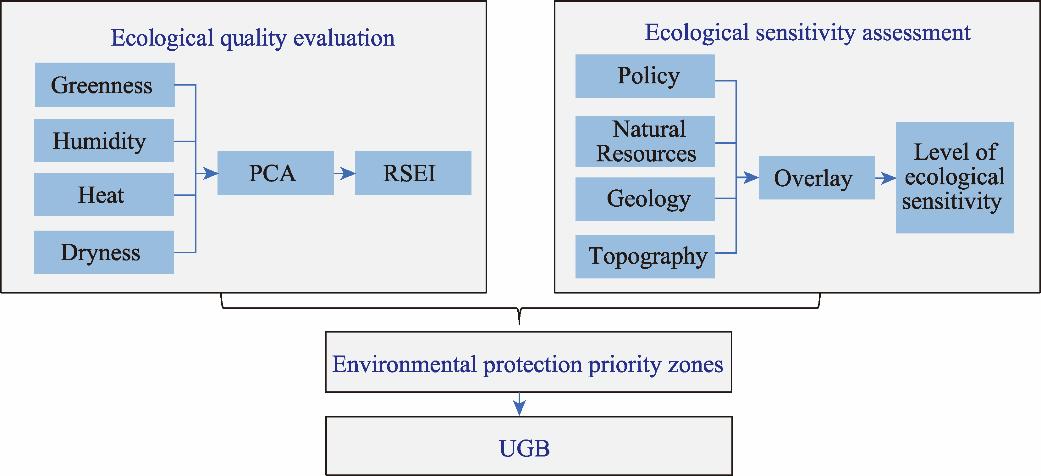
Environmental protection priority zones arise from a composite analysis combining ecological quality evaluation using RSEI and ecological sensitivity assessment. The results of these two analysis methods are then overlaid to create a priority map for ecological protection or UGB. The methodological flowchart is shown in Figure 1.
Fig. 1. Methodological flowchart used in this study. PCA, principal component analysis; RSEI, remote sensing ecological index; UGB, urban growth boundary.

2.3.1. Ecological quality evaluation using remote sensing ecological index (RSEI)

We used RSEI to assess a region’s environmental quality based on several parameters, including greenness measured by the normalized difference vegetation index (NDVI), humidity defined by the wetness index (WET), heat defined by land surface temperature (LST), and dryness defined by the normalized difference bare soil index (NDBSI) (Li et al., 2021; Yang and Su, 2023). NDBSI is a composite of soil index and index-based built-up index (Yang et al., 2021; Yang and Su, 2023).
NDVI is often used to measure vegetation growth and can directly describe a region’s ecological quality (Townshend and Justice, 1986; Li et al., 2021). The formula used to calculate NDVI is as follows:
NDVI = ρ NIR ρ RED ρ NIR + ρ RED ,
where ρNIR is the near-infrared band (band 5), with reflection spectral values from 0.85 to 0.88 μm; and ρRED is the red band (band 4), with reflection spectral values from 0.64 to 0.67 μm. The values of NDVI range from -1.000 to 1.000.
WET is an index that represents humidity. Low humidity indicates land degradation, low vegetation cover, and poor ecological conditions, whereas high humidity indicates adequate soil moisture, high surface vegetation cover, and good ecological conditions (Li et al., 2021). This study used WET to reflect moisture conditions by the following formula (Huang et al., 2002; Li et al., 2021):
WET OLI = 0.1511 ρ Blue + 0.1973 ρ Green + 0.3283 ρ Red 0.3407 ρ NIR 0.7117 ρ SWIR1 0.4559 ρ SWIR2 ,
where WETOLI represents the wetness; ρBlue is the blue band (band 2); ρGreen is the green band (band 3); ρSWIR1 is the shortwave infrared 1 (band 6); and ρSWIR2 is the shortwave infrared 2 (band 7).
LST represents an indicator of heat. It is closely related to vegetation growth, crop yields, surface water circulation, urbanization, other natural phenomena and processes, and human activities (Sobrino et al., 2004). LST is used as a heat index to reflect environmental conditions. The equtions used to calculate LST (°C) are written as follows (Li et al., 2021):
LST = T sensor 1 + λ T sensor ρ ln ε ,
ε = 0.995 ( NDVI 0.000 ) 0.970 ( 0.000 < NDVI 0.157 ) 0.986 ( NDVI > 0.727 ) 1.0094 + 0.047 ln NDVI ( 0.157 < NDVI 0.727 ) ,  
T sensor = K 2 ln K 1 L λ + 1 ,
L λ = G a i n × D N + B i a s ,
where Tsensor is the satellite brightness temperature (K); λ is the wavelength of emitted light (11.43 µm for band 6 of Landsat 5 and 10.90 µm for band 10 of Landsat 8); ρ is a constant (1.438×10⁻² mK); ε is the emissivity of the ground surface; K1 and K2 are the calibration parameters; Lλ is the sensor spectral radiance (W/(m2•nm•sr)); Gain and Bias are the values from metadata provided by Landsat imagery data; and DN represents the pixelized digital number.
Dryness is related to resistant drying, which can harm the environment. The dryness index is calculated by combining the soil index and index-based built-up index into a new index called NDBSI (Xu et al., 2018). The calculation of this index is as follows (Li et al., 2021):
IBI = 2 ρ SWIR1 ( ρ SWIR1 + ρ NIR ) 1 ρ NIR ( ρ Red + ρ NIR ) 1 ρ Green ( ρ SWIR1 + ρ Green ) 1 2 ρ SWIR1 ( ρ SWIR1 + ρ NIR ) 1 + ρ NIR ( ρ Red + ρ NIR ) 1 + ρ Green ( ρ SWIR1 + ρ Green ) 1 ,
SI = ρ SWIR 1 + ρ Red ρ NIR + ρ Blue ρ SWIR 1 + ρ Red + ρ NIR + ρ Blue ,
NBDSI = ( IBI + SI ) 2 ,
where IBI represent the index-based built-up index; and SI is the soil index.
After the four indicators (NDVI, WET, LST, and NDBSI) were obtained, the next step was to normalize each indicator’s value in a range of 0-1, where a value close to 0 indicates poor condition, whereas a value close to 1 indicates good condition (Das et al., 2023).
Positive parameter:  X i j i = X i j X j , min X j , max X j , min ,
Negative paremeter:  X i j i = X j , max X i j X j , max X j , min ,
where Xi ij is an original value of the pixel in area i; Xij is a standardized score; Xj,max is the highest pixel value; and Xj,min is the lowest pixel value.
The following step was conducting principal component analysis (PCA). In this study, we utilized geography-based PCA in ArcGIS software (version 10.8, ESRI, California, the United State). PCA is an effective tool for measuring the relationship between variables and reducing the dimensionality of the dataset (Kumari and Raman, 2022). It also helps to eliminate any impacts of collinearity between variables (Seddon et al., 2016). Although PCA has limitations, such as the requirement for uniform application (Wang et al., 2023), in the context of this study, it produced new orthogonal variables called principal components (PCs), which were then composited to construct the RSEI. We employed all PCs derived from PCA to calculate RSEI using the following formula (Das et al., 2023):
RSEI = r i 1 PC i 1 + r i 2 PC i 2 + r i 3 PC i 3 + . . . + r i n PC i n ,
where ri1, ri2, ri3, …, and rin are the contribution ratios of principal component (PC); and PCi1, PCi2, PCi3, …, and PCin are the raster files containing the PCs’ scores. Furthermore, normalization was conducted so that the PC values ranged from 0.00000 to 1.00000. Then the PC values were classified into five categories, including very poor (<0.20000), poor (0.20000-0.40000), average (0.40000-0.60000), good, (0.60000-0.80000), and very good (>0.80000) (Das et al., 2023).

2.3.2. Ecological sensitivity assessment

Ecological sensitivity is a method that simultaneously assesses environmental, social, and natural factors. The selection of indicators should consider comprehensiveness and facilitate visual interpretation (Sun et al., 2016). It also accurately represents the diverse characteristics of ecological subsystems. Additionally, the chosen indicators must reflect local conditions such as location, weather, and topography, which are typically measured using various spatial units (Kong et al., 2017).
According to national and regional regulations in Indonesia, rice fields, green open space, nature reserves, protected forests, riverbanks within 50 m, lake borders within 100 m, coastal lines within 100 m, and areas with slope gradients exceeding 40.00% must be protected and are not eligible for development. This study utilized these regulations to guide the weighting of variables (Table 2).
Table 2 Indicators, variables, and weights used for assessing ecological sensitivity.
Indicator Variable Ecological sensitivity level Data source
Non- ecological sensitivity Light ecological sensitivity Moderate ecological sensitivity High ecological sensitivity Very high ecological sensitivity
Policy Area of protected
rice fields
Rice fields (5) Regulation number 1589/SK-HK.02.01/XII/2021 issued by Ministry of Agrarian Affairs and Spatial Planning Republic of Indonesia (2021)
Area of green open
spaces
Green open
spaces (5)
Regulation number 1 of 2021 issued by Tegal City Government (2021)
Natural resources Forest areas Permanent production
forest
and limited
production
forest (4)
Nature reserves
and protected
forests (5)
Regulation number 6605/MEN LHK-PKTL/KUH/PLA.2/11/ 2019 issued by Ministry of Environment and Forestry Republic of Indonesia (2019)
Riverbanks Within a distance of 0-50 m (5) Regulation number 28/PRT/M/ 2015 issued by Ministry of Public Works and Housing Republic of Indonesia (2015)
Lake borders Within a distance of 0-100 m (5) Regulation number 28/PRT/M/ 2015 issued by Ministry of Public Works and Housing Republic of Indonesia (2015)
Coastal line Within a distance of 0-100 m (5) Regulation number 51 of 2016
issued by Presidential Regulation of the Republic of Indonesia (2016)
Geology Flood hazard Low with a score of 0.0-0.3 (2) Moderate with a score of 0.3-0.6 (3) High with a score of 0.6-1.0 (4) Indonesia’s National Board for Disaster Management (2024)
Volcanic eruption
hazard
Low with a score of 0.0-0.3 (2) Moderate with a score of 0.3-0.6 (3) High with a score of 0.6-1.0 (4) Indonesia’s National Board for Disaster Management (2024)
Landslide and soil
movement hazard
Low with a score of 0.0-0.3 (2) Moderate with a score of 0.3-0.6 (3) High with a score of 0.6-1.0 (4) Indonesia’s National Board for Disaster Management (2024)
Topography Slope 0.00%-
8.00% (1)
8.00%-
15.00% (2)
25.00%-
30.00% (3)
30.00%-
45.00% (4)
>45.00% (5) Rahmad et al. (2018)

Note: In the column of ecological sensitivity level, the value in parentheses represents the weight.

Ecological sensitivity assessment was based on identifying limiting factors, as demonstrated by Arsyad (2010). The overlay of variables was conducted to pinpoint the limiting factors for an area, where the variable with the greatest limiting factors determines the area’s ecological sensitivity level. Ecological sensitivity was categorized into five levels: non-ecological sensitivity, light ecological sensitivity, moderate ecological sensitivity, high ecological sensitivity, and very high ecological sensitivity. Non-ecological sensitivity is significantly impacted by human activities that may endure high-intensity development. Light ecological sensitivity is the area that faces less ecological pressure and can withstand substantial interference from human activities. However, the area easily causes problems such as soil erosion and ecosystem imbalance. Moderate ecological sensitivity is a sensitive buffer transition zone with relatively slow ecological restoration and limited tolerance to human disturbance. Therefore, the economic development projects in this zone need to be carried out in a planned manner. High ecological sensitivity covers the area with complex ecosystems, fragility, and low self-healing ability. This area has important ecological functions and should be managed as a secondary key protected area. Very high ecological sensitivity is the area with the highest ecological value and is also the most vulnerable and difficult to recover. In order to avoid irreversible environmental damage and value loss, this area will be designated as a key protected area (Xu et al., 2023).

2.3.3. Analysis of environmental protection priority zones

Environmental protection priority zones were identified by overlaying the result of RSEI with ecological sensitivity analysis. Previous studies have mapped environmental protection priority zones using RSEI to assess ecological quality and the analytical hierarchy process to assess ecological sensitivity (Yang et al., 2021; Feng et al., 2023). However, this study introduced a novel approach to measure ecological sensitivity by identifying limiting factors that were already incorporated in spatial planning and regulations. We then combined the results of RSEI and ecological sensitivity using a logical union method to determine environmental protection priority zones.
The areas with very good ecological quality or very high ecological sensitivity should be protected to prevent further urban expansion and designated as ecological preservation zones (Yang et al., 2021; Xu et al., 2023). Meanwhile, the areas with good ecological quality or high ecological sensitivity can allow urban development with limitations. These areas typically have better ecological features, such as vegetation cover, water bodies, and relatively low human pressure (Yang et al., 2021); the ecosystem conditions of these areas are complex and vulnerable, with low recovery capacities, yet the areas play a vital role in ecological functions (Xu et al., 2023). The remaining areas, falling into other categories, are more suitable for built-up land development and urban activities. The classification of environmental protection priority zones is shown in Table 3.
Table 3 Determination of environmental protection priority zones.
Classification First priority zone (ecological constraint zone) Second priority zone (conditional urban development zone) Third priority zone
(urban development zone)
Ecological evaluation based on remote sensing ecological index (RSEI) results Very good ecological quality Good ecological quality Average ecological quality, poor ecological quality, and very poor ecological quality
Ecological sensitivity assessment results Very high ecological sensitivity High ecological sensitivity Moderate ecological sensitivity, light ecological sensitivity, and non- ecological sensitivity

3. Results

3.1. Ecological quality evaluation

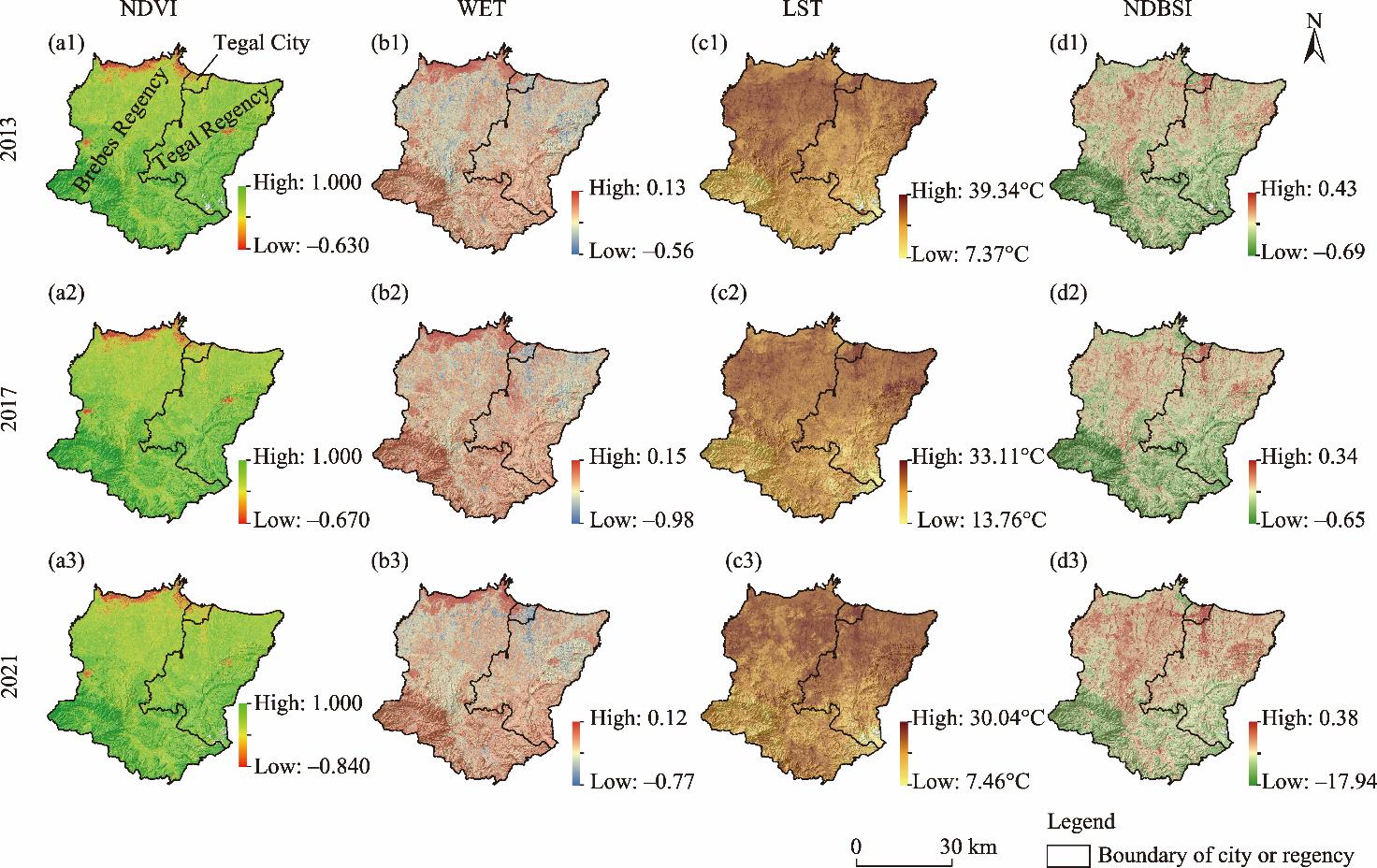
Figure 2 shows the spatial distributions of NDVI, WET, LST, and NDBSI in 2013, 2017, and 2021. Tegal Regency and southern Brebes Regency exhibited higher NDVI values, reaching up to 1.000. In contrast, lower NDVI values below 0.000 were predominantly observed in the northern regions of Brebes Regency, Tegal City, and Tegal Regency. Similarly, the WET values in the same years were higher in the northern regions of Brebes Regency, Tegal City, and Tegal Regency, and in the southern region of Brebes Regency. Tegal Regency and the central region of Brebes Regency displayed lower WET values.
Fig. 2. Spatial distributions of ecological evaluation indicators in 2013, 2017, and 2021. (a1-a3), normalized difference vegetation index (NDVI); (b1-b3), wetness index (WET); (c1-c3), land surface temperature (LST); (d1-d3), normalized difference bare soil index (NDBSI).
Based on LST analysis, Tegal City, Tegal Regency, and Brebes Regency experienced a decline in their maximum temperature from 2013 to 2021. The highest LST value recorded in 2013 was 39.34°C. In 2017, LST reached 33.11°C, whereas in 2021, it decreased to 30.04°C. Although the highest LST decreased over time, the area with high temperatures continued to expand from 2013 to 2021 (Fig. 2). The results of the dryness index analysis, represented by NDBSI in 2013, 2017, and 2021, showed that the areas with high dryness index values continued to expand each year. Higher dryness index values became dominant in Tegal City and the central regions of Tegal Regency and Brebes Regency.
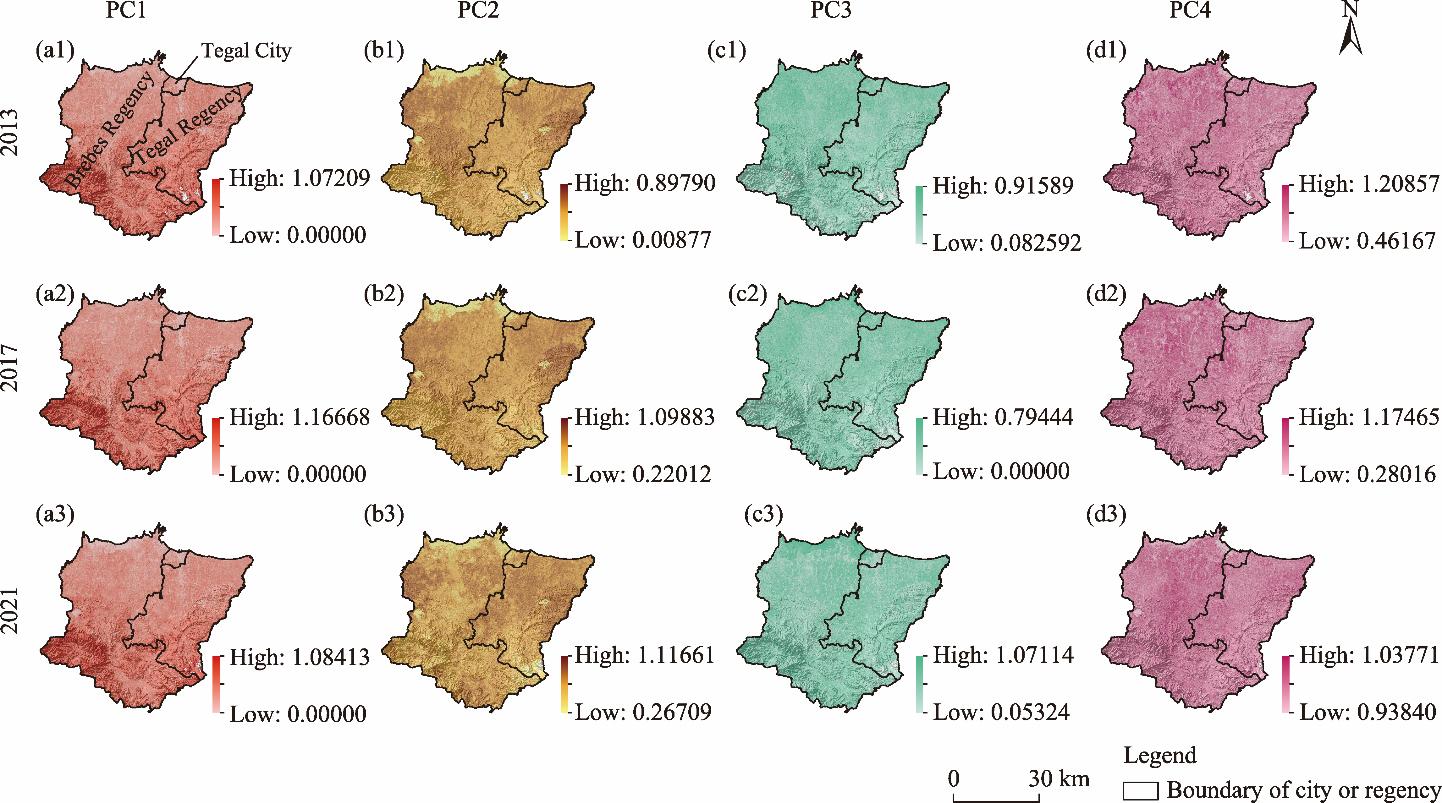
The PCA results in 2013, 2017, and 2021 indicated that PC1 (the first principal component) and PC2 (the second principal component) accounted for more than 90.00% of the variance, whereas PC3 (the third principal component) and PC4 (the fourth principal component) contributed less than 10.00%. Table 4 shows the correlation between the PCs (PC1, PC2, PC3, and PC4) and original RSEI variables, where a higher value indicates a stronger correlation. PC1 represented good-quality greenness, as increasing NDVI—correlated most strongly with PC1—was accompanied by increasing humidity and decreasing temperature and dryness. In contrast, PC2 represented low-quality greenness, with NDVI showing the highest correlation with PC2 in 2013 and 2017 and the second-highest correlation in 2021, followed by decreasing humidity, rising temperature, and dryness. PC3 represented temperature in 2013 and 2017 but shifted to represent humidity in 2021. Similarly, PC4 represented humidity in 2013 and 2017 but shifted to represent dryness in 2021. This shift in the variables’ correlation with PC3 and PC4 shows that temperature-related issues in 2013 and 2017 evolved into humidity and dryness concerns in 2021, indicating a growing tendency for ecological issues in this study area. The distribution pattern of PC1 and PC2, as revealed by the PCA results, indicates that high-quality NDVI (PC1) was primarily concentrated in the southern region, whereas poor-quality NDVI (PC2) was predominantly observed in the northern region. The distribution of PC3 and PC4 was less consistent over the years, likely owing to the minor contribution of these variables to the model (Fig. 3).
Table 4 Correlation between principal components and original RSEI variables.
Year Indicator PC1 PC2 PC3 PC4
2013 NDVI 0.70495 0.67911 0.00771 0.20442
WET 0.17190 -0.42692 0.35910 0.81193
LST -0.39045 0.41461 0.81965 -0.06184
NDBSI -0.56661 0.42970 -0.44628 0.54328
Eigenvalue 0.01472 0.00463 0.00154 0.00037
Contribution rate (%) 69.22 21.77 7.26 1.73
2017 NDVI 0.61882 0.77001 -0.10776 0.11191
WET 0.10345 -0.19069 0.21934 0.95122
LST -0.47513 0.48719 0.73247 -0.01956
NDBSI -0.61694 0.36519 -0.63542 0.28683
Eigenvalue 0.01742 0.00447 0.00180 0.00020
Contribution rate (%) 72.89 18.72 7.51 0.85
2021 NDVI 0.74901 0.66139 0.03352 0.02059
WET 0.12055 -0.18854 0.97036 0.09123
LST -0.65073 0.72590 0.22261 -0.00778
NDBSI -0.03162 0.00927 -0.08787 0.99559
Eigenvalue 0.01078 0.00380 0.00087 0.00000
Contribution rate (%) 69.74 24.60 5.62 0.02

Note: PC1, the first principal component; PC2, the second principal component; PC3, the third principal component; PC4, the fourth principal component; NDVI, normalized difference vegetation index; WET, wetness index; LST, land surface temperature; NDBSI, normalized difference bare soil index.

Fig. 3. Spatial distributions of PC1 (a1-a3), PC2 (b1-b3), PC3 (c1-c3), and PC4 (d1-d3) in 2013, 2017, and 2021. PC1, the first principal component; PC2, the second principal component; PC3, the third principal component; PC4, the fourth principal component.
The results indicate that the study area was predominantly in the good ecological quality. However, in 2017, the average ecological quality became the most dominant. The very poor ecological quality showed a general trend of decline, although a slight increase was observed from 2017 to 2021. The study area experienced fluctuations in the poor ecological quality and average ecological quality but exhibited a decreasing trend from 2013 to 2021. Conversely, the areas with good ecological quality expanded despite a reduction in 2017. Furthermore, the very good ecological quality showed an expansion trend from 2013 to 2021. Overall, ecological quality improved, advancing toward the good ecological quality and very good ecological quality from 2013 to 2021 (Table 5). Table 5 also details each region’s ecological quality. In 2013, Tegal City predominantly fell into the average ecological quality, accounting for 50.31% of the total area, which increased to 67.33% by 2021. The area proportions of good ecological quality and very good ecological quality also rose, albeit marginally. In Brebes Regency, the regions with good ecological quality covered the largest area, amounting 82,224.69 hm2 or 47.16% of the total area in 2013, which increased to 99,726.02 hm2 or 57.19% of the total area in 2021. In Tegal Regency, the majority of the area fell within good ecological quality, from 55,133.28 hm2 or 56.02% of the total area in 2013, to 68,846.07 hm2 or 70.00% of the total area in 2021.
Table 5 Ecological evaluation results using RSEI in 2013, 2017, and 2021.
Region Category of ecological quality index Area (hm2)
2013 2017 2021
Whole study area Very poor ecological quality 1175.85 332.27 471.59
Poor ecological quality 13,066.90 22,256.58 5233.41
Average ecological quality 101,050.70 115,041.58 53,772.58
Good ecological quality 137,357.97 114,732.69 168,572.09
Very good ecological quality 20,128.74 20,417.05 44,730.50
Tegal City Very poor ecological quality 9.38 48.20 1.41
Poor ecological quality 1313.42 1842.18 429.05
Average ecological quality 1966.43 1538.99 2631.43
Good ecological quality 619.15 476.13 846.15
Very good ecological quality 0.16 3.02 0.49
Brebes Regency Very poor ecological quality 1164.95 273.58 471.49
Poor ecological quality 10,080.52 14,594.61 4809.04
Average ecological quality 64,831.65 71,186.74 34,722.44
Good ecological quality 82,224.69 71,576.72 99,726.02
Very good ecological quality 16,065.98 16,736.14 34,638.79
Tegal Regency Very poor ecological quality 10.90 58.70 0.10
Poor ecological quality 2986.37 7661.97 424.37
Average ecological quality 36,219.06 43,854.84 19,050.14
Good ecological quality 55,133.28 43,155.96 68,846.07
Very good ecological quality 4062.76 3680.91 10,091.70
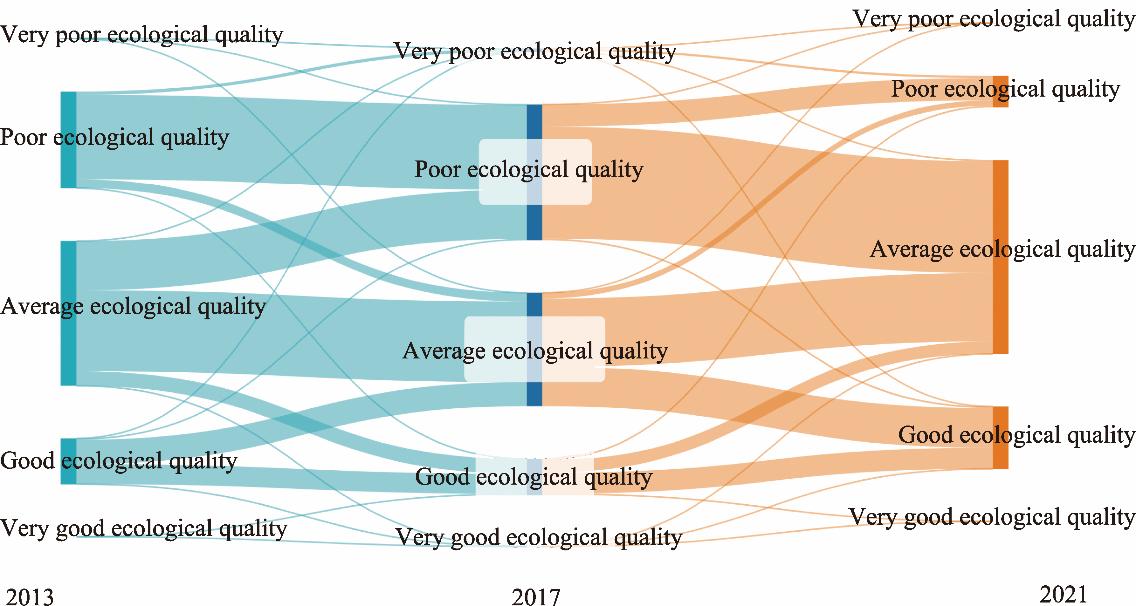
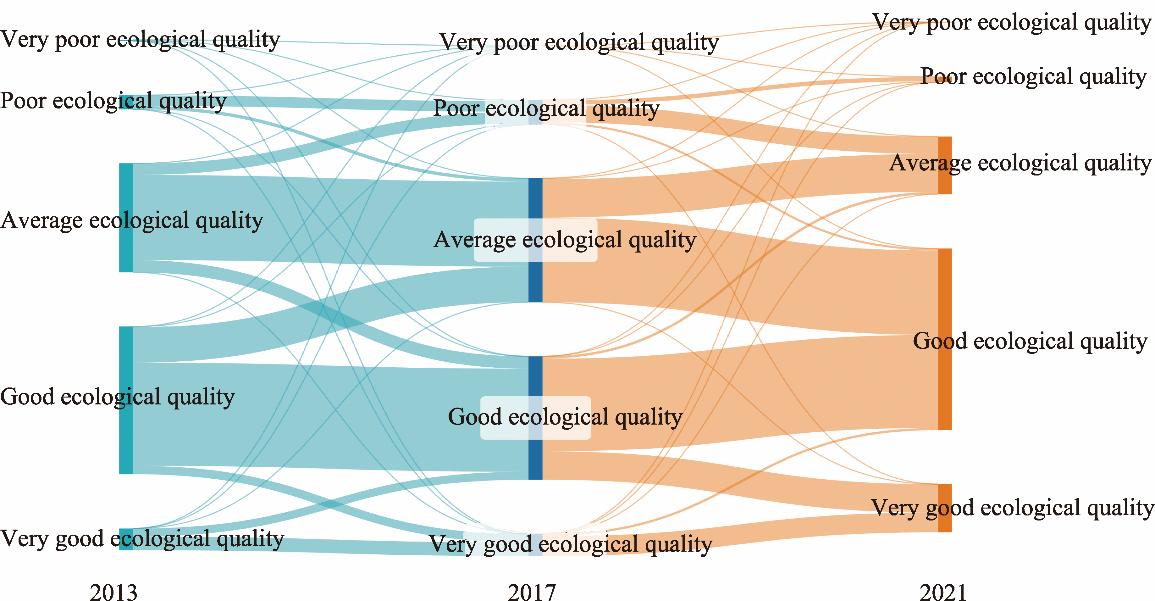
Changes in ecological quality from 2013 to 2021 in Tegal City are illustrated in Figure 4. The increase in poor ecological quality in 2017 originated from the average ecological quality in 2013. While some areas within average ecological quality remained stable from 2013 to 2017, other areas that were in good ecological quality in 2013 deteriorated to average ecological quality by 2017. Fortunately, some regions in poor ecological quality improved to average ecological quality, and some in average ecological quality advanced to good ecological quality from 2017 to 2021. Thus, the overall ecological quality in Tegal City improved from 2013 to 2021.
Fig. 4. Changes in ecological quality from 2013 to 2021 in Tegal City.
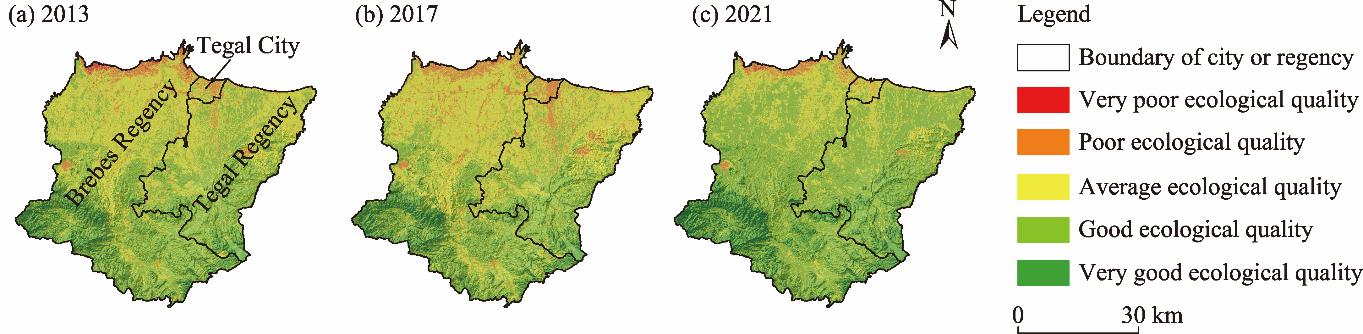
In Brebes and Tegal regencies, a decline was observed in the area with good ecological quality, which transitioned into the average ecological quality from 2013 to 2017, making the average ecological quality the dominant category in 2017. The other categories remained relatively stable during this period. Interestingly, the area within good ecological quality expanded by 2021, establishing it as the predominant category. Additionally, some areas classified as good ecological quality in 2017 advanced to very good ecological quality by 2021. This detailed information is depicted in Figure 5. Figure 6 shows the spatial distributions of all ecological quality categories over time in the study area. In 2013, the areas with very good ecological quality and good ecological quality were distributed in the southern part of the study area, especially in Brebes Regency and Tegal Regency. It is similar to the situation in 2017, that is the spatial distributions of good ecological quality and very good ecological quality were concentrated in the southern regions. In 2021, ecological quality in good and very good categories spread towards the center of Brebes Regency and Tegal Regency. Many regions in 2013 and 2017 had an average ecological quality, then improved to good ecological quality and very good ecological quality in 2021. Meanwhile, from 2013 to 2021, regions with very poor ecological quality and poor ecological quality were mainly scattered in Tegal City and the coastal region of Brebes Regency.
Fig. 5. Changes in ecological quality from 2013 to 2021 in Brebes and Tegal regencies.
Fig. 6. Spatial distributions of different categories of ecological quality index in 2013 (a), 2017 (b), and 2021 (c).

3.2. Ecological sensitivity analysis results

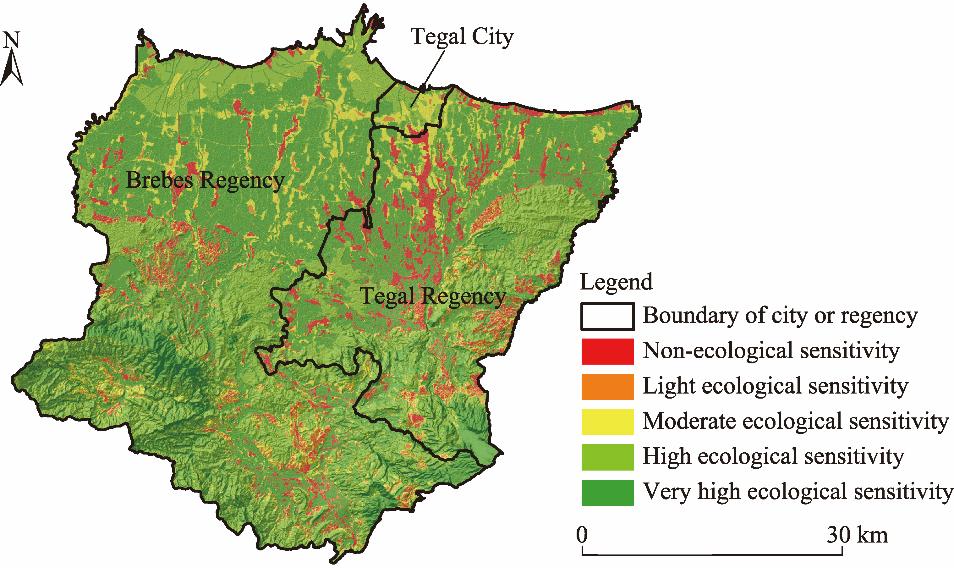
According to the results of ecological sensitivity assessment, Tegal City predominantly fell into high ecological sensitivity level, encompassing 32.79% of its total area. Only 5.66% of the city was categorized as non-ecological sensitivity. Conversely, Brebes and Tegal regencies were primarily categorized as very high ecological sensitivity and high ecological sensitivity, collectively accounting for over 70.00% of their total area. The area proportions of non-ecological sensitivity in Brebes and Tegal regencies were just 4.68% and 11.90%, respectively. Table 6 shows more detailed information on the area within each ecological sensitivity level and its spatial distribution. Figure 7 indicates that the areas with high ecological sensitivity and very high ecological sensitivity were randomly distributed. The most dominant distribution of both categories was located in the southern and central parts of Tegal and Brebes regencies. The central part of Brebes and Tegal regencies was very sensitive because these areas are dominated by rice fields that should be protected. While in the southern part, many steep slopes and protected forest areas existed. The areas with non-ecological sensitivity and light ecological sensitivity were dominantly distributed in Tegal City, northern regions of Tegal Regency, and northern regions of Brebes Regency. These areas are urban areas and activity centers of the study area.
Table 6 Ecological sensitivity analysis results.
Ecological sensitivity level Brebes Regency Tegal City Tegal Regency
Area (hm2) Percentage
in the total area (%)
Area (hm2) Percentage
in the total area (%)
Area (hm2) Percentage
in the total area (%)
Very high ecological sensitivity 84,068.04 48.21 1070.00 27.38 45,922.62 46.66
High ecological sensitivity 60,318.82 34.59 1281.41 32.79 28,425.61 28.88
Moderate ecological sensitivity 16,260.66 9.33 1249.94 31.98 8439.45 8.58
Light ecological sensitivity 5564.77 3.19 85.80 2.20 3916.39 3.98
Non-ecological sensitivity 8155.52 4.68 221.37 5.66 11,708.31 11.90
Total 174,367.79 100.00 3908.53 100.00 98,412.38 100.00
Fig. 7. Spatial distribution of ecological sensitivity in the study area.

3.3. Different environmental protection priority zones

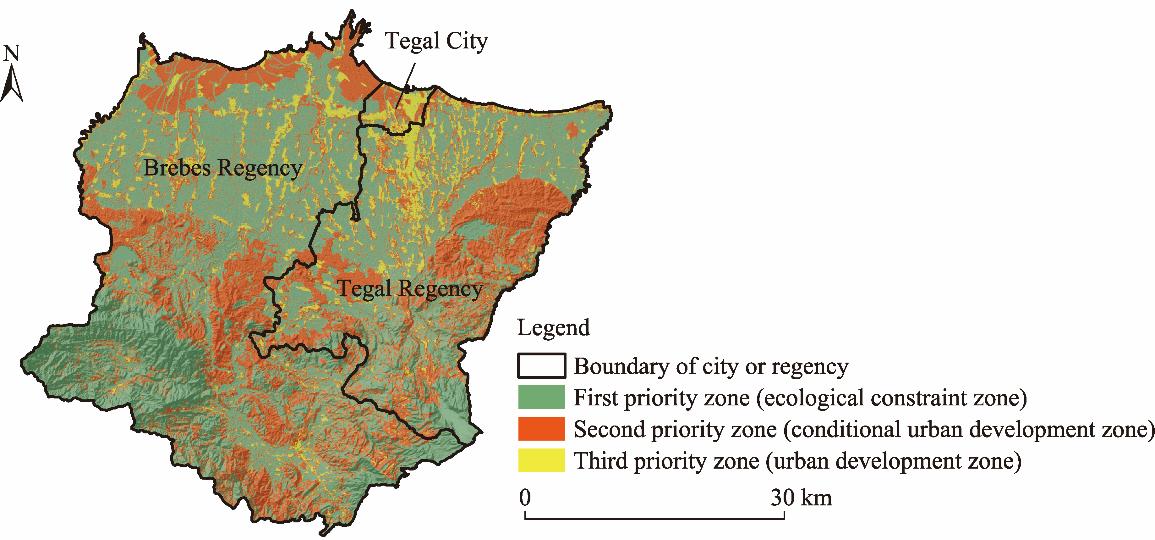
The results show that ecological quality in Tegal and Brebes regencies was predominantly categorized as good ecological quality and very good ecological quality, in contrast to the moderate ecological quality and poor ecological quality observed in Tegal City. Furthermore, over 45.00% of the areas in Tegal and Brebes regencies exhibited very high ecological quality. This indicates that Tegal and Brebes regencies, being peri-urban areas of Tegal City, play a crucial role in maintaining the region’s environmental health. These ecosystems are essential for delivering ecosystem services to the study area and, in particular, to the core urban area. Based on the ecological quality and sensitivity analysis results, we classified the study area into three classes of environmental protection priority zones (Table 7; Fig. 8). The first priority zone (ecological constraint zone) covered 1070.01 hm2 or 27.38% of the area of Tegal City, 107,677.67 hm2 or 61.73% of the area of Brebes Regency, and 52,355.96 hm2 or 53.20% of the area of Tegal Regency. This zone can be proposed as a basis for delineating UGB. Subsequently, the second priority zone (conditional urban development zone) covered 1468.47 hm2 or 37.57% of Tegal City, 56,293.57 hm2 or 32.28% of Brebes Regency, and 36,549.42 hm2 or 37.14% of Tegal Regency. This zone permits urban development but with certain restrictions to preserve environmental quality. Last, the third priority zone (urban development zone) included 1370.05 hm2 or 35.05% of Tegal City, 10,429.55 hm2 or 5.98% of Brebes Regency, and 9507.00 hm2 or 9.66% of Tegal Regency; it is designated for further urban development. Figure 8 shows that the first priority zone (ecological constraint zone) was predominantly distributed in the central and southern regions of Brebes Regency and the central region of Tegal Regency. In contrast, Tegal City was dominated by the third priority zone (urban development zone). The second priority zone (conditional urban development zone) was predominantly distributed in coastal region of Brebes Regency and mountainous areas in the southern part of Brebes Regency and in the east of Tegal Regency. The third priority zone (urban development zone) was more spread compared to the first and second priority zones. This zone was dominantly found in Tegal City and in the middle region of Tegal Regency and the northern region of Brebes Regency.
Table 7 Area and percentage of ecological constraint zone, conditional urban development zone, and urban development zone in Tegal City, Brebes Regency, and Tegal Regency.
Environmental protection priority zone Tegal City Brebes Regency Tegal Regency
Area (hm2) Percentage in the total area (%) Area (hm2) Percentage in the total area (%) Area (hm2) Percentage in
the total area (%)
First priority zone (ecological constraint zone) 1070.01 27.38 107,644.67 61.73 52,355.96 53.20
Second priority zone (conditional urban development zone) 1468.47 37.57 56,293.57 32.28 36,549.42 37.14
Third priority zone (urban development zone) 1370.05 35.05 10,429.55 5.98 9507.00 9.66
Total 3908.53 100.00 174,367.79 100.00 98,412.38 100.00
Fig. 8. Spatial distribution of different environmental protection priority zones in this study area.

4. Discussion

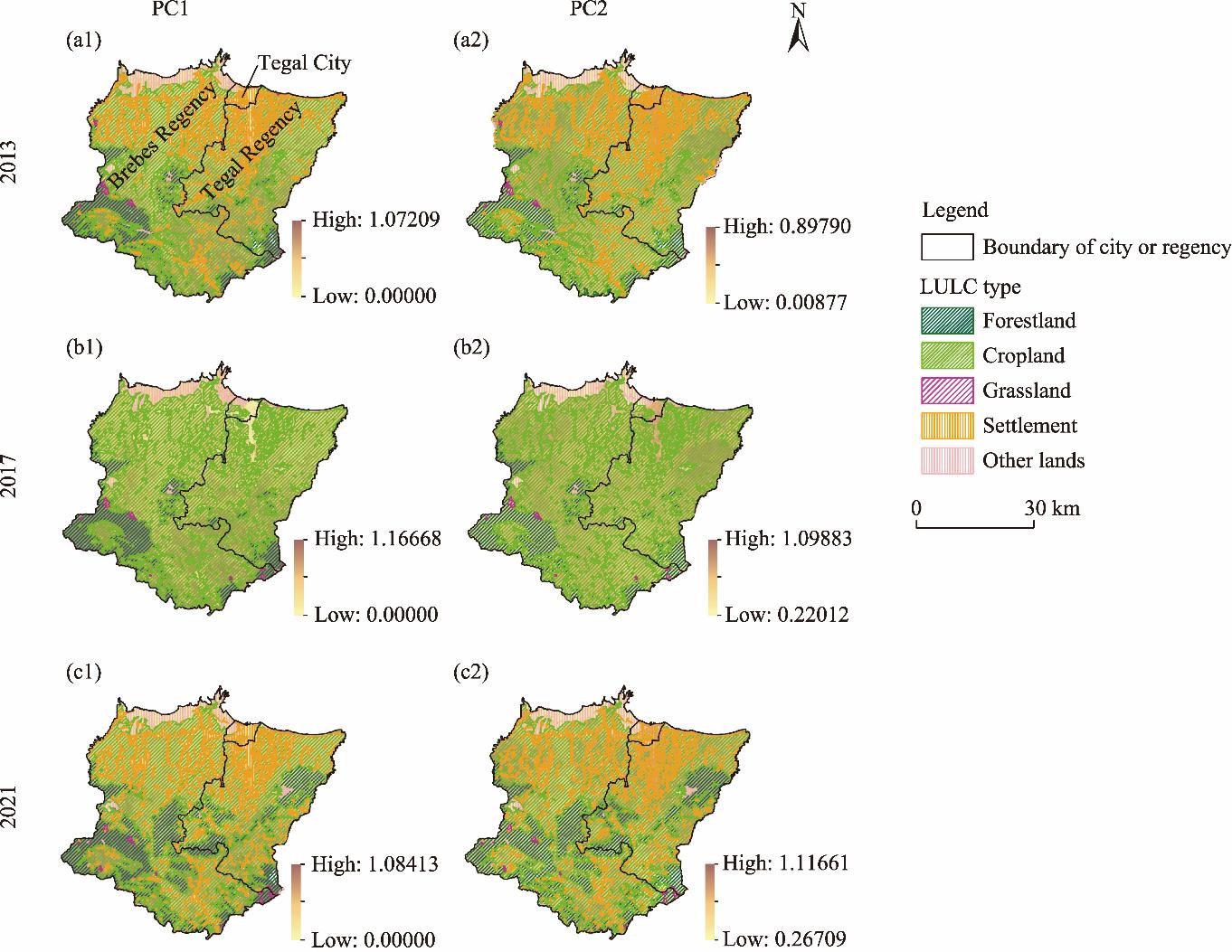
Environmental protection priority zones were built on the basis of ecological quality and ecological sensitivity. Ecological quality indicates the performance of ecosystem services in terms of greenness, humidity, heat, and dryness, while ecological sensitivity represents different aspects of policy, natural resources, geology, and topography. Ecological quality and ecological sensitivity are crucial to maintaining ecosystem services and delineating UGB to limit urban sprawl (Yang et al., 2021). Ecological quality evaluation, based on RSEI results, shows a declining trend from 2013 to 2017, followed by an improvement from 2017 to 2021. The PCA results elucidate this trend through the values of PC1 and PC2, which account for over 90.00% of the variance. PC1 indicates high-quality greenness, characterized by increased humidity and reduced temperature and dryness, typically found in forest lands. In contrast, PC2 denotes low-quality greenness, where green spaces decrease humidity, and increase temperature and dryness, commonly observed in fragmented cropland mixed with settlements (Fig. 9). The decline in ecological quality between 2013 and 2017 was primarily attributed to the fragmentation or mixing of agricultural land and built-up area. According to Yang and Su (2023), the expansion of built-up area typically leads to reduced environmental quality. Similarly, agricultural land—especially in monoculture farming—can increase temperature and decrease humidity (Lago-Olveira et al., 2024). Additionally, the El Niño phenomenon in 2017 exacerbated Indonesia’s prolonged dry season (Yuniasih et al., 2023), further diminishing the effects of high-quality greenness and contributing to the overall decline in ecological quality. However, from 2017 to 2021, ecological quality improved, partly owing to reforestation initiatives in 2021 (Fig. 9), which helped reduce emissions (Basuki et al., 2022). The La Niña phenomenon in 2021 also extended the wet season, resulting in lower maximum temperature (Yuniasih et al., 2023). These factors collectively enhanced the value of high-quality greenness, thereby improving ecological quality.
Fig. 9. Spatial distributions of land use and land cover (LULC) types overlapping with PC1 and PC2 in 2013 (a1 and a2), 2017 (b1 and b2), and 2021 (c1 and c2).
The ecological sensitivity analysis revealed that the peri-urban areas of Brebes and Tegal regencies exhibit a markedly higher level of ecological sensitivity compared to Tegal City. This observation contrasts with the typical lower sensitivity in peri-urban areas of large urban or metropolitan regions (Chen et al., 2022). Tegal and Brebes regencies host diverse ecosystems, including forests, rivers and lakes, rice fields, etc., all contributing to their heightened ecological sensitivity. According to Liu et al. (2023), the areas with high ecological sensitivity are often concentrated in forest regions with varied topographic reliefs.
The results of RSEI and ecological sensitivity assessments were integrated to define the environmental protection priority zones in the study area. These combined results delineated the ecological constraint zone, conditional urban development zone, and urban development zone as the first, second, and third priority zones for environmental protection, respectively. The ecological constraint zone, characterized by very good ecological quality or very high ecological sensitivity, necessitates protection from urban development pressures and should be designated as a protection area (Yang et al., 2021; Xu et al., 2023). The areas with very good ecological quality were identified by their highly functional ecosystems, robust vegetation, and relatively low human impact (Yang et al., 2021). Meanwhile, the areas with high ecological sensitivity included conservation forests, riparian zones, lake and beach shorelines, designated green open spaces, steep topographies, and protected rice fields. The conditional urban development zone, with good ecological quality or high ecological sensitivity, is characterized by relatively robust ecosystem services, adequate ecological space, vegetation cover, water bodies, and low human pressure (Yang et al., 2021). The ecological sensitivity analysis revealed that the peri-urban areas of Brebes and Tegal regencies exhibit a markedly higher level of ecological sensitivity compared to Tegal City. This observation contrasts with the typical lower sensitivity in peri-urban areas of large urban or metropolitan regions (Chen et al., 2022). Tegal and Brebes regencies host diverse ecosystems, including forests, rivers and lakes, rice fields, etc., all contributing to their heightened ecological sensitivity. According to Liu et al. (2023), the areas with high ecological sensitivity are often concentrated in forest regions with varied topographic reliefs.
The results of RSEI and ecological sensitivity assessments were integrated to define the environmental protection priority zones in the study area. These combined results delineated the ecological constraint zone, conditional urban development zone, and urban development zone as the first, second, and third priority zones for environmental protection, respectively. The ecological constraint zone, characterized by very good ecological quality or very high ecological sensitivity, necessitates protection from urban development pressures and should be designated as a protection area (Yang et al., 2021; Xu et al., 2023). The areas with very good ecological quality are identified by their highly functional ecosystems, robust vegetation, and relatively low human impact (Yang et al., 2021). Meanwhile, the areas with high ecological sensitivity include conservation forests, riparian zones, lake and beach shorelines, designated green open spaces, steep topographies, and protected rice fields. The conditional urban development zone, with good ecological quality or high ecological sensitivity, is characterized by relatively robust ecosystem services, adequate ecological space, vegetation cover, water bodies, and low human pressure (Yang et al., 2021). This zone’s sensitivity is due to its inclusion of production forests, areas prone to high disaster risk, and steep slopes. Conversely, the urban development zone encompasses areas with average ecological quality, poor ecological quality, and very poor ecological quality or moderate ecological sensitivity, light ecological sensitivity, and non-ecological sensitivity. This zone demonstrates low to moderate ecosystem service performance, sparse vegetation cover, and mild to significant urban heat island effects (Yang et al., 2021). Additionally, this zone is distinguished by its relatively flat and gentle topography, which poses low to moderate disaster vulnerability.
The ecological constraint zone is predominantly located in Tegal and Brebes regencies, covering more than 50.00% of the total area, whereas Tegal City accounts for approximately 27.38% of this zone. Overall, the first priority protection area constitutes 58.21% of the study area. Research by Liu et al. (2023) in the Shenzhen Metropolitan Area of China identified 27.38% of the region as part of the ecological resources zone, highlighting its fragility and the need for protection. However, the contrast between Tegal City and its peri-urban regions and larger metropolitan areas is notable. In Tegal City and its surroundings, over 50.00% of the area falls within the ecological constraint zone, compared to a typically smaller percentage in metropolitan areas. Tegal City and its surroundings underscore the role of small- and medium-sized cities as critical ecological resource areas that require conservation and restoration efforts (Chen et al., 2024). Thus, the future development of these cities must strike a balance between economic growth and environmental protection to foster sustainable development (Gao et al., 2021). Research conducted by Mardiansjah (2020) has indicated that Tegal City and Tegal Regency exhibit urban agglomeration extending up to 60 km from the city center, with projections suggesting that they will evolve into metropolitan areas in the future (Wirawan and Tambunan, 2018). From 2013 to 2021, substantial demographic and urban developments occurred in these regions. The urban population of Tegal City increased from 1,920,001 inhabitants in 2013 to 2,556,992 inhabitants in 2021, reflecting an annual growth rate of approximately 33.18%. Concurrently, built-up area expanded from 58,844.74 hm2 in 2013 to 70,435.03 hm2 in 2021, marking an expansion rate of 18.67%. This trend underscores future challenges in Tegal City and its surroundings, including population growth and land use changes that could adversely affect ecological conditions. Urban expansion impacts environmental and ecosystem sustainability, notably increasing LST as natural surfaces are replaced by heat-absorbing urban materials (Redman and Jones, 2005; Yuan et al., 2022). A similar study shows that urban sprawl leads to habitat quality degradation and landscape fragmentation (Chen et al., 2024). Strategies to mitigate these challenges include designing UGB to curb urban sprawl in small- and medium-sized cities. UGB effectively controls urban expansion (Bell and Jayne, 2009) and encourages the development of compact cities (Shawly, 2022).
UGB is not only physical spaces but dividing lines drawn around urban areas to separate them from rural areas (Shore, 2020). UGB delineates urban from non-urban areas, while protecting regions with high environmental sustainability and ecological sensitivity (Yang et al., 2021; Chen et al., 2023). Our findings suggest that the ecological constraint zone, characterized by very good ecological quality and high ecological sensitivity, can be used as a foundation for UGB delineation. The conditional urban development zone could then be developed into urban green spaces, significantly contributing to urban life quality through ecosystem services (Richards and Thompson, 2019).
UGB initiative also promotes compact city concepts characterized by intensive land use, centralized activities, and high density. Bin Sulaiman (2023) further describes compact cities as high-density, mixed-use areas optimized for public transport efficiency and conducive to cycling and walking. This concept is crucial to managing urban sprawl that threatens urban environmental capacity, and directing future development toward vertical construction and enhanced public transport systems. The concept of compact city can be applied in the priority zone of urban development, which is safe regarding biophysical, disaster, and natural resources. Countries like China have integrated urban planning tools such as UGB, ecological red lines, and permanent prime farmland into their spatial planning to protect ecologically vulnerable areas from urban encroachment (Liu and Zhou, 2021). Effective spatial planning is crucial for implementing UGB and the concept of compact city (Zhang et al., 2022a). In Indonesia, the successful implementation of UGB should be supported by national and regional policies, including national spatial plans and local zoning regulations.

5. Conclusions

This study was conducted to identify environmental protection priority zones in small- and medium-sized cities such as Tegal City and its surrounding areas (including Tegal and Brebes regencies in Indonesia), which have experienced rapid urbanization. The evaluation combined RSEI and ecological sensitivity analysis to identify environmental protection priority zones in the study area. The main findings are as follows: (1) Tegal City and its surrounding areas showed improvements in ecological quality from 2013 to 2021; (2) Tegal and Brebes regencies exhibited higher ecological sensitivity compared to Tegal City; (3) the ecological constraint zone can serve as a basis for delineating UGB; (4) the conditional urban development zone can serve as a foundation for developing urban green spaces; and (5) the urban development zone can be recommended to support the formation of a compact city.
Using the analysis of environmental protection priority zone to delineate and design UGB is crucial for not only restricting urban sprawl but also providing ecosystem services. UGB can enhance greenness and humidity while reducing temperature and dryness. Additionally, UGB can mitigate environmental risks—particularly in natural disaster prevention and food security enhancement—as ecological sensitivity is taken into account. Understanding the benefits of UGB will improve stakeholder awareness and commitment to developing UGB to maintain urban amenities and sustainability. This study also offers a measurable approach for delineating UGB, assisting urban planners in making informed spatial planning decisions. We recommend the integration of the UGB concept into national policies, such as national spatial planning and national urban policies, as well as regional policies, including urban and regional spatial planning. The results of this study can serve as a reference for developing countries, particularly in Asia, where economic development and urbanization are advancing rapidly and concurrently. However, this study has some limitations, including (1) the limited use of Landsat 8 OLI satellite imagery, which covers only the period from 2013 to 2021; (2) the assumption that ecological quality and ecological sensitivity are equally essential in determining environmental protection priority zones; and (3) the lack of consideration for potential future development scenarios of the study area. Future research could explore dynamic scenarios of urban development and their impacts on UGB planning.

Authorship contribution statement

Rizal IMANA: conceptualization, data curation, methodology, writing - original draft, and writing - review & editing; Andrea Emma PRAVITASARI: conceptualization, methodology, and writing - review & editing; and Didit Okta PRIBADI: conceptualization, methodology, and writing - review & editing. All authors approved the manuscript.

Declaration of conflict of interest

The authors declare that they have no known competing financial interests or personal relationships that could have appeared to influence the work reported in this paper.

This study is part of the research umbrella entitled “Spatial Quantitative Zoning and Regional Development Model Based on Environmental Carrying Capacity to Achieve Sustainable Spatial Planning for Jawa-Bali Island”, which is funded by the Directorate of Research and Community Service, Ministry of Education, Culture, Research, and Technology, Indonesia (027/E5/PG.02.00.PL/2024). We would like to express our deepest gratitude to Bogor Agricultural University for their invaluable support and resources that made this research possible, and we are also profoundly thankful to the Directorate of Research and Community Service, Ministry of Education, Culture, Research, and Technology, Indonesia, for their financial and administrative support.

[1]
Andari, M.T., Pravitasari, A.E., Anwar, S., 2022. Urban sprawl analysis as a recommendation for spatial utilization control for agricultural land development in Karawang Regency. Journal of Regional and Rural Development Planning. 6(1), 74-88.

[2]
Arsyad, S., 2010. Soil and Water Conservation. Bogor: IPB Press.

[3]
Bakshi, A., Esraz-Ul-Zannat, M., 2023. Application of delineation based on a neural network approach and landscape metrics for Khulna City, Bangladesh. Heliyon. 9, e16272, doi: 10.1016/j.heliyon.2023.e16272.

[4]
Basuki, I., Adinugroho, W.C., Utomo, N.A., et al., 2022. Reforestation opportunities in Indonesia: Mitigating climate change and achieving sustainable development goals. Forests. 13(3), 447, doi: 10.3390/f13030447.

[5]
Bell, D., Jayne, M., 2009. Small cities? Towards a research agenda. Int J. Urban Reg. Res. 33(3), 683-699.

[6]
Bin Sulaiman, F., 2023. Compact city: What is the extent of our exploration for its meanings? A systematic review. Sustainability. 15(13), 10302, doi: 10.3390/su151310302.

[7]
Chen, D., Liu, R.R., Zhou, M.X., 2023. Delineation of urban growth boundary based on habitat quality and carbon storage: A case study of Weiyuan County in Gansu, China. Land. 12(5), 1006, doi: 10.3390/land12051006.

[8]
Chen, J., Wang, S.S., Zou, Y.T., 2022. Construction of an ecological security pattern based on ecosystem sensitivity and the importance of ecological services: A case study of the Guanzhong Plain urban agglomeration, China. Ecol. Indic. 136, 108688, doi: 10.1016/j.ecolind.2022.108688.

[9]
Chen, J.Y., Xue, J.F., Gu, K., et al., 2024. Balancing urban expansion with ecological integrity: An ESP framework for rapidly urbanizing small and medium-sized cities, with insights from Suizhou, China. Ecol. Inform. 80, 102508, doi: 10.1016/j.ecoinf.2024.102508.

[10]
Dadi, W., Mulugeta, M., Semie, N., 2024. Impact of urbanization on the welfare of farm households: Evidence from Adama Rural District in Oromia regional state, Ethiopia. Heliyon. 10(1), e23802, doi: 10.1016/j.heliyon.2023.e23802.

[11]
Das, M., Das, A., Pereira, P., 2023. Developing an integrated urban ecological efficiency framework for spatial ecological planning: A case on a tropical mega metropolitan area of the global south. Geosci. Front. 14(1), 101489, doi: 10.1016/j.gsf.2022.101489.

[12]
Earth Resources Observation and Science (EROS) Center, 2018. USGS EROS Archive - Digital Elevation - Shuttle Radar Topography Mission (SRTM). [2024-05-03]. https://www.usgs.gov/centers/eros/science/usgs-eros-archive-digital-elevation-shuttle-radar-topography-mission-srtm

[13]
Fahmi, F.Z., Hudalah, D., Rahayu, P., et al., 2014. Extended urbanization in small and medium-sized cities: The case of Cirebon, Indonesia. Habitat Int. 42, 1-10.

[14]
Feng, H.D., Zhang, X.G., Nan, Y., et al., 2023. Ecological sensitivity assessment and spatial pattern analysis of land resources in Tumen River Basin, China. Appl. Sci. 15, 4197, doi: 10.3390/app13074197.

[15]
Fitri, T.Y., Adiwibowo, S., Pravitasari, A.E., 2022. The impact of land-use changes and economic losses of paddy field conversion: A case study of Ciampea Sub-district, Bogor Regency, West Java Province. In: The 2nd International Seminar on Natural Resources and Environmental Management. IOP Conference Series: Earth and Environmental Science. 012104, doi: 10.1088/1755-1315/950/1/012104.

[16]
Fuadina, L.N., Rustiadi, E., Pravitasari, A.E., 2020. The dynamic of land use changes and regional development in Bandung Metropolitan Area. In: The 6th International Conference of Jabodetabek. IOP Conference Series: Earth and Environmental Science. 012002, doi: 10.1088/1755-1315/556/1/012002.

[17]
Fuadina, L.N, Rustiadi, E., Pravitasari, A.E., 2021. Driving factors affecting urban sprawl in Bandung Metropolitan Area. Tataloka. 23(1), 105-114.

[18]
Gao, Q., Fang, C.L., Liu, H.M., et al., 2021. Conjugate evaluation of sustainable carrying capacity of urban agglomeration and multi-scenario policy regulation. Sci. Total Environ. 785, 147373, doi: 10.1016/j.scitotenv.2021.147373.

[19]
Huang, C., Wylie, B., Yang, L., et al., 2002. Derivation of a tasselled cap transformation based on Landsat 7 at-satellite reflectance. Int. J. Remote Sens. 23(8), 1741-1748.

[20]
Indonesian Geospatial Information Agency, 2020. Land Use and Land Cover (LULC). [2024-05-01]. https://www.big.go.id/

[21]
Indonesia’s National Board for Disaster Management, 2024. inaRISK. [2024-05-01]. https://inarisk.bnpb.go.id/

[22]
Jaya, B., Rustiadi, E., Fauzi, A., et al., 2021. Land conversion and availability of agricultural land in 2035 in Puncak Area Bogor Regency. In: International e-Conference on Sustainable Agriculture and Farming System. IOP Conference Series: Earth and Environmental Science. 012059, doi: 10.1088/1755-1315/694/1/012052.

[23]
Kong, L.Q., Tian, G.J., Ma, B.G., et al., 2017. Embedding ecological sensitivity analysis and new satellite town construction in an agent-based model to simulate urban expansion in the Beijing metropolitan region, China. Ecol. Indic. 82, 233-249.

[24]
Kumari, R., Raman, R., 2022. Regional disparities in healthcare services in Uttar Pradesh, India: A principal component analysis. GeoJournal. 87(6), 5027-5050.

[25]
Lago-Olveira, S., Ouhemi, H., Idrissi, O., et al., 2024. Promoting more sustainable agriculture in the Moroccan drylands by shifting from conventional wheat monoculture to a rotation with chickpea and lentils. Clean. Env. Syst. 12, 100169, doi: 10.1016/j.cesys.2024.100169.

[26]
Li, J.G., Lei, J., Li, S.H., et al., 2022. Spatiotemporal analysis of the relationship between urbanization and the eco-environment in the Kashgar metropolitan area, China. Ecol. Indic. 135, 108524, doi: 10.1016/j.ecolind.2021.108524.

[27]
Li, J.Y., Gong, J., Guldmann, J.M., et al., 2021. Assessment of urban ecological quality and spatial heterogeneity based on remote sensing: A case study of the rapid urbanization of Wuhan City. Remote Sens. 13(21), 4440, doi: 10.3390/rs13214440.

[28]
Liu, X.Y., Wei, M., Li, Z.G., et al., 2022. Multi-scenario simulation of urban growth boundaries with an ESP-FLUS model: A case study of the Min Delta region, China. Ecol. Indic. 135, 108538, doi: 10.1016/j.ecolind.2022.108538.

[29]
Liu, X.Y., Su, Y., Li, Z.G., et al., 2023. Constructing ecological security patterns based on ecosystem services trade-offs and ecological sensitivity: A case study of Shenzhen metropolitan area, China. Ecol. Indic. 154, 110626, doi: 10.1016/j.ecolind.2023.110626.

[30]
Liu, Y.S., Zhou, Y., 2021. Territory spatial planning and national governance system in China. Land Use Pol. 102, 105288, doi: 10.1016/j.landusepol. 2021.105288.

[31]
Mardiansjah, F.H., 2020. Extended urbanization in smaller-sized cities and small town development in Java: The case of the Tegal Region. In: International Conference on Planning towards Sustainability. IOP Conference Series: Earth and Environmental Science. 012030, doi: 10.1088/1755-1315/447/1/012030.

[32]
Ministry of Agrarian Affairs and Spatial Planning Republic of Indonesia, 2021. Regulation Number 1589/SK-HK.02.01/XII/2021 about Establishment of Protected Paddy Field Maps in Districts/Cities in West Sumatra Province, Banten Province, West Java Province, Central Java Province, Special Region of Yogyakarta Province, East Java Province, Bali Province, and West Nusa Tenggara Province. [2024-05-03]. https://www.atrbpn.go.id/in Indonesian).

[33]
Ministry of Environment and Forestry Republic of Indonesia, 2019. Regulation Number 6605/MENLHK-PKTL/KUH/PLA.2/11/2019 about Map of Forest Area in Central Java Province. [2024-05-03]. https://sigap.menlhk.go.id/in Indonesian).

[34]
Ministry of Public Works and Housing Republic of Indonesia, 2015. Regulation Number 28/PRT/M/ 2015 about Determination of River Boundary Line and Lake Boundary Line. [2024-05-03]. https://peraturan.bpk.go.id/Details/159992/permen-pupr-no-28prtm2015-tahun-2015in Indonesian).

[35]
Pravitasari, A.E., Rustiadi, E., Mulya, S.P., et al., 2018. Identifying the driving forces of urban expansion and its environmental impact in Jakarta-Bandung mega urban region. In: The 4th International Symposium on LAPAN-IPB Satellite for Food Security and Environmental Monitoring. IOP Conference Series: Earth and Environmental Science. 012044, doi: 10.1088/1755-1315/149/1/012044.

[36]
Pravitasari, A.E., Suhada, A., Mulya, S.P., et al., 2019. Land use/cover changes and spatial distribution pattern of rice field decreasing trend in Serang Regency, Banten Province. In: The 1st International Seminar on Natural Resources and Environmental Management. IOP Conference Series: Earth and Environmental Science. 012033, doi: 10.1088/1755-1315/399/1/012033.

[37]
Pravitasari, A.E., Rustiadi, E., Priatama, R.A., et al., 2021. Spatiotemporal distribution patterns and local driving factors of regional development in Java. ISPRS Int. J. Geo-Inf. 10(12), 812, doi: 10.3390/ijgi10120812.

[38]
Pravitasari, A.E., Priatama, R.A., Mulya, S.P., et al., 2022. Local sustainability performance and its spatial interdependency in urbanizing Java island: The case of Jakarta-Bandung mega urban region. Sustainability. 14(21), 13913, doi: 10.3390/su142113913.

[39]
Pravitasari, A.E., Indraprahasta, G.S., Rustiadi, E., et al., 2024. Dynamics and predictions of urban expansion in Java, Indonesia: Continuity and change in mega-urbanization. ISPRS Int. J. Geo-Inf. 13(3), 102, doi: 10.3390/ijgi13030102.

[40]
Presidential Regulation of the Republic of Indonesia, 2016. Regulation Number 51 of 2016 about Coastal Line Boundaries. [2024-05-05]. https://peraturan.bpk.go.id/Details/40463/perpres-no-51-tahun-2016in Indonesian).

[41]
Qin, Z.L., Sha, Z.Y., 2023. Modeling the impact of urbanization and climate changes on terrestrial vegetation productivity in China by a neighborhood substitution analysis. Ecol. Model. 482, 110405, doi: 10.1016/j.ecolmodel.2023.110405.

[42]
Rahmad, R., Suib, S., Nurman, A., 2018. GIS application for mapping landslide threat levels in Sibolangit District, Deli Serdang Regency, North Sumatera. Majalah Geografi Indonesia. 32(1), doi: 10.22146/mgi.31882 (in Indonesian).

[43]
Redman, C.L., Jones, N.S., 2005. The environmental, social, and health dimensions of urban expansion. Popul. Env. 26(6), 505-520.

[44]
Richards, D.R., Thompson, B.S., 2019. Urban ecosystems: A new frontier for payments for ecosystem services. People Nat. 1(2), 249-261.

[45]
Rustiadi, E., Pravitasari, A.E., Setiawan, Y., et al., 2021. Impact of continuous Jakarta megacity urban expansion on the formation of the Jakarta-Bandung conurbation over the rice farm regions. Cities. 111, 103000, doi: 10.1016/j.cities. 2020.103000.

[46]
Seddon, A.W.R., Macias-Fauria, M., Long, P.R., et al., 2016. Sensitivity of global terrestrial ecosystems to climate variability. Nature. 531, 229-232.

[47]
Shawly, H., 2022. Evaluating compact city model implementation as a sustainable urban development tool to control urban sprawl in the city of Jeddah. Sustainability. 14(20), 13218, doi: 10.3390/su142013218.

[48]
Shore, T., 2020. What are urban growth boundaries and why do we need them? Greenbelt Alliance. [2024-05-18]. https://www.greenbelt.org/blog/what-are-urban-growth-boundaries-need/

[49]
Silva, J.D.E., Correia, M., 2023. The main drivers of urban sprawl in Portuguese medium cities between 2001 and 2011. Land Use Pol. 132, 106803, doi: 10.1016/j.landusepol.2023.106803.

[50]
Sobrino, J.A., Jiménez-Muñoz, J.C., Paolini, L., 2004. Land surface temperature retrieval from LANDSAT TM 5. Remote Sens. Environ. 90(4), 434-440.

[51]
Soo, K.T., 2007. Zipf’s law and urban growth in Malaysia. Urban Stud. 44(1), 1-14.

[52]
Statistics Indonesia, 2018. Indonesia’s Population Projection 2015-2045 by SUPAS 2015. [2024-05-18]. https://www.bps.go.id/id/publication/2018/10/19/78d24d9020026ad95c6b5965/proyeksi-penduduk-indonesia-2015-2045-hasil-supas-2015.htmlin Indonesian).

[53]
Sun, T.T., Lin, W.P., Chen, G.S., et al., 2016. Wetland ecosystem health assessment through integrating remote sensing and inventory data with an assessment model for the Hangzhou Bay, China. Sci. Total Environ. 566, 627-640.

[54]
Tegal City Government, 2021. Regulation Number 1 of 2021 about Amendment to Tegal City Regional Regulation No. 4/2012 on Tegal City Regional Spatial Plan 2011-2031. [2024-05-18]. https://peraturan.bpk.go.id/Details/185543/perda-kota-tegal-no-1-tahun-2021

[55]
Townshend, J.R.G., Justice, C.O., 1986. Analysis of the dynamics of African vegetation using the normalized difference vegetation index. Int. J. Remote Sens. 7(11), 1435-1445.

[56]
UN-Habitat, 2022a. World Cities Report 2022:Envisaging the Future of Cities. [2024-05-05]. https://unhabitat.org/world-cities-report-2022-envisaging-the-future-of-cities

[57]
UN-Habitat, 2022b. ASEAN Sustainable Urbanization Report 2022: Sustainable Cities toward 2025 and Beyond. [2024-05-20]. https://unhabitat.org/asean-sustainable-urbanisation-report

[58]
Wang, S.B., Li, Z.Y., Long, Y., et al., 2024. Impacts of urbanization on the spatiotemporal evolution of ecological resilience in the Plateau Lake Area in Central Yunnan, China. Ecol. Indic. 160, 111836, doi: 10.1016/j.ecolind.2024.111836.

[59]
Wang, Z.W., Chen, T., Zhu, D.Y., et al., 2023. RSEIFE: A new remote sensing ecological index for simulating the land surface eco-environment. J. Environ. Manage. 326(A), 116851, doi: 10.1016/j.jenvman.2022.116851.

[60]
Wardana, A.P., Pravitasari, A.E, Panuju, D.R., 2023. Dynamics of land cover, development level, and regional typology of Central Java Province based on Sustainable Development Index. In: The 3rd International Seminar of Natural Resources and Environmental Management. IOP Conference Series: Earth and Environmental Science. 012035, doi: 10.1088/1755-1315/1266/1/012035.

[61]
Wirawan, B., Tambunan, J.R., 2018. Challenges on Java’s small city spatial planning. In: The 1st ITB Centennial and 4th PlanoCosmo International Conference. IOP Conference Series: Earth and Environmental Science. 012054, doi: 10.1088/1755-1315/158/1/012054.

[62]
Xu, H.Q., Wang, M.Y., Shi, T.T., et al., 2018. Prediction of ecological effects of potential population and impervious surface increases using a remote sensing based ecological index (RSEI). Ecol. Indic. 93, 730-740.

[63]
Xu, Y., Liu, R., Xue, C.B., et al., 2023. Ecological sensitivity evaluation and explanatory power analysis of the Giant Panda National Park in China. Ecol. Indic. 146, 109792, doi: 10.1016/j.ecolind.2022.109792.

[64]
Yang, S., Su, H., 2023. Evaluation of urban ecological environment quality based on Google Earth engine: A case study in Xi’an, China. Pol. J. Environ. Stud. 32(1), 927-942.

[65]
Yang, X.D., Bai, Y.P., Che, L., et al., 2021. Incorporating ecological constraints into urban growth boundaries: A case study of ecologically fragile areas in the Upper Yellow River. Ecol. Indic. 124, 107436, doi: 10.1016/j.ecolind.2021.107436.

[66]
Yuan, G.N., Marquez, G.P.B., Deng, H.R., et al., 2022. A review on urban agriculture: Technology, socio-economy, and policy. Heliyon. 8, e11583, doi: 10.1016/j.heliyon.2022.e11583.

[67]
Yuniasih, B., Harahap, W.N., Wardana, D.A.S., 2023. El Niño and La Niña climate anomalies in Indonesia during 2013-2022. Agroista Jurnal Agroteknologi. 6(2), 136-143 (in Indonesian).

[68]
Zhang, H., Wang, Z.Q., Chai, J., 2022a. Land use∖cover change and influencing factors inside the urban development boundary of different level cities: A case study in Hubei Province, China. Heliyon. 8(9), e10408, doi: 10.1016/j.heliyon.2022.e10408.

[69]
Zhang, Z., Hu, B.Q., Qiu, H.H., 2022b. Comprehensive evaluation of resource and environmental carrying capacity based on SDGs perspective and three-dimensional Balance Model. Ecol. Indic. 138, 108788, doi: 10.1016/j.ecolind.2022.108788.

Outlines

/