



Cotton production assessment in the Tarim River Basin based on CMIP6 models
Received date: 2025-04-07
Revised date: 2025-08-04
Online published: 2026-03-12
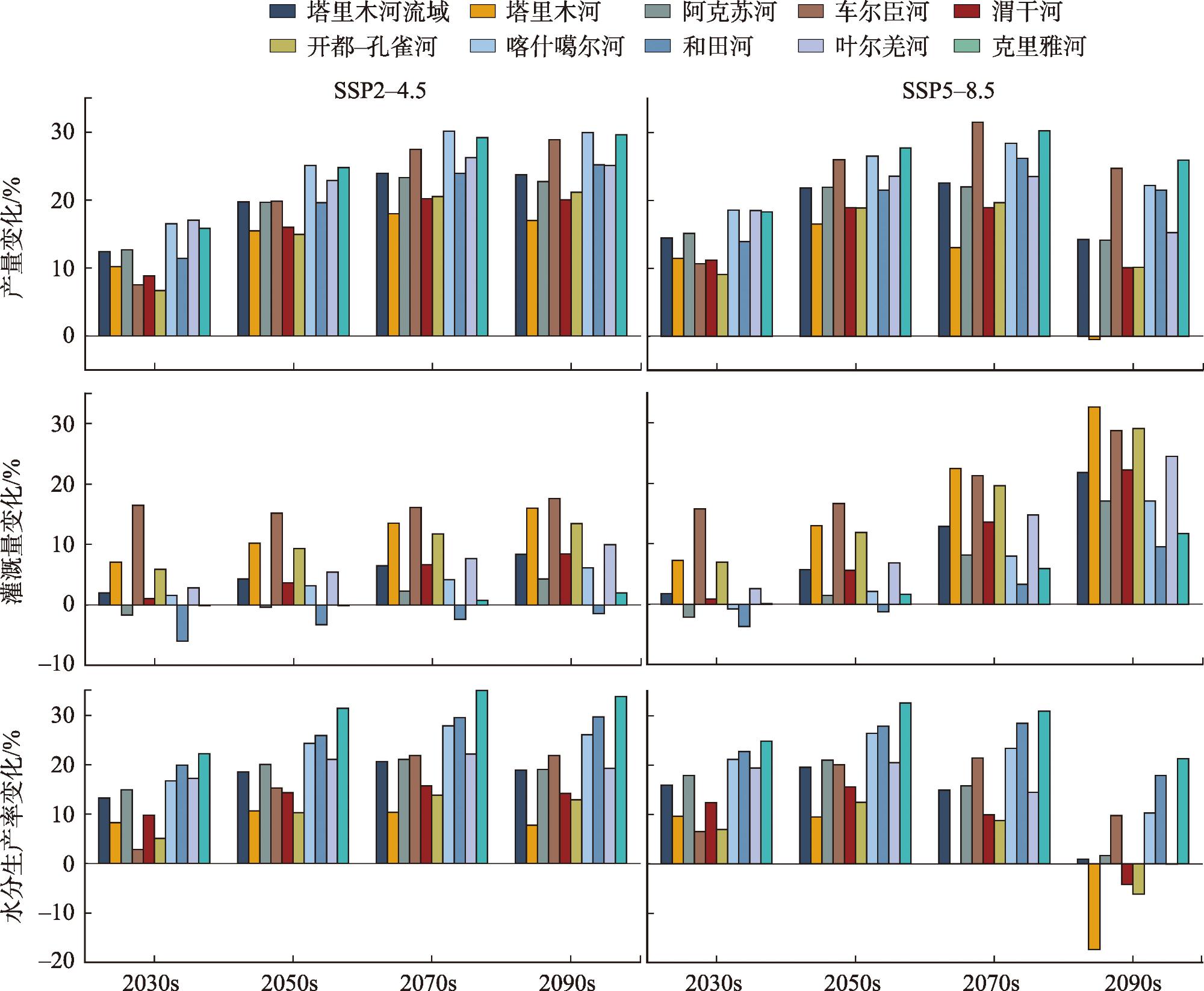
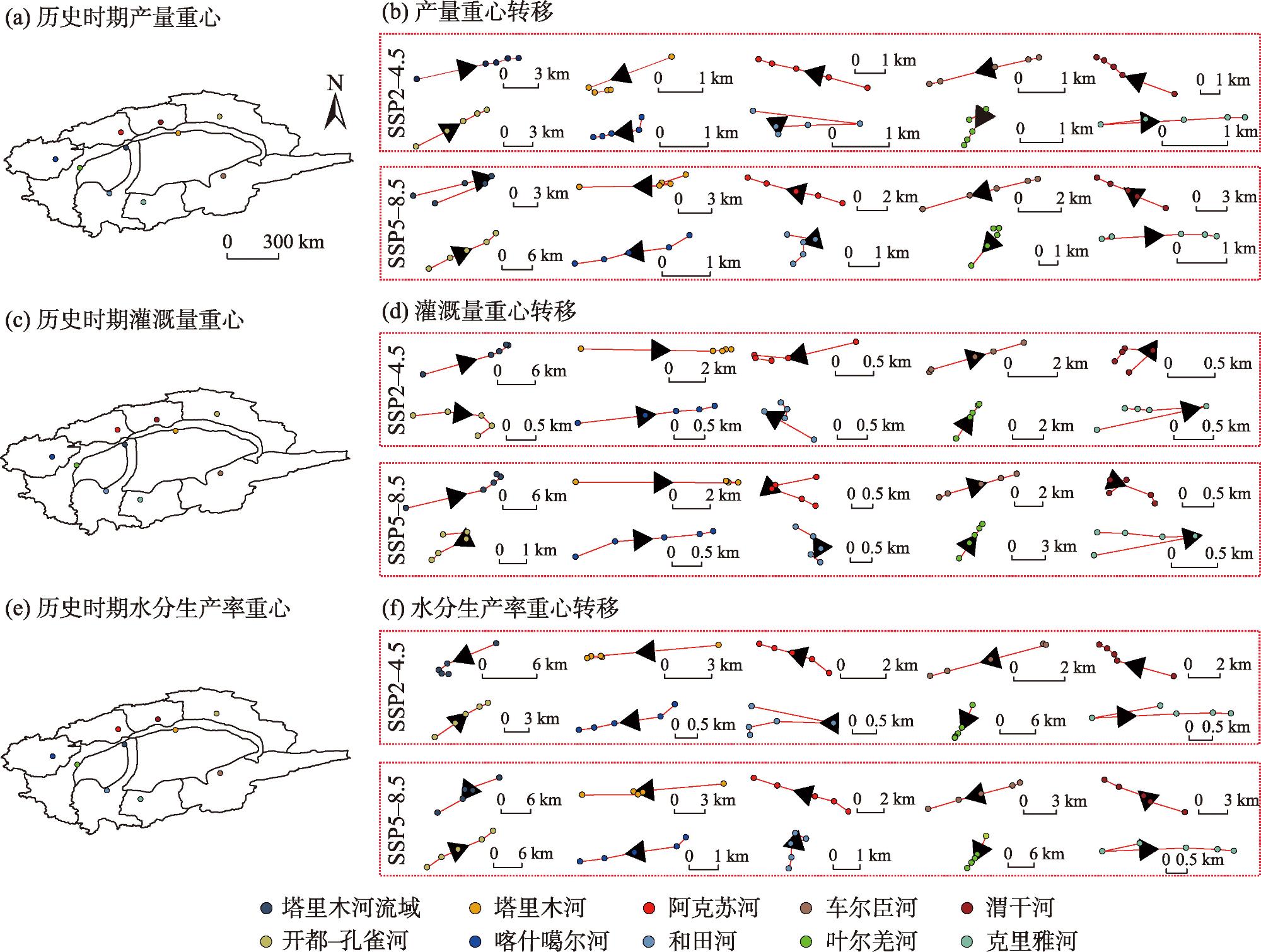
Climate change significantly affects cotton production. This study assessed the effectiveness of the DSSAT-CROPGRO-Cotton model in simulating cotton production in the Tarim River Basin. Using climate change datasets generated by CMIP6 climate models under the SSP2-4.5 and SSP5-8.5 Shared Socioeconomic Pathways, the study analyzed the spatiotemporal variations and centroid shift patterns of climate characteristics, cotton yield, irrigation water volume, and water productivity from 2021 to 2100. The results indicate that during the cotton-growing season, temperature in the Tarim River Basin is projected to rise by up to 4.9 ℃, whereas precipitation is expected to decrease by an average of 3.4-4.4 mm, and solar radiation is likely to decline by 0.6-0.7 MJ∙m-2 from 2021 to 2100. The DSSAT-CROPGRO-Cotton+GIS coupled model reliably simulated cotton yield and irrigation water volume in the Tarim River Basin. Under future scenarios, cotton yield is projected to increase by 12.42%-23.96% relative to historical levels, with irrigation water volume rising by 1.76%-21.82% and water productivity by 0.95%-20.61%. The changes in cotton yield, irrigation water volume, and water productivity under the SSP2-4.5 and SSP5-8.5 scenarios exhibit distinct patterns. In the SSP2-4.5 scenario, cotton yield is expected to follow an “increase-stagnation” pattern, whereas irrigation water volume is anticipated to “continuously increase,” and water productivity is likely to follow an “increase-decrease” pattern. In contrast, under the SSP5-8.5 scenario, cotton yield is projected to follow an “increase-stagnation-decrease” pattern, with irrigation water volume still “continuously increasing,” whereas water productivity is expected to follow an “increase-stagnation-sharp decrease” pattern. Centroid analysis shows that under the SSP2-4.5 scenario, the centroid of cotton yield is expected to shift northeastward, whereas under the SSP5-8.5 scenario, it exhibits a “northeast-southwest” oscillation. The centroid of irrigation water volume is projected to shift northeastward, whereas that of water productivity is likely to shift southwestward in future scenarios.
YUE Shengru , HU Xuefei , HOU Xiaohua , MENG Fujun . Cotton production assessment in the Tarim River Basin based on CMIP6 models[J]. Arid Zone Research, 2025 , 42(10) : 1925 -1938 . DOI: 10.13866/j.azr.2025.10.15
表1 耦合模式比较计划第六阶段(CMIP6)中13种模式信息Tab. 1 Thirteen-model information in phase 6 of the Coupled Model Intercomparison Project (CMIP6) |
| 编号 | 名称 | 国家 | 发布年份 | 空间分辨率(经向×纬向) |
|---|---|---|---|---|
| 1 | ACCESS-ESM1-5 | 澳大利亚 | 2019年 | 1.875°×1.241° |
| 2 | BCC-CSM2-MR | 中国 | 2017年 | 1.125°×1.125° |
| 3 | CMCC-ESM2 | 意大利 | 2017年 | 1.25°×0.9375° |
| 4 | ESM2-0 | 中国 | 2022年 | 1.875°×1.875° |
| 5 | INM-CM4-8 | 俄罗斯 | 2016年 | 2.00°×1.50° |
| 6 | INM-CM5-0 | 俄罗斯 | 2016年 | 2.00°×1.50° |
| 7 | IPSL-CM6A-LR | 法国 | 2017年 | 2.50°×1.26° |
| 8 | MPI-ESM1-2-HR | 德国 | 2017年 | 0.9375°×0.9375° |
| 9 | MPI-ESM1-2-LR | 德国 | 2017年 | 1.875°×1.875° |
| 10 | MRI-ESM2-0 | 日本 | 2017年 | 1.125°×1.125° |
| 11 | NESM3 | 中国 | 2016年 | 1.875°×1.875° |
| 12 | NorESM2-MM | 挪威 | 2017年 | 2.50°×2.50° |
| 13 | TaiESM1 | 中国 | 2018年 | 1.25°×0.9375° |
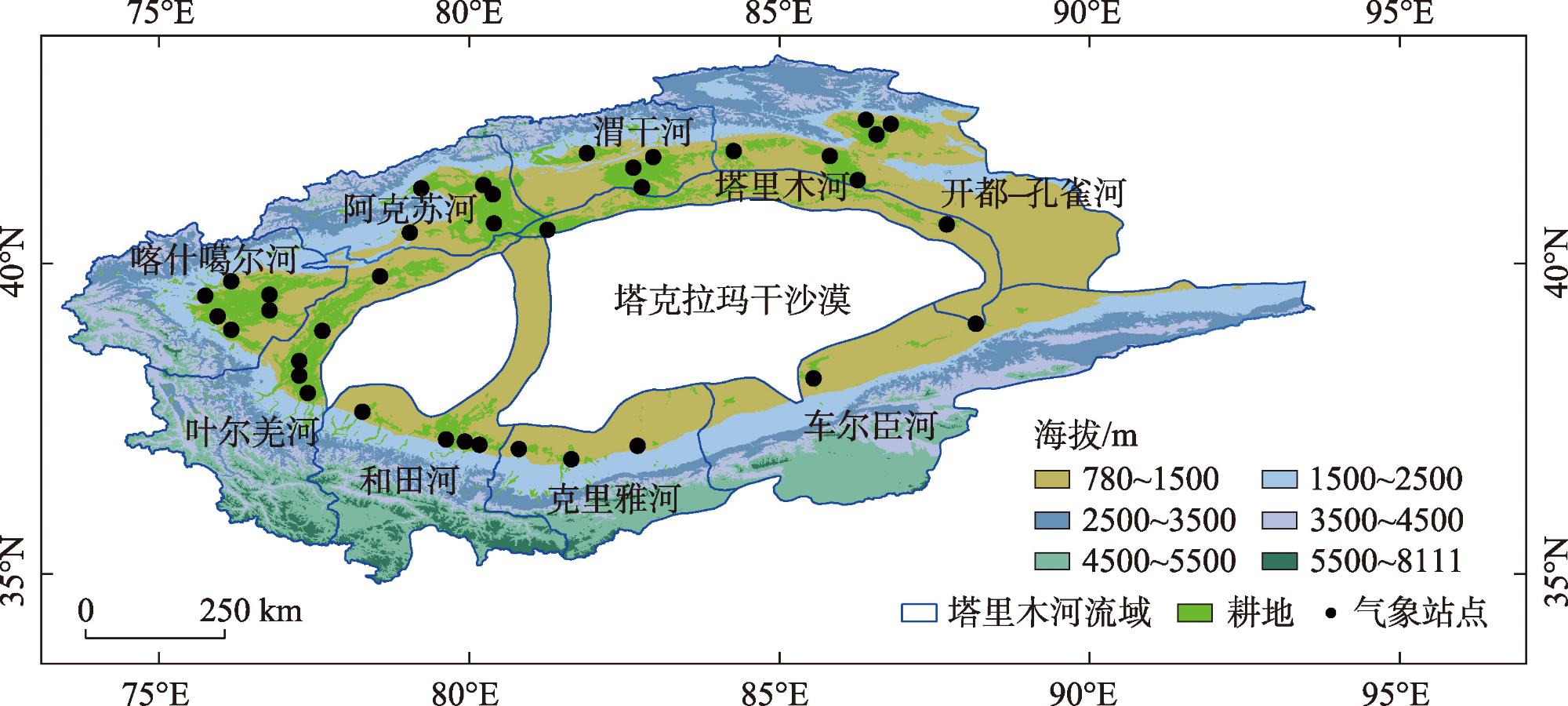
表2 塔里木河流域气象站点信息Tab. 2 Meteorological station information of the Tarim River Basin |
| 区站号 | 站点名称 | 纬度 | 经度 | 海拔/m | 区站号 | 站点名称 | 纬度 | 经度 | 海拔/m |
|---|---|---|---|---|---|---|---|---|---|
| 51559 | 和静 | 42.32°N | 86.40°E | 1100.90 | 51720 | 柯坪 | 40.50°N | 79.05°E | 1161.80 |
| 51567 | 焉耆 | 42.08°N | 86.57°E | 1055.30 | 51722 | 阿瓦提 | 40.65°N | 80.40°E | 1044.30 |
| 51568 | 和硕 | 42.25°N | 86.80°E | 1085.40 | 51730 | 阿拉尔 | 40.55°N | 81.27°E | 1012.20 |
| 51627 | 乌什 | 41.22°N | 79.23°E | 1395.80 | 51765 | 铁干里克 | 40.63°N | 87.70°E | 846.00 |
| 51628 | 阿克苏 | 41.12°N | 80.38°E | 1107.10 | 51777 | 若羌 | 39.03°N | 88.17°E | 887.70 |
| 51629 | 温宿 | 41.27°N | 80.23°E | 1133.10 | 51802 | 英吉沙 | 38.93°N | 76.17°E | 1297.50 |
| 51633 | 拜城 | 41.78°N | 81.90°E | 1229.20 | 51810 | 麦盖提 | 38.92°N | 77.63°E | 1178.20 |
| 51636 | 新和 | 41.55°N | 82.65°E | 1009.80 | 51811 | 莎车 | 38.43°N | 77.27°E | 1231.20 |
| 51639 | 沙雅 | 41.23°N | 82.78°E | 980.40 | 51814 | 叶城 | 37.92°N | 77.40°E | 1360.40 |
| 51642 | 轮台 | 41.82°N | 84.27°E | 982.00 | 51815 | 泽普 | 38.20°N | 77.27°E | 1274.70 |
| 51644 | 库车 | 41.72°N | 82.97°E | 1081.90 | 51818 | 皮山 | 37.62°N | 78.28°E | 1375.40 |
| 51655 | 尉犁 | 41.35°N | 86.27°E | 884.90 | 51826 | 策勒 | 37.02°N | 80.80°E | 1336.50 |
| 51656 | 库尔勒 | 41.73°N | 85.82°E | 899.80 | 51827 | 墨玉 | 37.17°N | 79.63°E | 1348.90 |
| 51704 | 阿图什 | 39.72°N | 76.17°E | 1298.70 | 51828 | 和田 | 37.13°N | 79.93°E | 1375.00 |
| 51707 | 伽师 | 39.50°N | 76.78°E | 1204.70 | 51829 | 洛浦 | 37.08°N | 80.17°E | 1347.90 |
| 51708 | 阿克陶 | 39.15°N | 75.95°E | 1325.10 | 51839 | 民丰 | 37.07°N | 82.72°E | 1409.50 |
| 51709 | 喀什 | 39.48°N | 75.75°E | 1385.60 | 51855 | 且末 | 38.15°N | 85.55°E | 1247.20 |
| 51716 | 巴楚 | 39.80°N | 78.57°E | 1116.50 | 51931 | 于田 | 36.85°N | 81.65°E | 1422.00 |
| 51717 | 岳普湖 | 39.25°N | 76.78°E | 1206.30 |
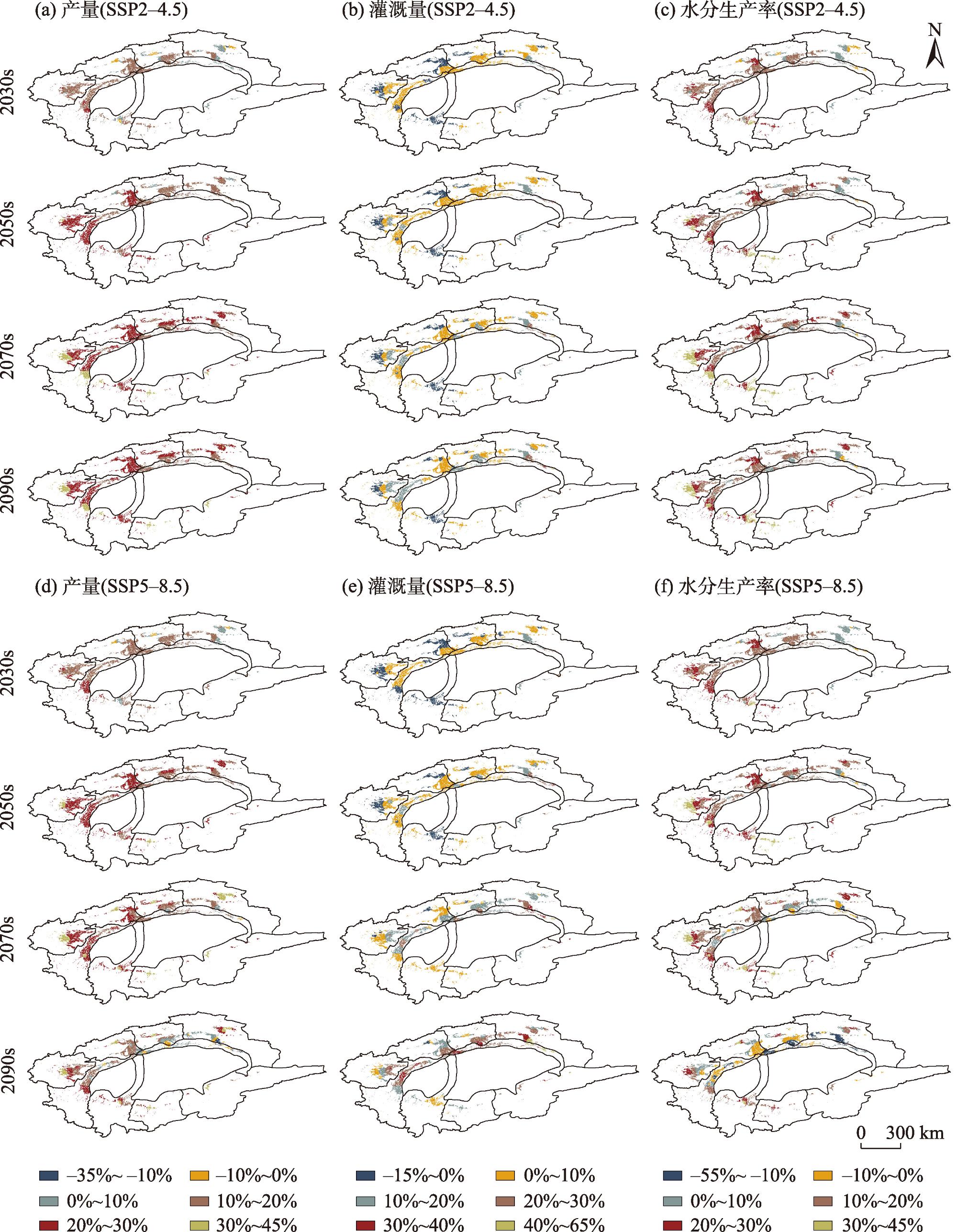
图6 未来情景下棉花产量、灌溉量和水分生产率变化空间特征Fig. 6 Spatial variation characteristics of cotton yield, irrigation amount and water productivity under future scenarios |
| [1] |
|
| [2] |
李娜. 气候变化对棉花生长和产量的影响[D]. 西安: 西北农林科技大学, 2021.
[
|
| [3] |
|
| [4] |
|
| [5] |
李萌. 南疆膜下滴灌棉花灌溉和施肥调控效应及生长模拟研究[D]. 杨凌: 西北农林科技大学, 2020.
[
|
| [6] |
杜江涛, 张楠, 龚珂宁, 等. 基于DSSAT模型的南疆膜下滴灌棉花灌溉制度优化[J]. 生态学杂志, 2021, 40(11): 3760-3768.
[
|
| [7] |
|
| [8] |
陈发虎, 谢亭亭, 杨钰杰, 等. 我国西北干旱区“暖湿化”问题及其未来趋势讨论[J]. 中国科学:地球科学, 2023, 53(6): 1246-1262.
[
|
| [9] |
山建安, 朱睿, 尹振良, 等. 基于CMIP6模式的中国西北地区干旱时空变化[J]. 干旱区研究, 2024, 41(5): 717-729.
[
|
| [10] |
|
| [11] |
徐杨, 李秀芬, 葛全胜, 等. 气象干旱对中亚棉花产量的影响[J]. 地理学报, 2022, 77(9): 2338-2352.
[
|
| [12] |
|
| [13] |
|
| [14] |
|
| [15] |
罗磊, 李曦光, 李萧婷, 等. 气候变化下沙棘在新疆潜在分布格局的变化[J]. 干旱区研究, 2025, 42(3): 511-522.
[
|
| [16] |
|
| [17] |
|
| [18] |
|
| [19] |
|
| [20] |
王兴鹏, 辛朗, 杜江涛, 等. 基于DSSAT模型的南疆膜下滴灌棉花生长与产量模拟[J]. 农业机械学报, 2022, 53(9): 314-321.
[
|
| [21] |
|
| [22] |
|
| [23] |
|
| [24] |
|
| [25] |
|
| [26] |
|
| [27] |
|
| [28] |
陈亚宁, 徐宗学. 全球气候变化对新疆塔里木河流域水资源的可能性影响[J]. 中国科学(D辑: 地球科学), 2004, 34(11): 1047-1053.
[
|
| [29] |
张音, 孙从建, 刘庚, 等. 近20a塔里木河流域山区NDSI对气候变化的响应[J]. 干旱区研究, 2024, 41(10): 1639-1648.
[
|
| [30] |
朱世峰, 王卫光, 丁一民, 等. 基于CMIP6的长江中下游未来水稻高温热害时空变化特征[J]. 农业工程学报, 2023, 39(3): 113-122.
[
|
| [31] |
|
| [32] |
童成立, 张文菊, 汤阳, 等. 逐日太阳辐射的模拟计算[J]. 中国农业气象, 2005, 26(3): 165-169.
[
|
| [33] |
王雪姣. 气候变化对新疆棉花物候、产量和品质的影响与适应措施[D]. 北京: 中国农业大学, 2015.
[
|
| [34] |
|
| [35] |
|
| [36] |
赵爱琴. 基于大尺度水肥耦合模型估算新疆膜下滴灌棉花生产潜力(英文)[J]. 农业工程学报, 2019, 35(5): 111-118.
[
|
| [37] |
|
| [38] |
|
| [39] |
|
| [40] |
|
| [41] |
|
| [42] |
|
| [43] |
|
/
| 〈 |
|
〉 |