



Division index of early or late and length grade in climate seasons in Xizang
Received date: 2024-06-03
Revised date: 2024-08-09
Online published: 2025-08-13
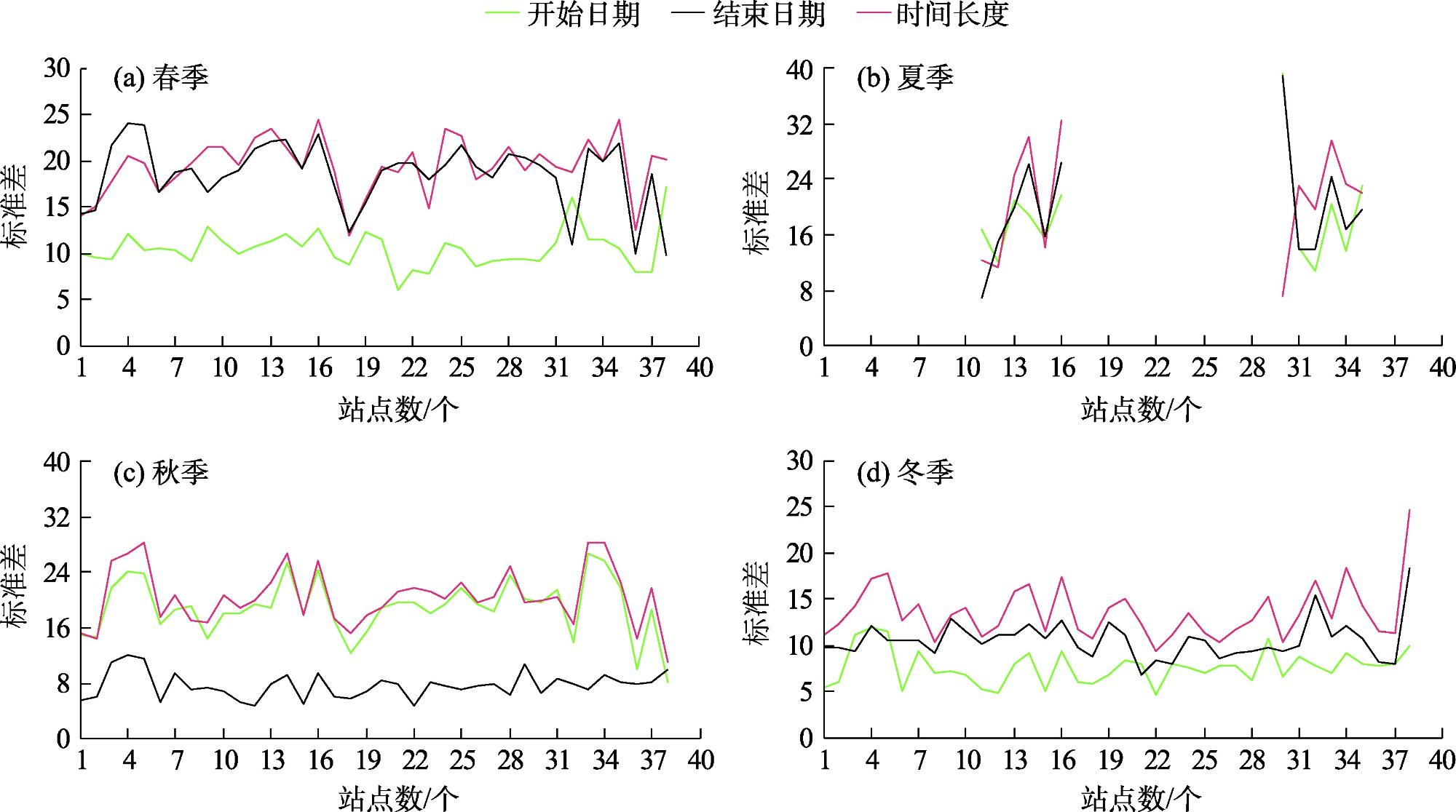
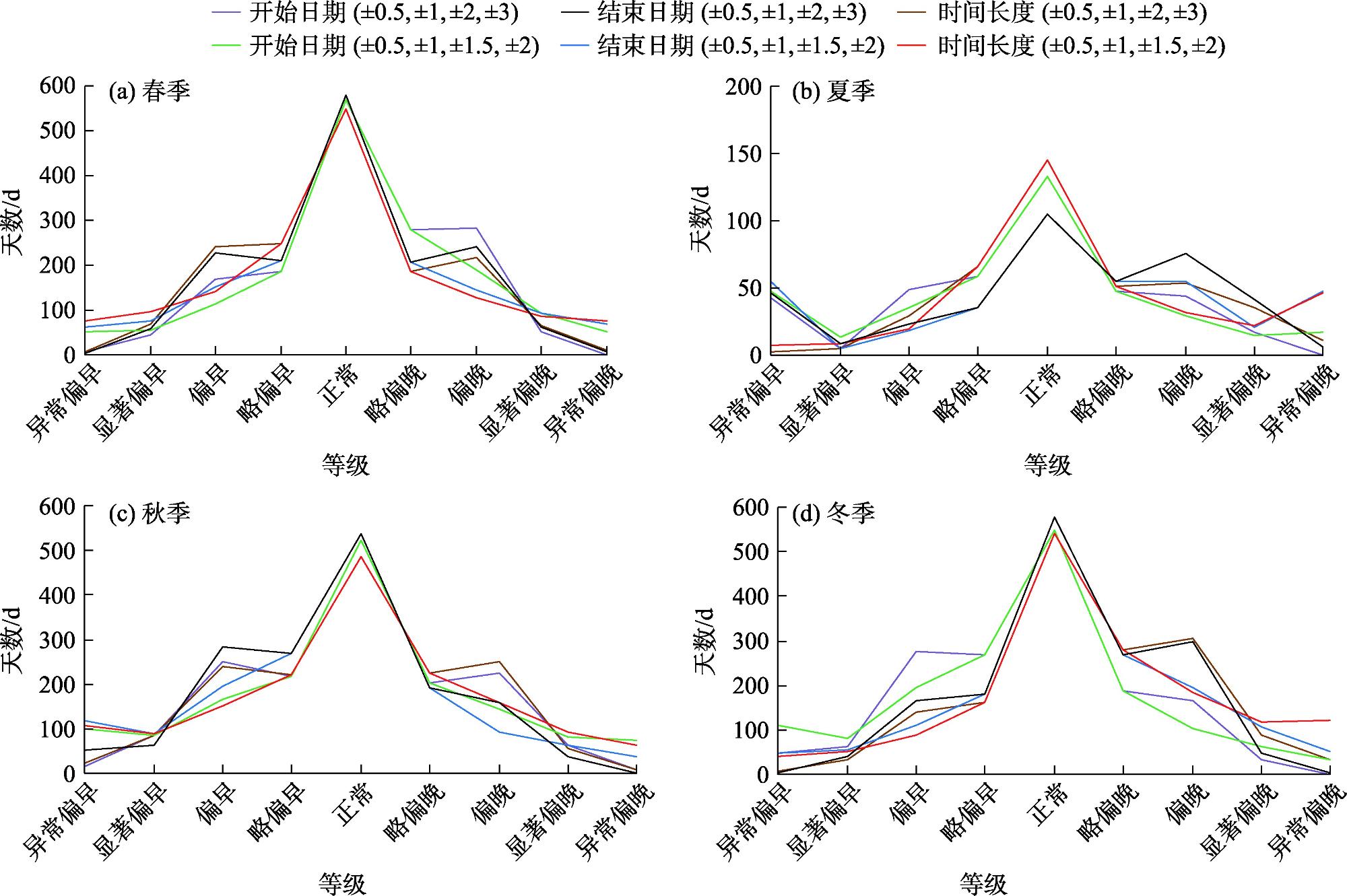
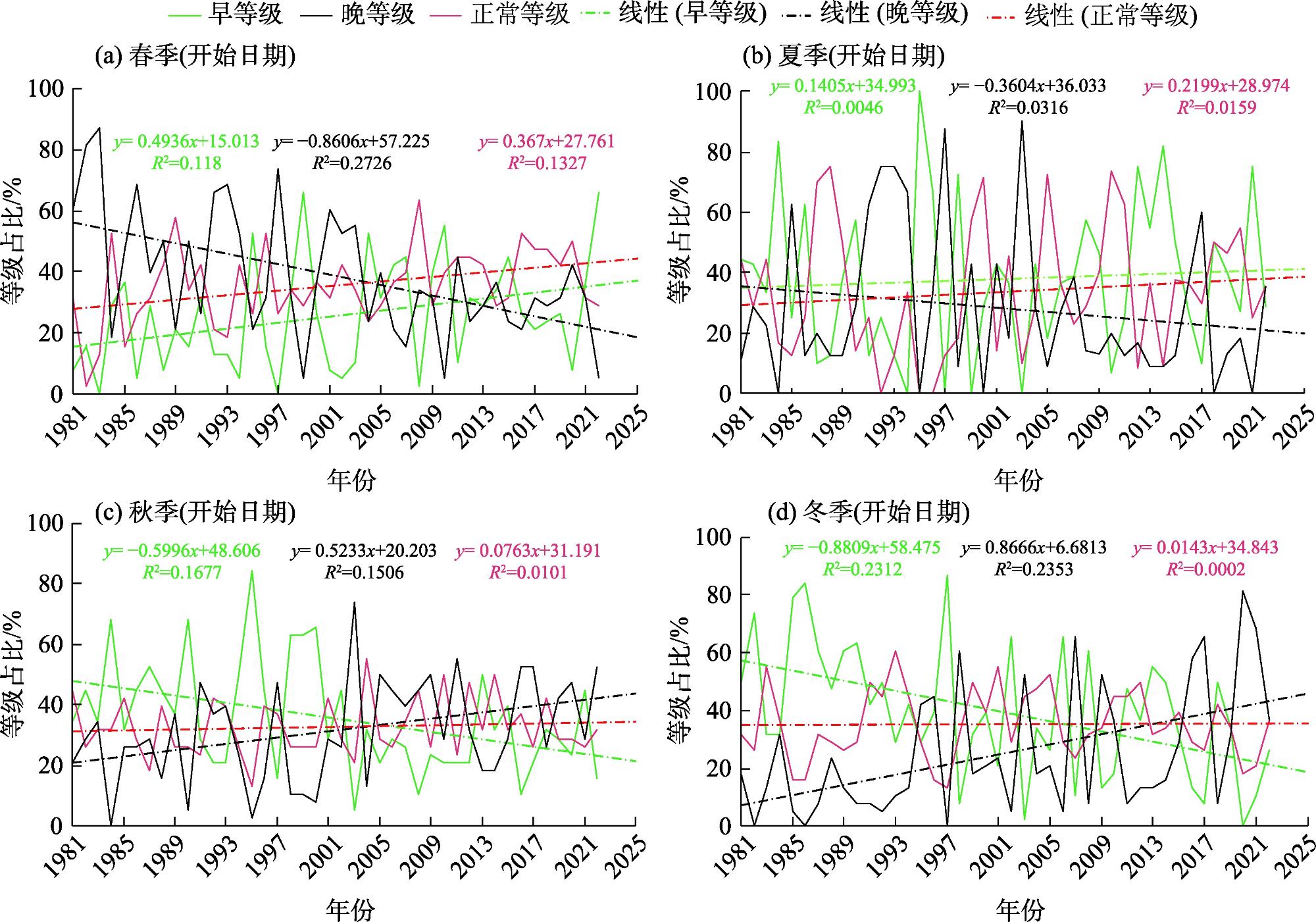
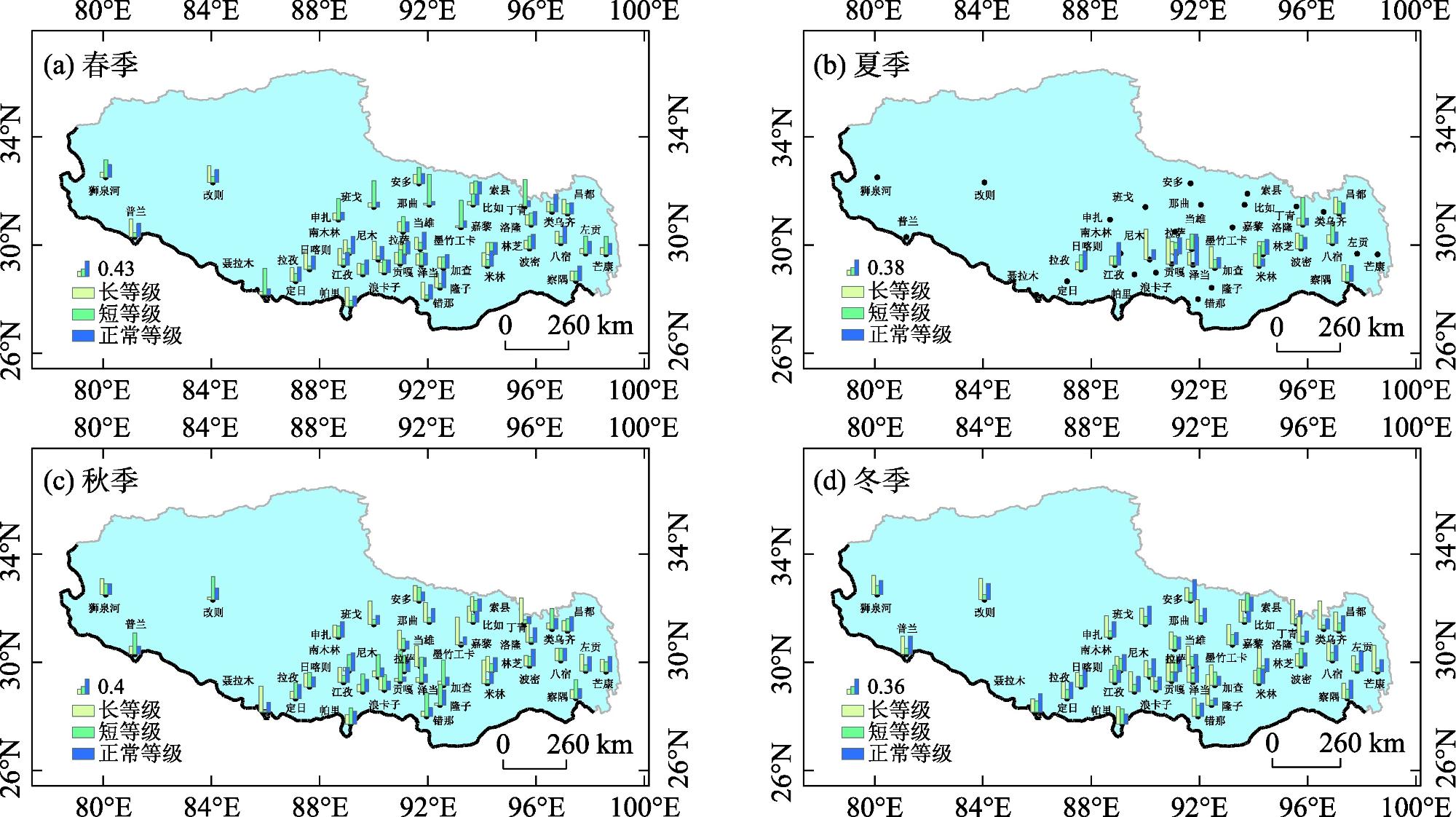
To better understand the response mechanisms of seasonal changes in high-altitude areas to ecological and environmental factors amid global climate change, it is crucial to study the indicators of seasonal early or late and length grade duration classification in Xizang. In this study, we analyzed daily temperature data from 38 meteorological stations in Xizang (1981-2023) using temperature thresholds of 6 ℃, 17 ℃, 17 ℃ and 6 ℃ for four seasons, to explore the classification indices and evolution laws of seasonal early or late and length grade. The results revealed the following: (1) The average start dates for spring, summer, autumn, and winter at the 38 stations were April 21, June 17, July 17, and October 17, with average lengths of 56 d, 29 d, 92 d, and 188 d, respectively. (2) The start and end times, as well as the lengths of the climatic seasons, exhibit characteristics of minimum standard deviation in winter and maximum standard deviation in summer. (3) The start dates, end dates, and length of the climatic seasons, as well as the start and end times and length of the four seasons, showed the following patterns: Normal>slightly early (late) and early (late)>significantly early (late) and abnormally early (late). A indicator is more in line with the threshold of the classification indicators of early or late and length grade. (4) In Xizang, the onset of spring and summer trends was earlier, while autumn and winter had late trends. (5) The start date of spring, the end date of winter, and the length of summer across the 38 stations were primarily classified as normal, whereas the start dates of summer, autumn, and winter, along with the end dates of spring and autumn, were mainly categorized as early. Conversely, the lengths of spring and autumn were mainly classified as short, while winter was predominantly classified as long, and the end date of summer was primarily considered late. These findings provide valuable insights into climate resource management, ecological protection, and the overall impact on human production and life.
SHI Jiqing , LUO Suxuan , ZHANG Weihua , ZHOU Kanshe , HU Jie , ZHANG Dongdong , GAN Chenlong . Division index of early or late and length grade in climate seasons in Xizang[J]. Arid Zone Research, 2024 , 41(11) : 1797 -1807 . DOI: 10.13866/j.azr.2024.11.01
表1 气候季节等级划分指标Tab. 1 Index for classification of climate season grade |
| 气候季节等级 | 开始日期 | 结束日期 | 时间长度 | |
|---|---|---|---|---|
| 划分指标A | 异常偏早(短) | ΔD<-3α | ΔT<-3β | ΔL<-3δ |
| 显著偏早(短) | -3α≤ΔD<-2α | -β3≤ΔT<-2β | -3δ≤ΔL<-2δ | |
| 偏早(短) | -2α≤ΔD<-α | -2β≤ΔT<-β | -2δ≤ΔL<-δ | |
| 略偏早(短) | -α≤ΔD<-1/2α | -β≤ΔT<-1/2β | -δ≤ΔL<-1/2δ | |
| 正常 | -1/2α≤ΔD<1/2α | -1/2β≤ΔT<1/2β | -1/2δ≤ΔL<1/2δ | |
| 略偏晚(长) | 1/2α≤ΔD<α | 1/2β≤ΔT<β | 1/2δ≤ΔL<δ | |
| 偏晚(长) | α≤ΔD<2α | β≤ΔT<2β | δ≤ΔL<2δ | |
| 显著偏晚(长) | 2α≤ΔD≤3α | 2β≤ΔT≤3β | 2δ≤ΔL≤3δ | |
| 异常偏晚(长) | ΔD>3α | ΔT>3β | ΔL>3δ | |
| 划分指标B | 异常偏早(短) | ΔD<-2α | ΔT<-2β | ΔL<-2δ |
| 显著偏早(短) | -2α≤ΔD<-3/2α | -2β≤ΔT<-3/2β | -2δ≤ΔL<-3/2δ | |
| 偏早(短) | -3/2α≤ΔD<-α | -3/2β≤ΔT<-β | -3/2δ≤ΔL<-δ | |
| 略偏早(短) | -α≤ΔD<-1/2α | -β≤ΔT<-1/2β | -δ≤ΔL<-1/2δ | |
| 正常 | -1/2α≤ΔD<1/2α | -1/2β≤ΔT<1/2β | -1/2δ≤ΔL<1/2δ | |
| 略偏晚(长) | 1/2α≤ΔD<α | 1/2β≤ΔT<β | 1/2δ≤ΔL<δ | |
| 偏晚(长) | α≤ΔD<3/2α | β≤ΔT<3/2β | δ≤ΔL<3/2δ | |
| 显著偏晚(长) | 3/2α≤ΔD≤2α | 3/2β≤ΔT≤2β | 3/2δ≤ΔL≤2δ | |
| 异常偏晚(长) | ΔD>2α | ΔT>2β | ΔL>2δ |
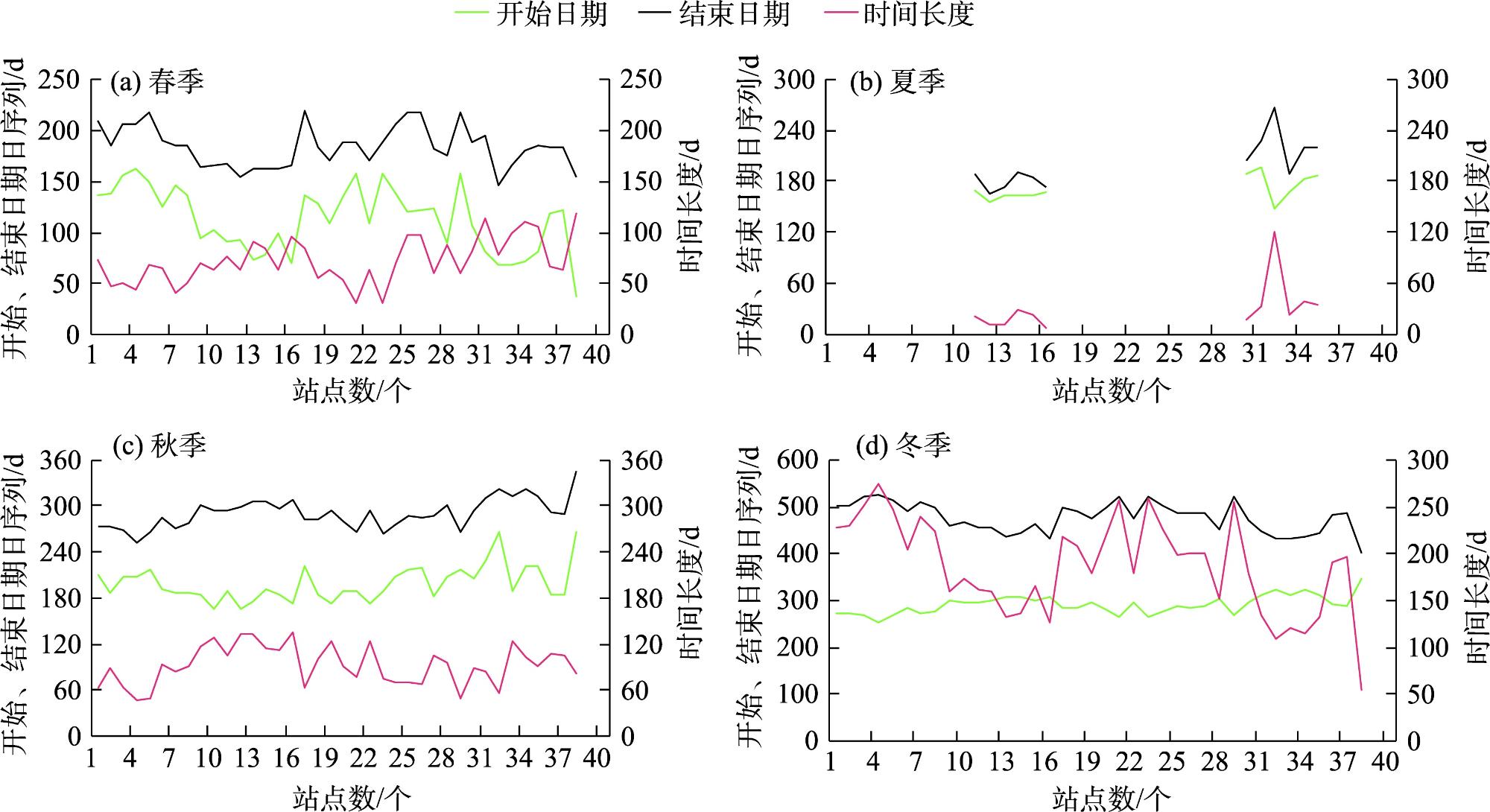
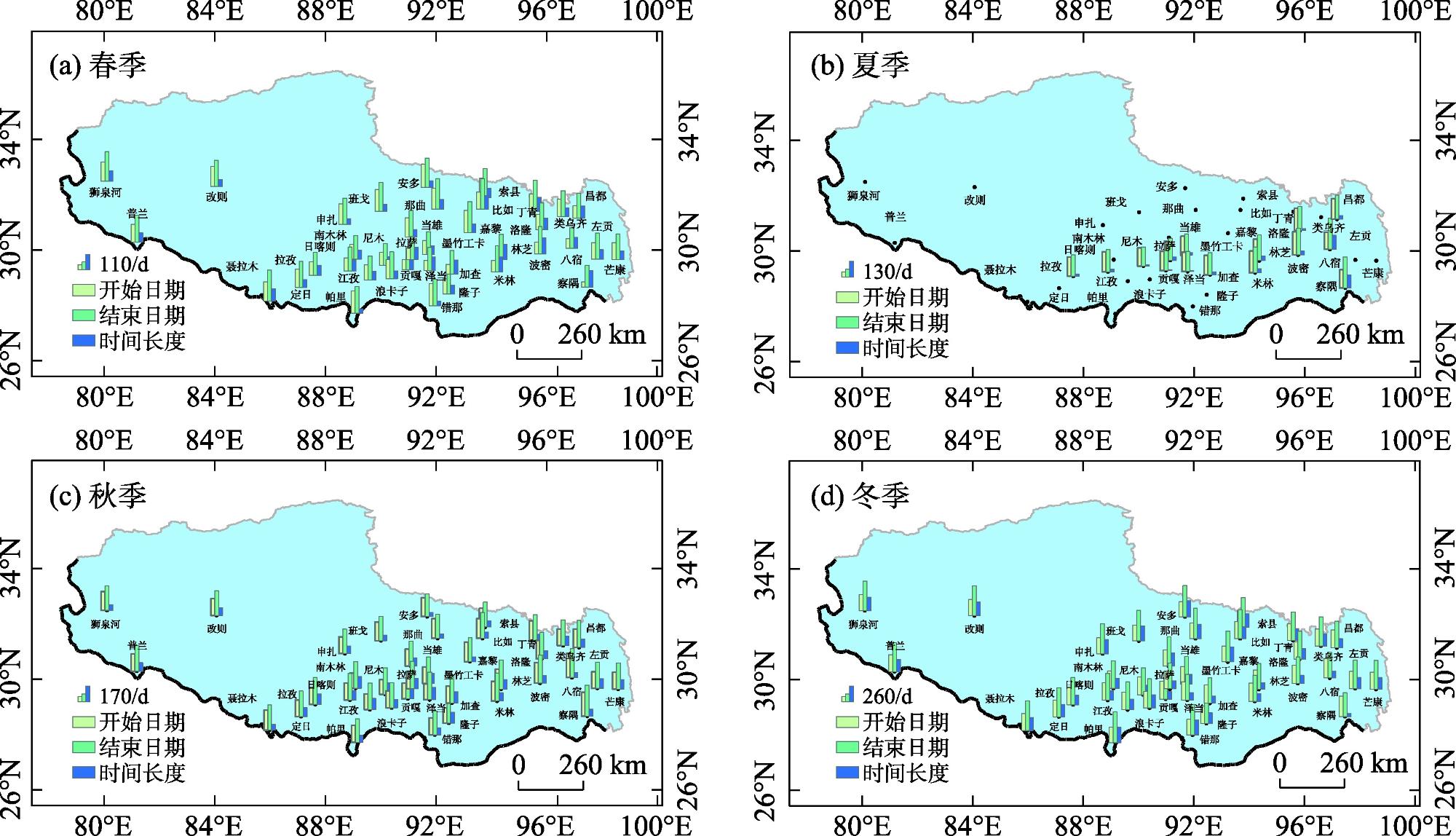
图2 西藏地区38站常年气候季节开始日期、结束日期、时间长度分布注:开始日期、结束日期均为日序列。下同。 Fig. 2 Distribution of the start date, end date and duration of the perennial climate season at 38 stations in Xizang |
表2 38站气候季节平均早晚和长短频率Tab. 2 Frequency of average early or late and length grade of climatic seasons at 38 stations |
| 季节 | “等级5”频率/% | “等级7”频率/% | |||||||||||||
|---|---|---|---|---|---|---|---|---|---|---|---|---|---|---|---|
| A指标 | B指标 | A指标 | B指标 | ||||||||||||
| 开始日期 | 结束日期 | 时间长度 | 开始日期 | 结束日期 | 时间长度 | 开始日期 | 结束日期 | 时间长度 | 开始日期 | 结束日期 | 时间长度 | ||||
| 春季 | 93 | 92 | 90 | 84 | 81 | 79 | 99 | 99 | 99 | 93 | 92 | 90 | |||
| 夏季 | 84 | 74 | 87 | 76 | 68 | 79 | 87 | 87 | 97 | 84 | 74 | 87 | |||
| 秋季 | 89 | 90 | 89 | 79 | 81 | 78 | 98 | 97 | 98 | 89 | 90 | 89 | |||
| 冬季 | 91 | 94 | 90 | 82 | 84 | 79 | 97 | 99 | 97 | 91 | 94 | 90 | |||
| [1] |
中国气象局气候变化中心. 中国气候变化蓝皮书(2023)[M]. 北京: 科学出版社, 2023.
[ The China Meteorological Administration Climate Change Center. Blue Book on Climate Change in China 2023[M]. Beijing: Science Press, 2023. ]
|
| [2] |
史继清, 甘臣龙, 周刊社, 等. 西藏青稞主要种植区干旱时空分布及致灾危险性评估[J]. 干旱区地理, 2023, 46(7): 1098-1110.
[
|
| [3] |
史继清, 周刊社, 张东东, 等. 西藏地区一种新的四季划分方法[J]. 干旱区地理, 2024, 47(5): 773-784.
[
|
| [4] |
史继清, 甘臣龙, 边多, 等. 1981—2015年西藏全区气候季节的变化[J]. 冰川冻土, 2018, 40(6): 1110-1119.
[
|
| [5] |
林蔚, 孙秀宝, 任国玉, 等. 季节划分和变化研究进展[J]. 地理科学进展, 2024, 43(4): 826-840.
[
|
| [6] |
张志高, 孙梓欣, 张秀丽, 等. 1960—2020年黄河流域气候生长季时空演变及成因分析[J]. 干旱区研究, 2023, 40(10): 1537-1546.
[
|
| [7] |
邬晓丹, 罗敏, 孟凡浩, 等. 气候暖湿化背景下新疆极端气候事件时空演变特征分析[J]. 干旱区研究, 2022, 39(6): 1695-1705.
[
|
| [8] |
陈峪, 姜允迪, 陈鲜艳, 等. 中华人民共和国气象行业标准《气候季节划分》(QX/T 152-2012)[S]. 北京: 气象出版社, 2012.
[
|
| [9] |
马彬, 张勃. 基于格点数据的1961—2016年中国气候季节时空变化[J]. 地理学报, 2020, 75(3): 458-469.
[
|
| [10] |
姚愚, 李蕊, 郑建萌, 等. 1961—2017年云南季节变化特征分析[J]. 气象科学, 2020, 40(6): 849-858.
[
|
| [11] |
刘玉莲. 1961—2010年黑龙江省气候季节时空分布及其变化特征[J]. 气象与环境学报, 2015, 31(2): 89-96.
[
|
| [12] |
张宝堃. 中国季节之分配[J]. 地理学报, 1934, 1(1): 29-74.
[
|
| [13] |
解明恩, 姚愚, 段玮, 等. 低纬高原气候季节变化特征研究——以云南昆明大理为例[J]. 热带气象学报, 2023, 39(2): 171-182.
[
|
| [14] |
汤懋苍, 钟海玲, 李栋梁. 青藏铁路沿线的四季划分及其温度变化分析[J]. 高原气象, 2003, 22(5): 440-444.
[
|
| [15] |
范思睿, 范广洲, 董一平, 等. 青藏高原四季划分方法探讨[J]. 高原山地气象研究, 2011, 31(2): 1-11.
[
|
| [16] |
张世轩, 张璐, 孙树鹏, 等. 全球变暖情况下中国季节的变化[J]. 高原气象, 2011, 30(3): 659-667.
[
|
| [17] |
孙树鹏, 张璐, 侯威, 等. 基于非线性相似度量方法研究中国季节划分[J]. 物理学报, 2011, 60(2): 809-815.
[
|
| [18] |
王士维, 孙栋元, 周敏, 等. 1951—2020年疏勒河流域气温时空变化特征[J]. 干旱区研究, 2023, 40(7): 1065-1074.
[
|
| [19] |
程玉琴, 尤莉, 朱宇, 等. 赤峰市气候季节划分方法及应用[J]. 干旱区资源与环境, 2017, 31(4): 171-177.
[ [
|
| [20] |
邢小艺, 郝培尧, 李冠衡, 等. 北京植物物候的季节动态特征——以北京植物园为例[J]. 植物生态学报, 2018, 42(9): 906-916.
[
|
/
| 〈 |
|
〉 |