



Effects of different land-use methods on the organic carbon composition and soil microbial biomass carbon of farmland soil
Received date: 2024-01-05
Revised date: 2024-08-06
Online published: 2025-08-12
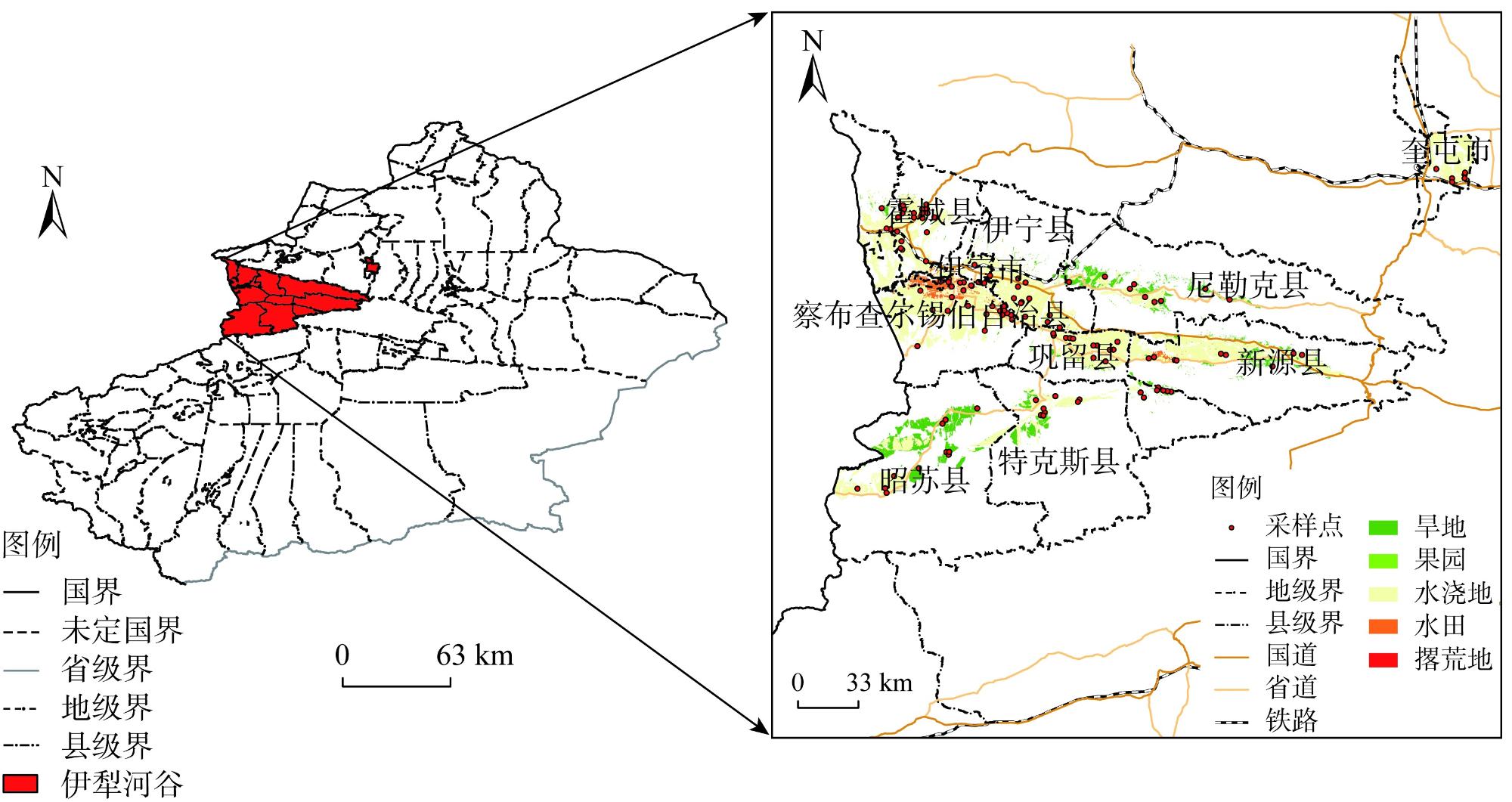
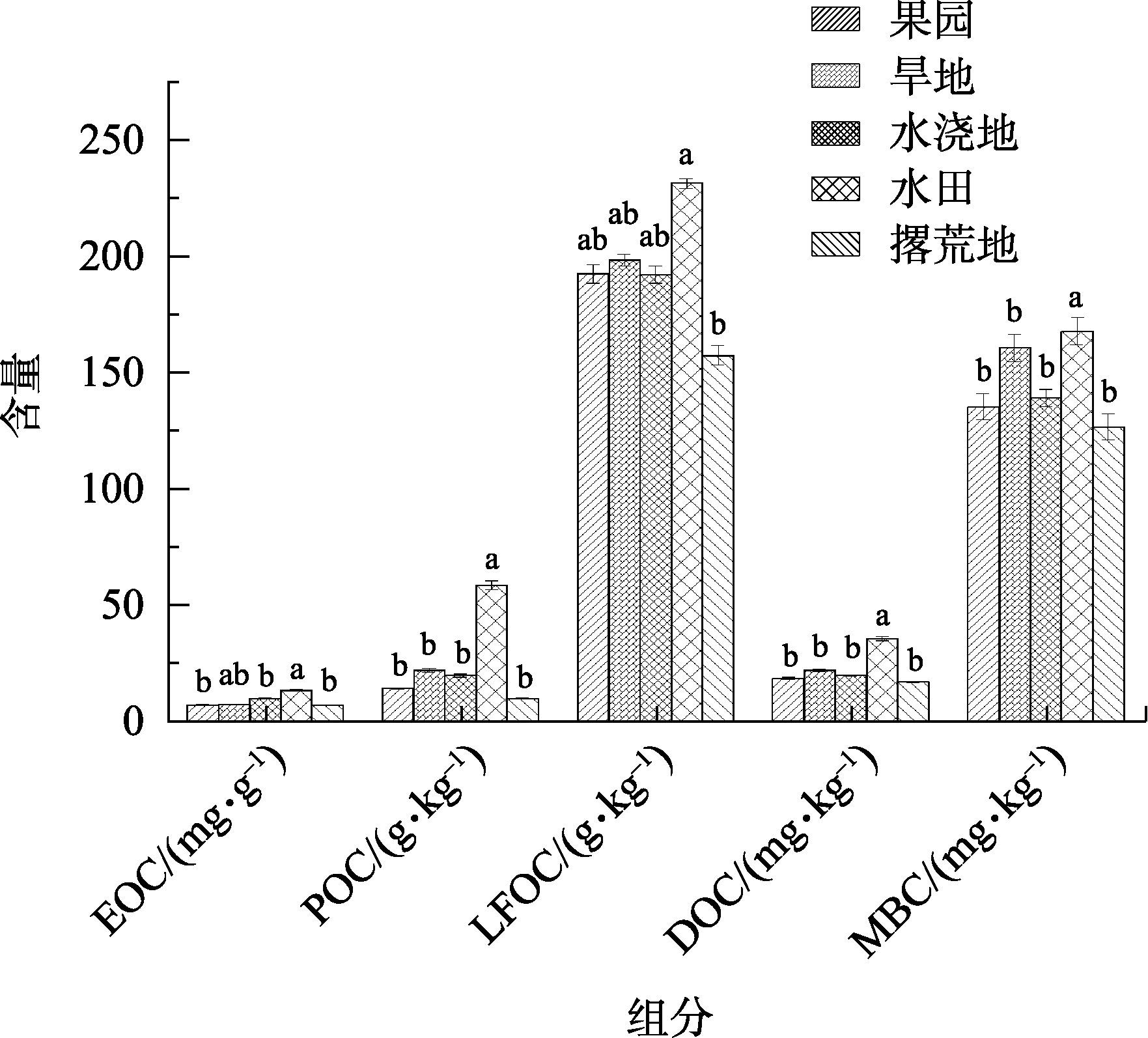
Investigating the content characteristics of organic carbon components and microbial biomass carbon in farmland soil under different land-use methods is of considerable significance for guiding the rational utilization and management of soil resources in the Ili River Valley. By combining field investigations, sample collection, indoor analysis, and geostatistics, this study explored the content characteristics of soil SOC, POC, DOC, LFOC, EOC, and MBC in five land-use types, including dryland, irrigated land, paddy field, orchard, and abandoned land in the Ili River Valley. This study compared and analyzed the effects of land-use changes on soil organic carbon components and microbial biomass carbon in farmland in the Ili River Valley. Results showed that the contents of TN, AN, AP, and AK in soil were in the order of paddy field>irrigated land>dryland>orchard>fallow land. The nutrient content of paddy soil was significantly higher than that of the other four land-use types. The soil SOC content showed significant differences, primarily reflected in paddy fields (25.62 g·kg-1)>dryland (13.80 g·kg-1)>irrigated land (12.19 g·kg-1)>orchards (11.58 g·kg-1)>abandoned land (8.81 g·kg-1), and all reached a significant difference level (P<0.05). The contents of soil SOC, DOC, POC, LFOC, and MBC showed the characteristics of paddy field>dryland>irrigated land>orchard>abandoned land, with significant differences. The EOC content showed the characteristics of paddy field>irrigated land>dryland>orchard>abandoned land, with significant differences. The contents of SOC, DOC, POC, LFOC, MBC, and EOC in paddy soil were significantly higher than those in the other four land-use types. A highly significant positive correlation was detected between soil SOC and POC, LFOC, and DOC in the five land-use types, with the correlation coefficients being 0.622, 0.36, and 0.489, respectively (P<0.01), indicating that soil SOC content is an important factor affecting soil particulate organic carbon, light organic carbon, and soluble organic carbon contents.
LI Na , XIN Huinan , LAI Ning , LI Yongfu , LYU Caixia , GENG Qinglong , DUAN Jingjing , CHEN Shuhuang . Effects of different land-use methods on the organic carbon composition and soil microbial biomass carbon of farmland soil[J]. Arid Zone Research, 2024 , 41(10) : 1789 -1796 . DOI: 10.13866/j.azr.2024.10.16
表1 不同土地利用方式下0~20 cm表层土壤理化性质Tab. 1 Physical and chemical properties of 0-20 cm surface soil under different land use methods |
| 土地利用方式 | SOC/(g·kg-1) | TN/(g·kg-1) | AN/(mg·kg-1) | AP/(mg·kg-1) | AK/(mg·kg-1) |
|---|---|---|---|---|---|
| 果园 | 11.58±4.85b | 1.12±0.38b | 82.43±1.43b | 12.58±3.47b | 136.83±4.44b |
| 水田 | 25.62±10.52a | 3.36±1.50a | 184.39±3.84a | 30.45±1.23a | 289.5±7.94a |
| 水浇地 | 12.19±4b | 1.33±0.79b | 108±0.78b | 21.48±0.78b | 187.08±1.64b |
| 旱地 | 13.80±8.45b | 1.16±0.41b | 98.93±2.72b | 15.85±8.90b | 142.83±7.71b |
| 撂荒地 | 8.81±2.12b | 0.96±0.41b | 77.31±2.15b | 12.26±1.71b | 112.14±3.84b |
注:不同小写字母表示同一类型不同土地利用的差异显著性(P<0.05)。 |
表2 土壤全氮、有机碳与其组分的相关系数Tab. 2 Correlation coefficients between soil organic carbon and its fractions |
| 指标 | TN | SOC | MBC | EOC | POC | LFOC |
|---|---|---|---|---|---|---|
| TN | 1 | |||||
| SOC | 0.993** | 1 | ||||
| MBC | 0.011 | 0.019 | 1 | |||
| EOC | -0.078 | -0.059 | 0.065 | 1 | ||
| POC | 0.622** | 0.618** | 0.294** | -0.04 | 1 | |
| LFOC | 0.36** | 0.336** | 0.224* | -0.002 | 0.402** | 1 |
| DOC | 0.489** | 0.487** | 0.338** | -0.189* | 0.732** | 0.465** |
注:*表示显著相关(P<0.05);**表示极显著相关(P<0.01)。 |
| [1] |
孙涛, 冯晓敏, 高新昊, 等. 多样化种植对土壤团聚体组成及其有机碳和全氮含量的影响[J]. 中国农业科学, 2023, 56(15): 2929-2940.
[
|
| [2] |
章晓芳, 郑生猛, 夏银行, 等. 红壤丘陵区土壤有机碳组分对土地利用方式的响应特征[J]. 环境科学, 2020, 41(3): 1466-1473.
[
|
| [3] |
尤俊坚. 污泥生物质炭对豫东黄泛区风沙土质量影响及评价研究[D]. 南京: 南京林业大学, 2023.
[
|
| [4] |
李菡, 袁红, 宋洪福, 等. 不同利用方式土壤有机碳及其组分研究进展[J]. 江西农业学报, 2020, 32(8): 57-63.
[
|
| [5] |
房飞, 唐海萍, 李滨勇. 不同土地利用方式对土壤有机碳及其组分影响研究[J]. 生态环境学报, 2013, 22(11): 1774-1779.
[
|
| [6] |
刘红宜, 陈冲, 卢瑛, 等. 珠江三角洲平原农田土壤有机碳组分及剖面分布特征[J]. 土壤通报, 2017, 48(2): 399-405.
[
|
| [7] |
郝海波, 许文霞, 侯振安. 水氮耦合对滴灌棉田土壤有机碳组分及酶活性的影响[J]. 植物营养与肥料学报, 2023, 29(5): 860-875.
[
|
| [8] |
张黎黎. 沂河流域不同土地利用方式下土壤有机碳、氮及其组分特征[D]. 济南: 山东师范大学, 2022.
[
|
| [9] |
贾重建, 刘红宜, 卢瑛, 等. 土地利用方式对土壤有机碳和团聚体组分特征的影响[J]. 热带地理, 2014, 34(5): 681-689.
[
|
| [10] |
张一鹤. 不同土地利用方式下黑土团聚体及有机碳组分特征[D]. 哈尔滨: 东北农业大学, 2018.
[
|
| [11] |
罗由林. 城郊农地利用方式转变对土壤有机碳稳定及核心微生物的影响[D]. 雅安: 四川农业大学, 2022.
[
|
| [12] |
杨桦, 彭小瑜, 杨淑琪, 等. 滇南喀斯特断陷盆地土地利用方式对土壤有机碳及其活性组分的影响[J]. 生态学报, 2022, 42(17): 7105-7117.
[
|
| [13] |
肖烨, 黄志刚, 武海涛, 等. 三江平原不同湿地类型土壤活性有机碳组分及含量差异[J]. 生态学报, 2015, 35(23): 7625-7633.
[
|
| [14] |
刘强, 梁鑫, 董佩丽, 等. 不同施肥措施对黄土丘陵区农田土壤有机碳组分和碳库管理指数的影响[J]. 土壤, 2023, 55(2): 446-452.
[
|
| [15] |
李娜, 陈署晃, 赖宁, 等. 基于GIS和地统计的伊犁州农田土壤养分空间变异特征分析[J]. 新疆农业科学, 2019, 56(11): 2096-2103.
[
|
| [16] |
杨长明, 欧阳竹, 杨林章, 等. 农业土地利用方式对华北平原土壤有机碳组分和团聚体稳定性的影响[J]. 生态学报, 2006, 26(12): 4148-4155.
[
|
| [17] |
胡尧, 李懿, 侯雨乐. 岷江流域不同土地利用方式对土壤有机碳组分及酶活性的影响[J]. 生态环境学报, 2018, 27(9): 1617-1624.
[
|
| [18] |
张恩月, 郑君焱, 苏迎庆, 等. 基于情景模拟的流域低碳土地利用格局优化研究——以汾河流域为例[J]. 干旱区研究, 2023, 40(2): 203-212.
[
|
| [19] |
马继龙, 史军辉, 王新英, 等. 洪水漫溢对塔里木河中游河岸胡杨林土壤有机碳及活性组分的影响[J]. 干旱区研究, 2023, 40(8): 1248-1257.
[
|
| [20] |
雷馨, 海新权. 祁连山地区土地利用变化对碳储量的影响及经济价值估算[J]. 干旱区研究, 2023, 40(11): 1845-1854.
[
|
| [21] |
祁心, 江长胜, 郝庆菊, 等. 缙云山不同土地利用方式对土壤活性有机碳、氮组分的影响[J]. 环境科学, 2015, 36(10): 3816-3824.
[
|
| [22] |
汪明霞, 朱志锋, 刘凡, 等. 江汉平原不同土地利用方式下农田土壤有机碳组成特点[J]. 水土保持研究, 2012, 19(6): 24-28.
[
|
| [23] |
|
| [24] |
姜文婷, 高翔菲, 宋锦浩, 等. 不同土地利用方式土壤有机碳组分及微生物群落对植物残体输入的响应[J]. 土壤通报, 2023, 54(4): 831-839.
[
|
| [25] |
李忠徽, 魏彬萌, 刘丹, 等. 黄绵土中碳酸钙含量和有机肥施用对土壤有机碳组分及CO2排放的影响[J]. 环境科学学报, 2018, 38(6): 2498-2505.
[
|
| [26] |
|
| [27] |
|
| [28] |
陈高起, 傅瓦利, 沈艳, 等. 岩溶区不同土地利用方式对土壤有机碳及其组分的影响[J]. 水土保持学报, 2015, 29(3): 123-129.
[
|
| [29] |
胡玉福, 彭佳佳, 蒋双龙, 等. 川中丘陵区不同土地利用方式土壤活性有机碳含量特征研究[J]. 水土保持学报, 2014, 28(2): 221-225.
[
|
| [30] |
安申群, 贡璐, 李杨梅, 等. 塔里木盆地北缘绿洲4种土地利用方式土壤有机碳组分分布特征及其与土壤环境因子的关系[J]. 环境科学, 2018, 39(7): 3382-3390.
[
|
| [31] |
|
| [32] |
张晓东, 李忠, 张峰. 新疆艾比湖地区不同土地利用类型土壤养分及活性有机碳组分研究[J]. 水土保持研究, 2017, 24(5): 55-62.
[
|
| [33] |
|
| [34] |
蒿廉伊. 控制降水对黄土高原西部荒漠草原土壤有机碳组分及其稳定性的影响[D]. 兰州: 西北师范大学, 2023.
[
|
| [35] |
周涛, 史培军, 王绍强. 气候变化及人类活动对中国土壤有机碳贮量的影响[J]. 地理学报, 2003, 58(5): 727-734.
[
|
| [36] |
李菊, 王琴, 孙辉. 海拔梯度对川西高寒土壤轻组分有机碳动态影响研究[J]. 水土保持研究, 2015, 22(1): 51-55.
[
|
/
| 〈 |
|
〉 |