
Plant Ecology

Research progress on the mechanism of formation, absorption and utilization of condensed water on leaf trichomes of desert plants

  • Alayi HANATI ,
  • LIU Yanxia ,
  • LAN Haiyan
Expand
  • Xinjiang Key Laboratory of Biological Resources and Genetic Engineering, College of Life Science and Technology, Xinjiang University, Urumqi 830017, Xinjiang, China

Received date: 2023-06-11

  Revised date: 2023-10-07

  Online published: 2024-06-20

Abstract

Desert plants have developed highly evolved water preservation and transportation systems for collecting and storing water through air under chronic water scarcity, the accessory structures such as trichomes on the leaf surface have important biological significance in collection, storage and transportation of the condensed water. Based on the current research progress, this review briefly summarizes the biological and ecological effects of condensate on desert plants, and expounds the theories related to leaf surface wettability and water collection capacity. Based on this, the important role of special structure of desert plants’ leaf surface (trichome) in the formation, transport and absorption of condensate is mainly discussed. The research methods of surface retention and absorption of condensate water were summarized, which may provide guidance for further study on trichome function and is helpful to understand the mechanism of condensate collection by desert plants driven by its structural characteristics in arid areas of China.

Cite this article

Alayi HANATI , LIU Yanxia , LAN Haiyan . Research progress on the mechanism of formation, absorption and utilization of condensed water on leaf trichomes of desert plants[J]. Arid Zone Research, 2024 , 41(1) : 114 -123 . DOI: 10.13866/j.azr.2024.01.11

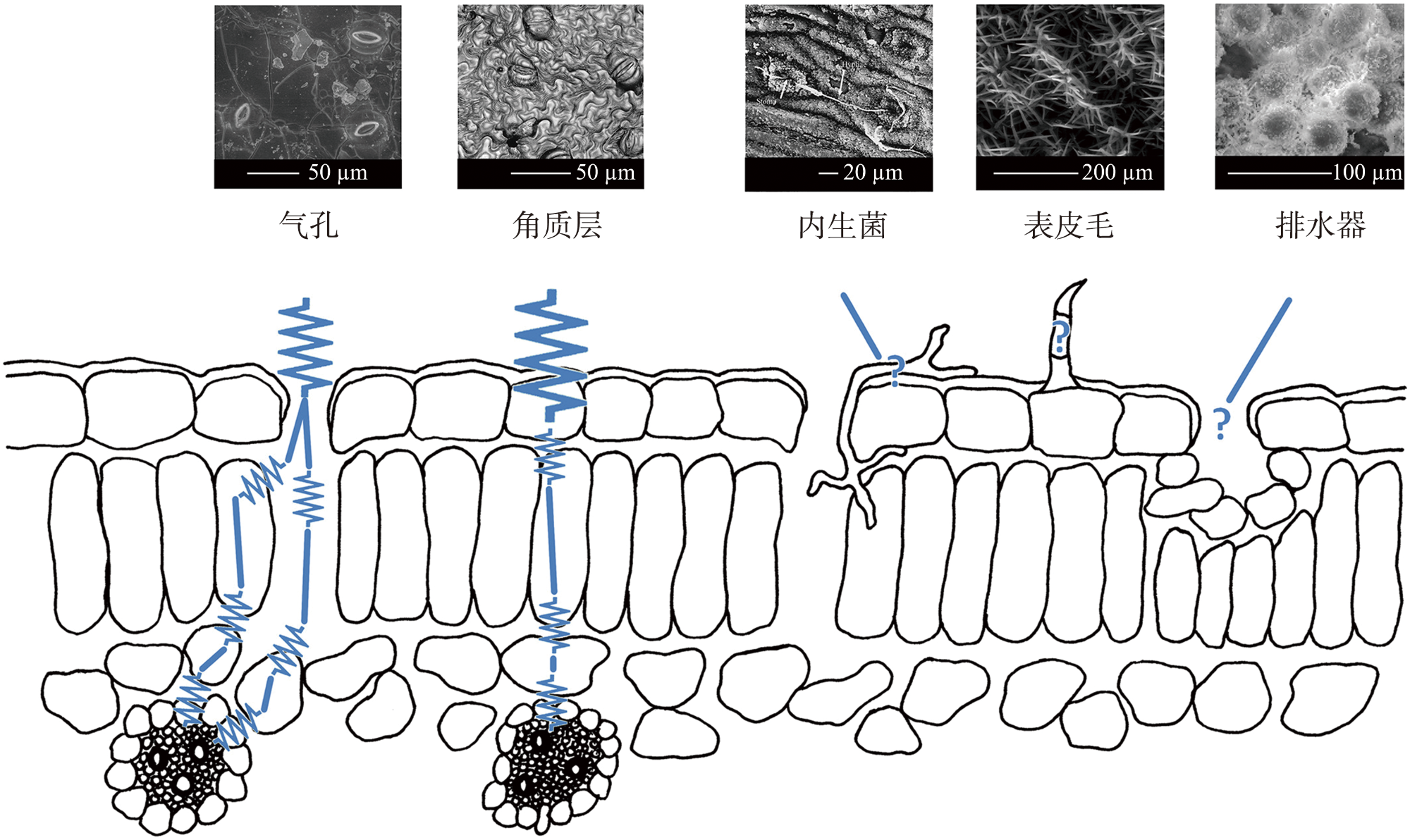
荒漠地区植物的水分资源输入量极少,主要涉及大气降水与凝结水[1]。由于昼、夜温度差异显著,导致靠近地面的空气中来自土壤蒸发和植物蒸腾的水汽遇到足够冷的地表或植物体表时产生水分凝结,特别是在春秋温差较大的季节[2]。凝结水作为一种洁净的水源,对极度缺水的荒漠植物具有重要的生态学意义[3]。通常叶片表面吸收水分的主要途径有气孔(Stoma)[4]、角质层(Cuticle)[5]、内生菌(Endophyte)[6]、表皮毛(Trichome)[7]、排水器(Hydathode)[8]等,如图1所示[9]。其中表皮毛被证实具有多种功能[10],包括吸收凝结水特性[11]。表皮毛的存在增加了叶片表面的润湿性及水分滞留时间[12],凝结水可以通过水滴的形式保留在叶片表皮毛层中[13],从而保证植物最大限度地获取凝结水资源[14]。国外学者模拟荒漠植物猪毛菜(Salsola crassa)表皮毛收集雾液滴的现象研发了雾收集材料[15]。近百年以来,国外学者对于荒漠植物相关领域开展了大量的研究;而国内的研究近二十年才起步。本文基于国内外对表皮毛的凝结水形成及吸收机制相关研究进行了综述,以期为表皮毛等荒漠植物特殊结构与植物相互作用的相关研究提供借鉴。
图1 叶片表面吸收水分的几种可能途径

注:图中第一行为叶片表面吸收水分的组织结构,第二行为叶片细胞内/间的水分通道。

Fig. 1 The possible pathways of water absorption on leaf surface

1 凝结水对荒漠植物的生态效应

荒漠地区由于昼夜温差效应,常导致靠近地表空气中的水汽在冷凉的植物体表凝结成水滴[16],随后被植物吸收。这种现象常见于旱生植物和盐生植物[17],由于特化或附属结构使其可以更容易从空气中吸收水分,从而使凝结水成为荒漠植物重要的水分来源。

1.1 植物体表结露量及持续时间

荒漠地区靠近地面的温和潮湿空气(特别是雾)遇到冷凉的植物体表时容易形成凝结水[18],荒漠地区形成雾天的数量主要与地理位置等因素有关[19]。通常干旱、半干旱地区的雾沉降天气主要发生在6—10月。夏季昼夜温差大,虽降水减少但雾沉降量增加,特别是6、7月的夜间和清晨容易出现较强的雾集;而秋季降水增加,雾沉降量减少[20]。通常雾水量的平均值约为0.16 L·m-2,而凌晨的雾水量峰值约为0.21 L·m-2[21]。塔克拉玛干沙漠东缘荒漠河岸林植物在生长季的冠层结露天数与结露量分别为86 d和8.64 mL。对过去近50 a气象资料统计结果显示,约五分之一时间内的降雨量低于凝结水总量,因此,凝结水是塔克拉玛干沙漠地区植物的重要水资源之一[22]

1.2 植物凝结水的生物学效应

通常植物叶片能够直接吸收水分(Foliar Water Uptake,FWU)[23]。有研究显示[24],超过85%的研究物种都观察到了FWU现象,FWU现象已被认为是个体、种群、物种和生态系统之间具有差异的共同过程。叶表结构可以显著改变叶片的润湿度和水分保留特性,如表皮蜡质[25]、气孔[26]、表皮毛[27]等结构。叶面水分吸收会引起叶片内部化学能梯度变化,通常用“水势”(ψ)来描述此变量。由于叶片内部通常处于水分饱和状态(高水势),而大气处于水分不饱和状态(低水势),从而导致水分的净流出(即蒸腾)[28]。如果叶片要吸收水分,叶片水势须比周围微环境低[29]。而当凝结水在叶片局部表面形成时就造就了叶片内部低水势的微环境,使叶面能够直接吸收凝结水,从而显著改变叶片水分状况[30]

1.3 植物凝结水的生态效应

尽管已经在许多植物中证明了叶片吸收露水的特性[31],但是这种自然现象的生态学意义仍然存在争议[32]。Monteith[33]提出假设,一方面如果叶片表面凝结水蒸发太快,将不会显著影响植物内部的水分含量;另一方面,如果植物通过根部吸收了足够的水分,则叶片吸收的少量凝结水也不会对植物的适应性做出显著的贡献。然而,相反的观点认为,在经常形成凝结水的干旱环境中,叶表吸收获得的水分即使没有发生长距离运输,对植物也能起到显著的生态效应。刘志东等[34]通过对荒漠短命植物狭果鹤虱(Lappula semiglabra))的研究表明,其叶片表皮毛对水分的吸收具有明显的影响,去除叶片被毛的狭果鹤虱的叶厚、叶重、叶片水势、净光合速率、气孔导度以及地上生物量(干重)均有显著变化。

2 荒漠植物表皮毛滞留、形成凝结水的机制

许多荒漠植物叶片表面具有短柔毛[35],由此形成的粗糙界面与叶表皮构成了一个“空气穴”结构,此结构有利于捕获空气中的水滴,从而在液体-固体之间形成一个超疏水表面[36]。当遇到与表面粗糙尺度相当的较小液滴时,如雾天形成的液滴大小为1~40 μm3,就能够渗入“空气穴”使其无法再保持超疏水状态,从而导致水分在植物叶表面滞留和扩散[37]。此模型被称为“Cassi-Baxter”模型,而超疏水表面的形成可能导致较大水滴从叶表面脱落[38]

2.1 叶片表面润湿特性及其影响因素

2.1.1 叶片表面润湿特性

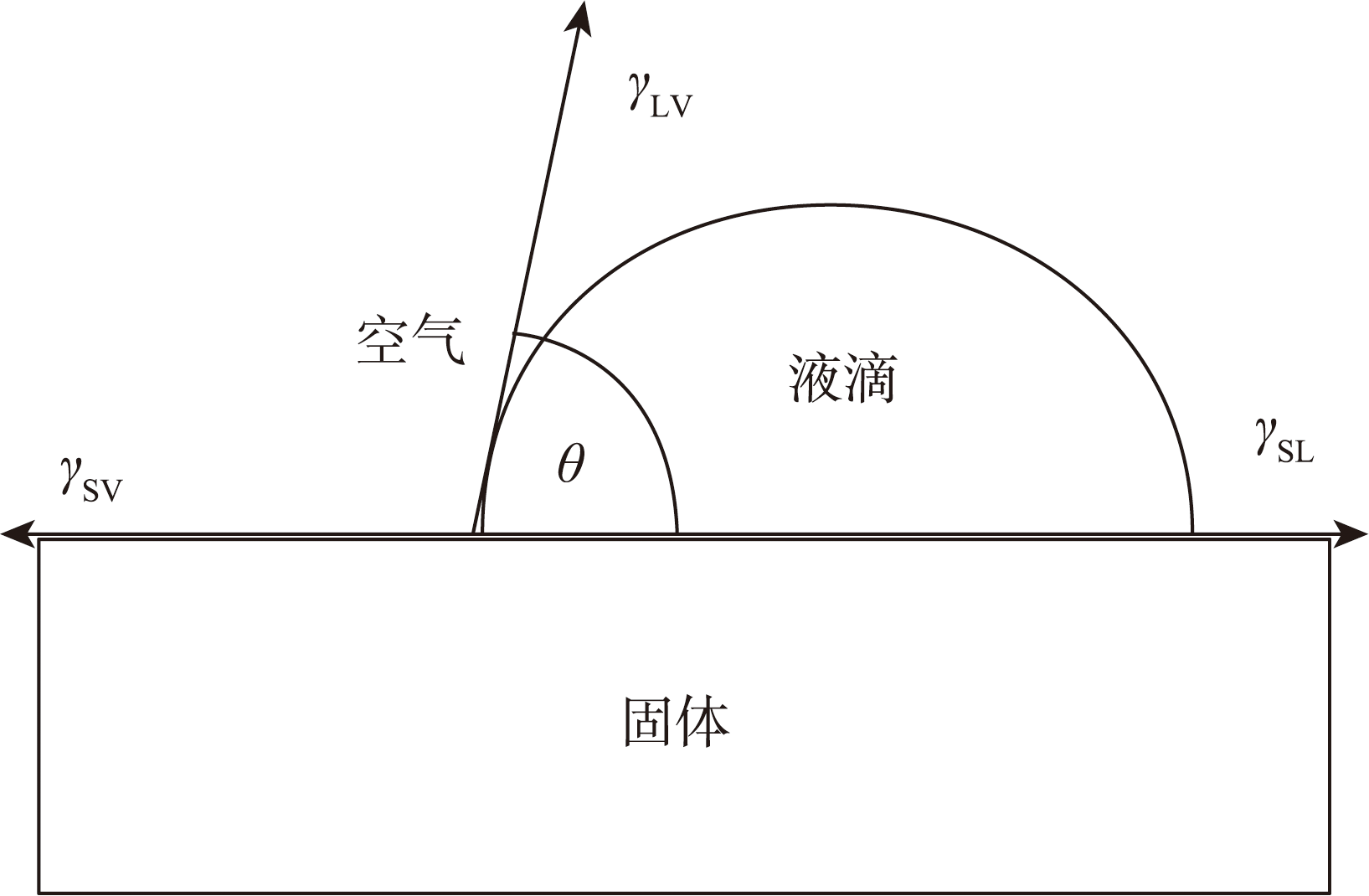
润湿是液体与固体表面保持接触的能力,是分子间相互作用的结果,通常由气、固、液界面可测量的水滴接触角来表征[39]图2)。接触角是液体和固体之间粘附力的反向测量值,接触角越小,液体在固体表面扩散面积越大;接触角越大,液体与表面的接触越少,更易形成球状水滴[40]。叶片表面润湿特性差异决定液滴接触角大小,这些特性包括表皮毛的数量和形态[41]、表皮细胞的微观三维结构[42]、蜡质层微观结构和组成[43]、气孔的数量和分布[44]等,可用下列润湿方程表示:
γ L V c o s θ = γ S V - γ S L
图2 液滴在水平固体表面的接触角示意图

Fig. 2 Contact angle of a drop resting upon a plane solid surface

式中:γLV为液气界面张力,γSV为固气界面张力,γSL为固液界面张力,θ为接触角[45]
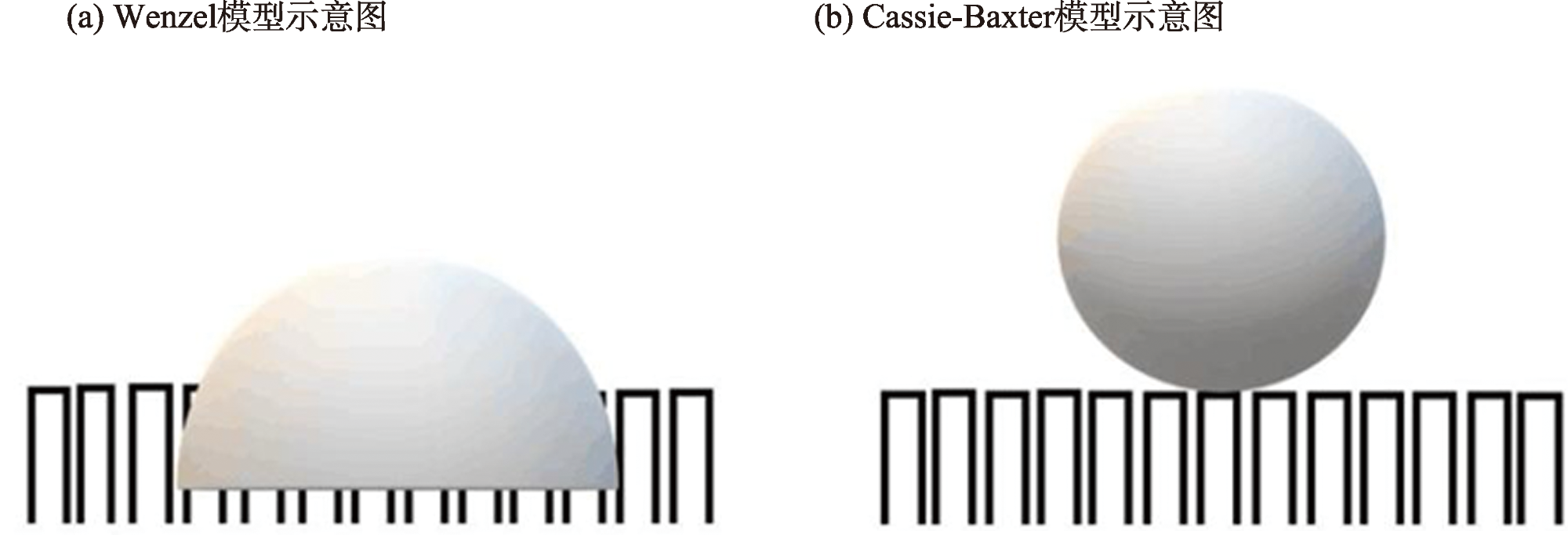
自然条件下多数植物的叶片表面都不是光滑的,这是叶面的疏水物质与粗糙因素共同作用的结果,并由此改变叶面的润湿性能。Wenzel(1936)[46]和Cassie 和Baxter(1944)[36]分别改进了Young方程,并结合固体表面的接触角与粗糙度,分别提出了Wenzel模型和Cassie-Baxter模型。Wenzel提出,由于非光滑表面的存在,实际固液接触面积大于表观几何观察面积,因此疏水性(或亲水性)增加,并假设液体始终可以填充表面的沟槽,如图3a所示;Cassie和Baxter则提出,液滴在非光滑表面上的接触是一种复杂的行为,由于微结构表面的尺度小于液滴的尺寸,当表面具有高度疏水性时,疏水性表面上的液滴不能填满表面的沟槽,空气被滞留在液滴下方,如图3b所示。
图3 非光滑表面疏水模型

Fig. 3 Schematic diagram of the hydrophobic model on non-smooth surface

2.1.2 叶片表面润湿性影响因素

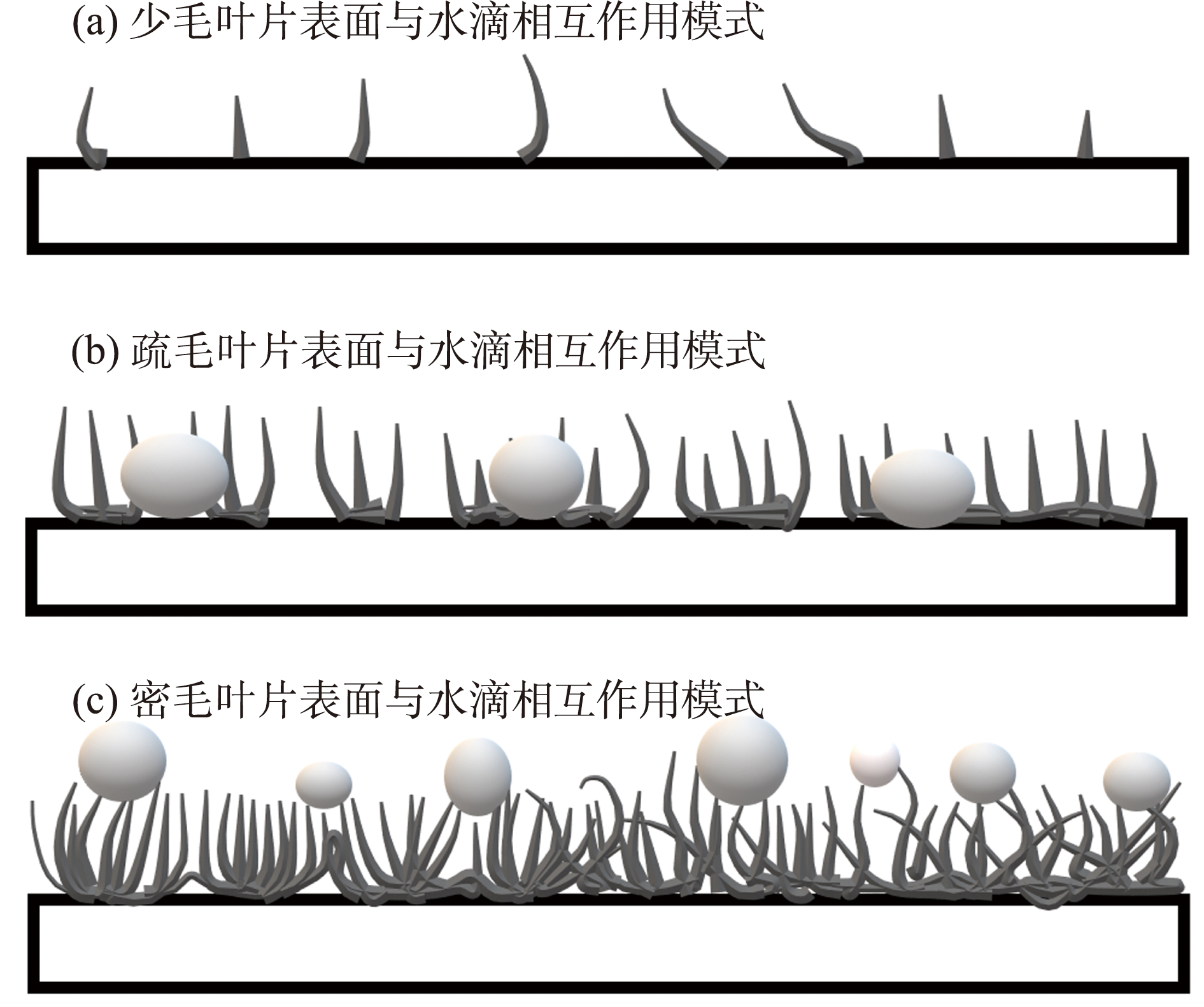
许多荒漠植物叶片表面覆盖有表皮毛,研究表明,表皮毛的密度、结构等均会导致显著不同的叶片润湿性[47]。表皮毛密度不同,则表皮毛与水分相互作用也会有所差异。研究表明,不同密度表皮毛与水分相互作用有三种不同模式,分别是少毛叶片表面与水滴相互作用模式、疏毛叶片表面与水滴相互作用模式、密毛叶片表面与水滴相互作用模式,如图4所示,表皮毛的密度不同则液滴接触角大小不同[12]。研究显示,接触角与表皮毛密度之间存在正相关[48],当1 mm2表皮毛密度大于25根时可形成表皮毛冠层结构,导致叶片具有更强的疏水性[49]。研究显示,被浓密的圆锥形表皮毛覆盖的荒漠植物叶面接触角可达到139°,而被疏生的绒毛覆盖的叶面接触角约为70°。表皮毛结构的变化(如有无蜡质)对叶片润湿性会产生显著的影响[50]。如蜡状表皮毛的近轴面极疏水,无蜡表皮毛的叶面只在短时间内拒水;不含蜡质的羊草(Leymus chinensis)毛状体背面接触角仅为97°;而蜡状表皮毛叶面具有极强的拒水性,其接触角可达150°[51]
图4 水滴和植物叶表面表皮毛之间的三种相互作用方式

Fig. 4 Three interaction patterns between water droplets and leaf trichomes

2.2 叶片表面形成凝结水的物理机制

凝结水的形成是气态水与物体表面接触时转化为液态水的相变过程[52]。此过程包括以下4个物理学现象:异相成核、自相似增长、核植入以及液滴清除[53],其中成核是形成热力学稳定的纳米尺度水滴的过程[54]。自然大气中的水汽凝结成核的首要条件是凝结表面温度低于或等于露点温度[55],因此,合适的低温条件对凝结水的沉积至关重要。当环境温度低于露点温度时,空气中的水饱和蒸汽压降低,形成的凝结水增加。通常沙漠夜间的环境温度可低至0 °C左右,从而导致凝结水的大量形成[56]。其次,凝结水的形成需要大气中承载足够的水蒸气,水蒸气含量越高,形成凝结水的速率越快[57]

3 荒漠植物表皮毛吸收和利用凝结水的机制

在植物附属结构中,表皮毛是最强的防御结构之一,其复杂的三维网络能够帮助植物适应不同的恶劣环境[58]。表皮毛由单细胞或多细胞组成,分布于被子植物表面[59],具有不同的形态和结构。非腺状表皮毛常见的结构有圆锥状、针状、叶状等,具有减少水分蒸腾、提高异常温度耐受、保护植物免受紫外线辐射和昆虫及食草动物的伤害[60]。不仅如此,荒漠植物通过表皮毛促进凝结水的形成和吸收,从而改善叶片的水分状况[61]

3.1 表皮毛结构特征及吸水性

3.1.1 表皮毛结构特征

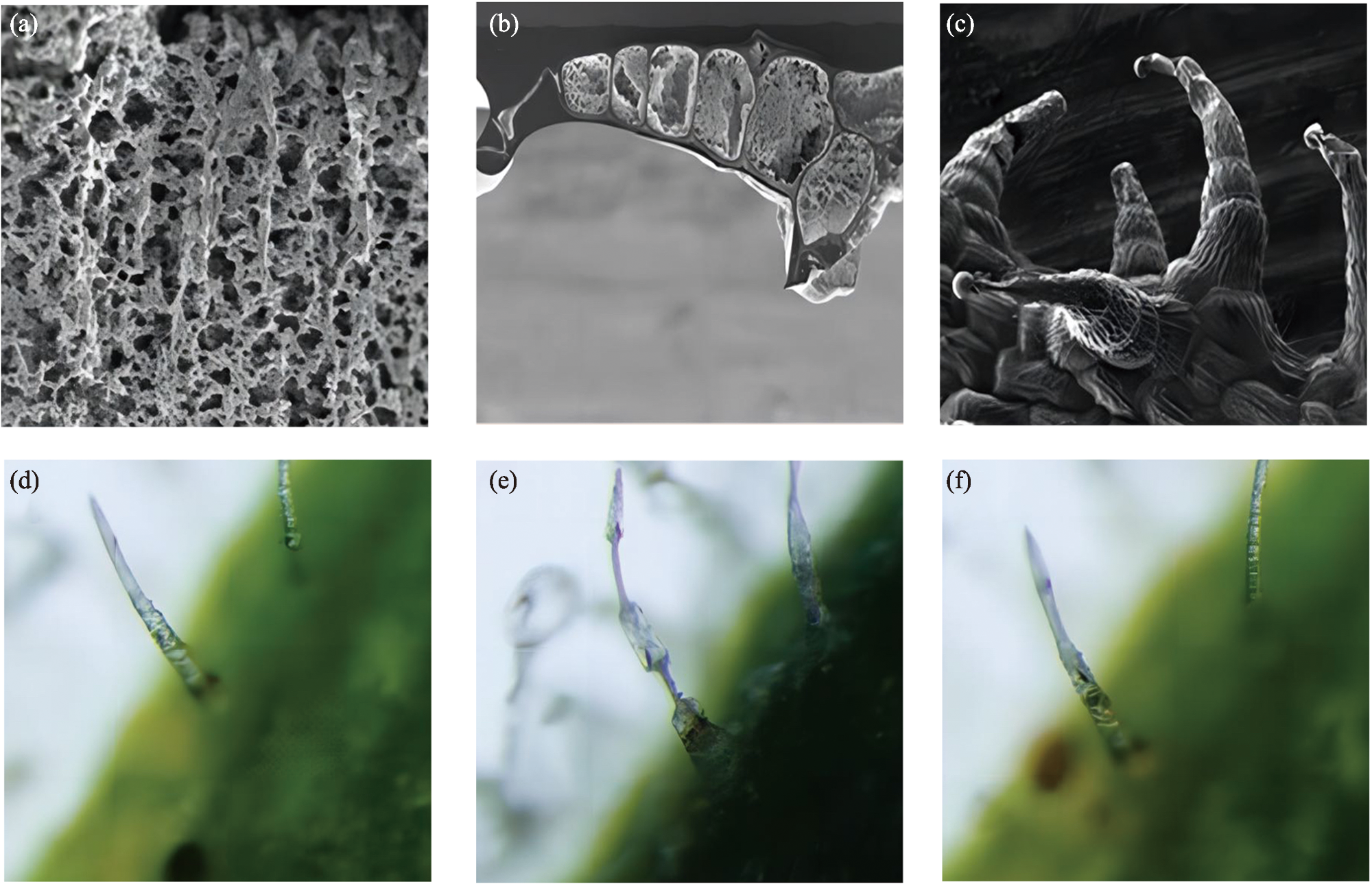
在纳米布沙漠干旱区,许多植物叶片表面具有纤维状的表皮毛,可通过促进凝结水的形成和吸收帮助植物获取水分[62]。日本学者以干旱条件下生长的具有圆锥状表皮毛结构的植物为材料,基于表皮毛形态变化与水分互作特性,探索了锥状表皮毛扭曲结构的形成,从而初步揭示了表皮毛收集凝结水以及表皮毛中微纤维储存和释放水分的特性:锥形表皮毛内部具有微纤维结构,扫描电镜下的结构如图5c所示,锥形表皮毛垂直切片结构如图5b所示,将锥形表皮毛垂直切片进一步放大后显示海绵状微纤维纹理(图5a);当水滴附着在表皮毛上后,表皮毛立即变成圆锥形(图5d),干旱条件下锥形表皮毛能够可逆地转化为垂直扭曲的压片结构(图5e),当再次接触水滴时恢复圆锥形结构(图5e),表皮毛这种可变化的结构有利于快速吸收、储存水分并进一步输送到叶肉细胞内[63]
图5 锥状表皮毛结构及水分捕获

Fig. 5 Structure and water harvesting of a conical trichome

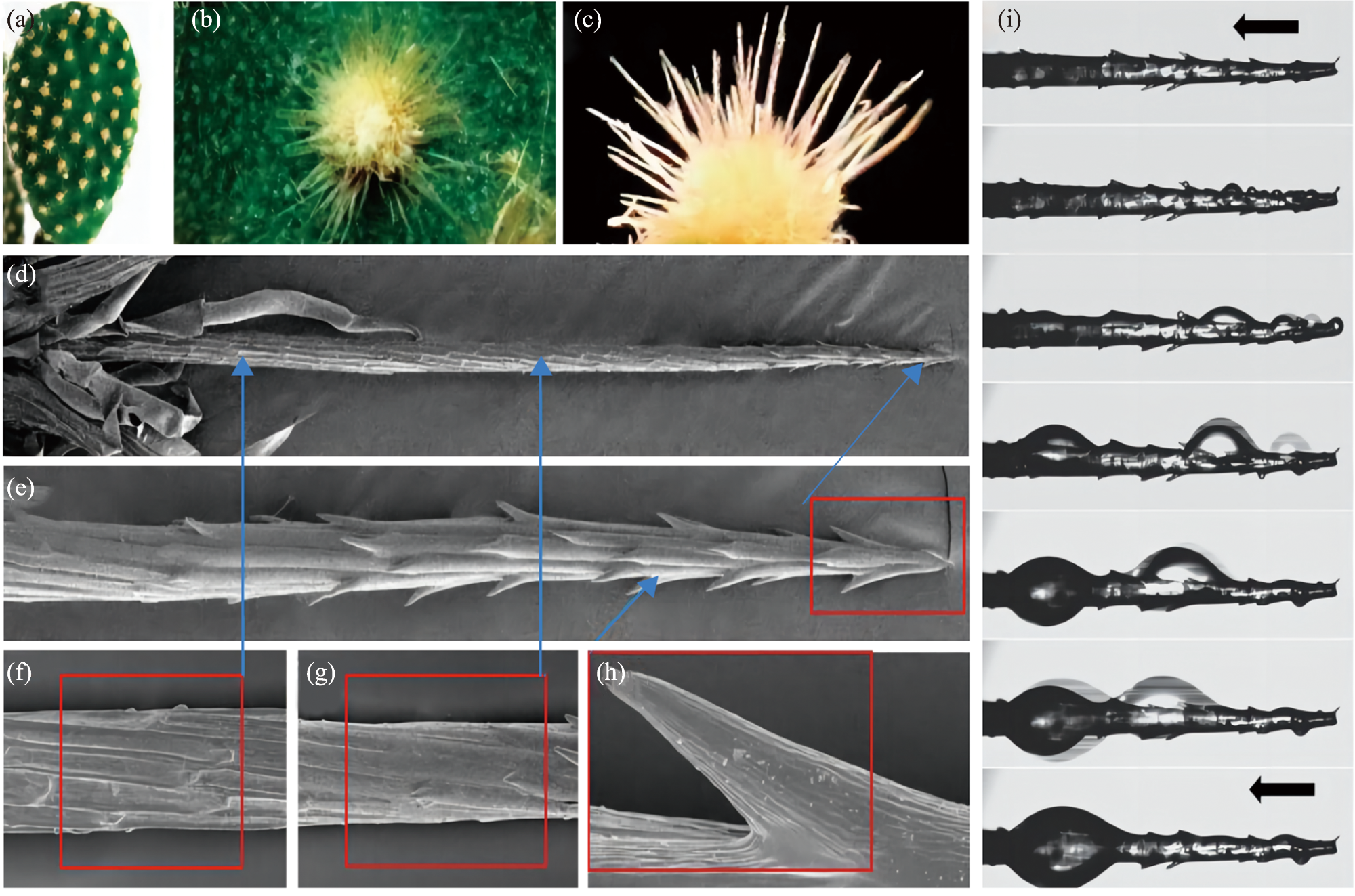
大多数仙人掌(Opuntia stricta)生长在荒漠地区或极端干燥的环境(如阿塔卡马沙漠)。为了适应恶劣环境,仙人掌进化出了高效的凝结水收集系统,该系统主要依靠叶片表面分布的针状表皮毛结构。所有仙人掌的茎都具有不同形状的增厚和肉质部分(图6a),适合储存水分;在长期进化过程中,仙人掌为了减少蒸发而失去了真正的叶片,只保留了针状的表皮毛结构(图6b图6c);单根仙人掌刺具有特殊的结构(图6d),包括锥形尖端(图6e)、较宽凹槽部分(图6f)、较窄凹槽部分(图6g)、倒刺结构部分(图6h);在以上特殊结构驱使下,水滴在单刺表面能够克服重力的作用,向叶片表面运动,箭头表示水滴移动方向(图6i[64]
图6 针状表皮毛结构及其集水现象

Fig. 6 Structure and water harvesting of needle-like trichome

3.1.2 表皮毛吸水特性

水的定向输送是由疏水/亲水双层驱使的结果[65],因为非均相表面张力可以诱导一种驱动力来辅助水的定向输送[66]。利用先进的生物成像技术对仙人掌的有效吸附凝结水及贮藏机理进行的探索实验证实,毛细管力可以促进其刺状表皮毛表面的凝结水滴移动到仙人掌茎中。荒漠区的高温、低湿有利于快速蒸发,由于其相对较高的蒸发速率,很难将叶片蒸腾降至最低,因此,表皮毛的疏水性增加了表皮毛的粘附性并降低其蒸腾速率。由此推测,仙人掌茎可以当作由疏水性表皮毛与亲水性粘液组成的双层材料,从而驱使水滴可以自发地从仙人掌表皮毛疏水层向亲水层渗透。当水滴在表皮毛表面形成Wenzel模型时,水分很快被吸收到茎中,而相反方向的传输会受到限制,从而使水滴扩散到亲水区域[67]

3.2 表皮毛驱动凝结水吸收的作用机制

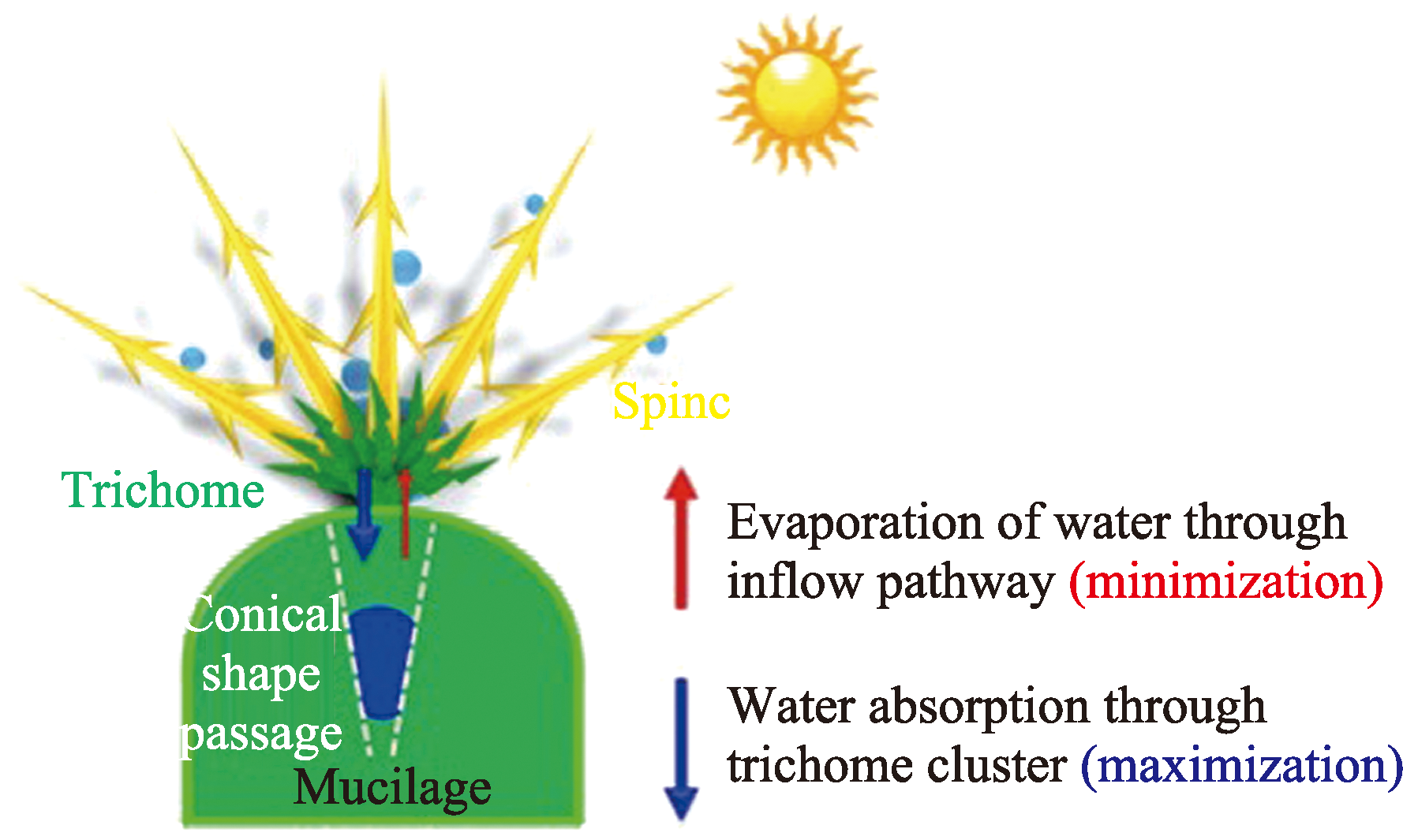
仙人掌的刺结构可以看作是表面有直线沟槽的锥状体,大量收集的凝结水通过表皮毛被吸收,少量水分通过流入路径被蒸发。仙人掌的生存策略如图7所示,当太阳升起时,水滴凝结在刺上,通过表皮毛簇吸收(向下方向,蓝色箭头),仙人掌茎中的粘液则能够减少水分蒸发的损失(向上,红色箭头)[68]
图7 仙人掌生存策略示意图

注:Mucilage(粘液);Spine(刺);Trichome(表皮毛);Conical shape passage(锥形通道);Evaporation of water through inflow pathway(水通过流入通道蒸发);Water absorption through trichome cluster(表皮毛簇吸收水分)。

Fig. 7 Schematic diagram of survival strategies of cactus

3.2.1 拉普拉斯压力差

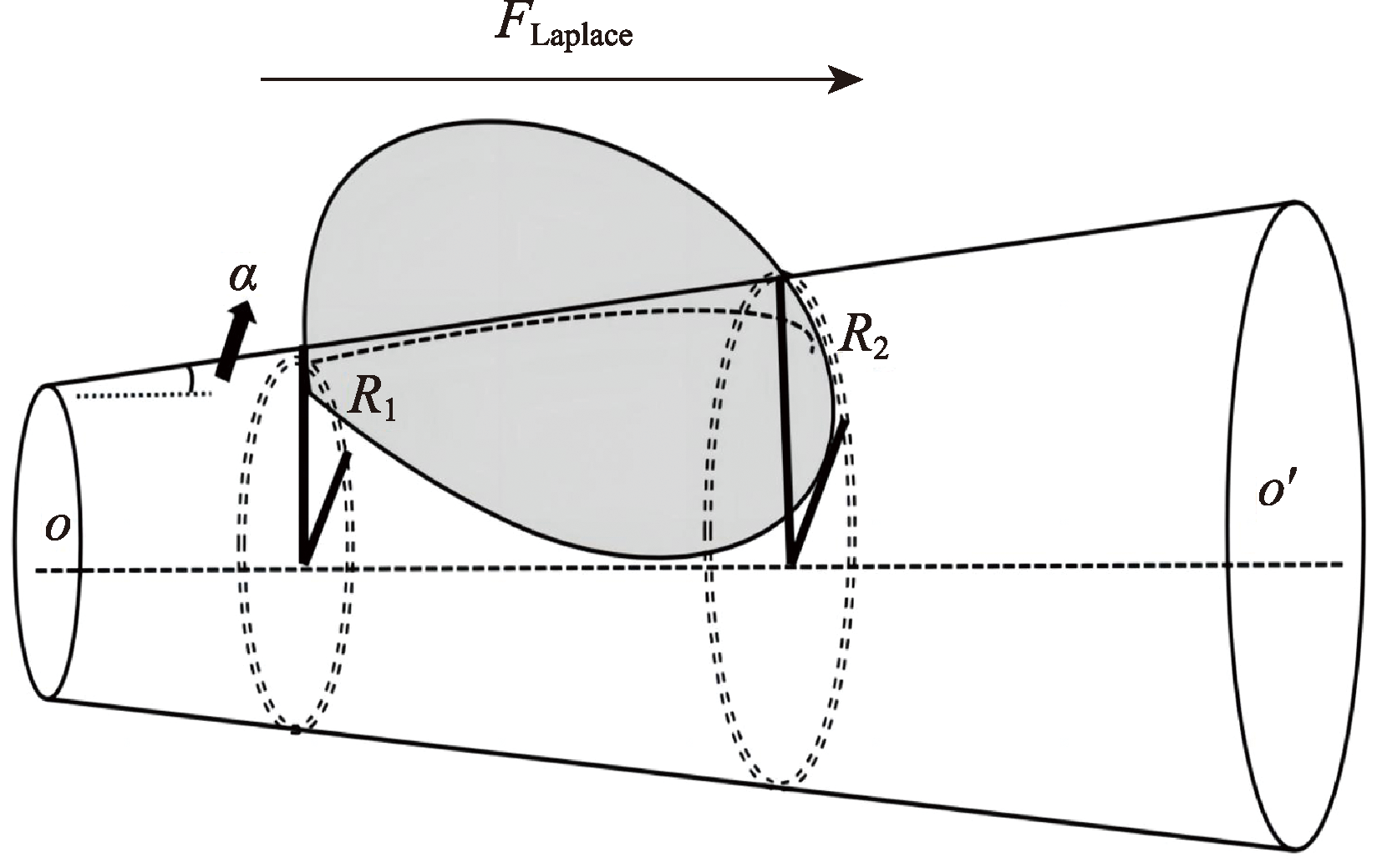
拉普拉斯压力差是液滴在曲率半径不同的单个毛或刺上所形成的压力差,其能够赋予液滴从毛或刺尖向根部移动的驱动力(图8[69]。这种锥体使两端液滴的局部半径不同从而产生拉普拉斯压差。可以根据拉普拉斯压强公式计算[70]
图8 锥形针刺结构上产生拉普拉斯压差驱动液滴运动的示意图

注:Laplace(拉普拉斯压力)

Fig. 8 A droplet motion driven by Laplacian differential pressure on a tapered needle structure

P = - R 1 R 2 12 γ ( R + R 0 ) 2 s i n α d z
式中:R1R2分别表示尖刺两端局部半径;R表示尖刺的局部半径;R0表示液滴径;γ表示水滴表面张力;α表示尖刺半锥角;dz表示尖刺的半径增量。

3.2.2 表面自由能梯度

表面自由能梯度也可以产生一个驱动力(F[71],使顶端收集的水滴能够向基部移动。仙人掌刺表面的微沟具有宽度梯度,靠近刺底处的结构较为粗糙稀疏。关于表面自由能梯度所产生的驱动力如下列公式所示。
F = l t i p I b a s e γ ( c o s θ A - c o s θ R ) d l
式中:γ表示粗糙度系数;θA表示刺中部液滴的前接触角;θR表示刺中部液滴的后接触角;dl表示从刺顶尖至底部积分变量。

4 植物体表滞留及吸收凝结水的研究方法

随着先进技术在叶表面水分研究领域的广泛应用,水分与叶片表面相互作用的机制逐渐得以解析。目前用于相关研究的方法涉及叶片解剖法、热脉冲与同位素示踪技术、叶片压力室法、环境扫描电镜法、荧光示踪法等。

4.1 解剖法

叶片是植物进行光合与蒸腾作用的主要器官[72],叶片表面及内部组织结构特征变化受水分、温度等外部环境因素影响较大。Schreel等[73]通过超微切片结合透射电镜观察到叶表皮细胞壁外层具有角质层而表皮毛细胞壁外层无角质层结构。Brighigna等[30]在水分胁迫条件下使用解剖法研究了松萝凤梨(Tillandsia usneoides)表皮毛超微结构,深入揭示了表皮毛形成及吸收水分的细胞系统,证实了营养物质的运输是由细胞质分泌过程中产生的亲水物质所促进。

4.2 热脉冲与同位素示踪技术

热脉冲和同位素示踪是生态生理学研究的常用技术之一。前者可在植物生长状态基本不变的情况下进行简单、实时、准确地测定植物冠层的蒸腾耗水量[74];后者是利用同位素或标记的化合物来指示和追踪相应元素和化合物在生物及其环境介质中的迁移、转化和积累的实验技术,通过氢氧稳定同位素分析植物叶和茎所含水分[75]。Burgess等[76]采用热脉冲技术发现,在足够凝结水形成的条件下,北美红杉(Sequoia sempervirens)出现树液倒流现象,同时利用同位素示踪技术证明其叶片可以直接吸收凝结水。随着干旱区叶面吸收水分的广泛研究,热脉冲与同位素技术将成为今后该领域深入研究的主要方法。

4.3 叶片压力室法

叶片压力室法被广泛用于测定植株水势,该方法简单、测定值稳定[77]。水分进入细胞通常是顺水势梯度进行,用水势(ψ)来表示水的运动方向[78]。Waseem等[79]在干旱胁迫下对锦鸡儿(Caragana korshinskii)进行了三种处理,充分浇水、有凝结水的干旱胁迫和无凝结水的干旱胁迫,结果表明与水分充足的植物相比,干旱胁迫植物近轴和远轴叶表面的毛状体密度分别增加了约50%和25%,以叶片水势(ψ)作为生理指标比较表皮毛对凝结水的吸收能力,结果表明有凝结水的植物中的叶片水势比没有凝结水的植物高约-2.6 MPa,从而证明表皮毛是重要的水分吸收结构。

4.4 环境扫描电镜法

为了更具体观察到含水样品真实形貌,基于扫描电镜原理先后产生了环境扫描电镜(Environmental Scanning Electron Microscope,ESEM)、冷冻扫描电镜(Cryogenic Scanning Electron Microscopy,Cryo-SEM)等技术。ESEM是在多级压差光阑技术下,最大程度减缓含水样品的水分散失[80]。Cryo-SEM是在固态氮气超低温冷冻条件下,使样品的液体水形成玻璃态的冰,以减少液体冷冻聚集,从而不影响样品表面形貌[81]。相关学者利用环境扫描电镜在微、纳米水平上对新鲜荷叶上微滴的动态悬浮行为进行了原位研究。在水滴凝结过程中,水滴沿着纳米级的乳头外表面形成了一个可湿性的微纳米结构梯度,这种梯度驱使水滴定向运动。此研究充分揭示了自然界中莲叶表面形成露珠的机制,有助于我们从微观和纳米角度解释自清洁的原理[82]

4.5 荧光示踪法

荧光显微技术可以利用特征波长的光在被检测物体上产生荧光进行显微检查[83]。如某些物质在不同光波下的荧光特性可以用来观察和研究植物细胞[84]。Pina等[85]通过荧光示踪技术对巴西半干旱地区的风车子属植物(Combretum leprosum)叶片凝结水的吸收进行研究,揭示了亲水性绒毛吸收的凝结水可通过栅栏组织进入叶肉细胞,证明了表皮毛不仅可以吸收水分还可以平衡植物体内水分的分布。

5 展望

本文基于干旱植物积水机理的研究进展,概述了凝结水形成的机制及对植物的作用效应,重点综述了叶片表面润湿特性理论,指出表皮毛在滞留凝结水过程中的关键作用;进一步探讨了表皮毛的存在对荒漠植物生存适应的影响,为荒漠植物耐旱机制研究提供借鉴。本课题组在前人研究基础上,结合多种方法研究了费尔干猪毛菜(Salsola ferganica)表皮毛结构特征及其对叶表面润湿性的影响,微观结构观察结果显示,费尔干猪毛菜表皮毛结构可能有助于从空气中捕获水分,而表皮毛表面的物理化学特性,包括疏水官能团、亲水性果胶和低结晶度,可能会增强水滴对表皮毛的附着力,提高对水份的获取,使其能够在恶劣条件下生存[86]。但是需要更多的研究来确定其纳米尺度结构和化学组成对其润湿的影响。
由于受到研究技术的限制,目前表皮毛的功能及其与植物相互作用机制的研究进展较为缓慢。在今后的研究中还需借助精密仪器进一步从组织、细胞、生理生化及分子生物学层面进行深入探索,深入研究荒漠植物表皮毛对凝结水的高效利用机制。与此同时,还需将理论与实践相结合,将表皮毛的仿生结构应用于实践中,如模仿某些植物创制3D高效捕雾机等研究,这些实践将对干旱地区水分利用产生积极的影响。
[1]
Eckardt F D, Soderberg K, Coop L J, et al. The nature of moisture at Gobabeb, in the central Namib Desert[J]. Journal of Arid Environments, 2013, 93(36): 7-19.

DOI

[2]
Agam N, Berliner P R. Dew formation and water vapor adsorption in semi-arid environments-A review[J]. Journal of Arid Environments, 2006, 65(4): 572-590.

DOI

[3]
Hill A J, Dawson T E, Shelef O, et al. The role of dew in Negev Desert plants[J]. Oecologia, 2015, 178(2): 317-327.

DOI PMID

[4]
Emery N C. Foliar uptake of fog in coastal California shrub species[J]. Oecologia, 2016, 182(3): 731-742.

DOI PMID

[5]
Fernández V, Bahamonde H A, Javier Peguero-Pina J, et al. Physico-chemical properties of plant cuticles and their functional and ecological significance[J]. Journal of Experimental Botany, 2017, 68(19): 5293-5306.

DOI PMID

[6]
Burgess S S O, Dawson T E. The contribution of fog to the water relations of Sequoia sempervirens (D. Don): Foliar uptake and prevention of dehydration[J]. Plant, Cell & Environment, 2004, 27(8): 1023-1034.

[7]
Ohrui T, Nobira H, Sakata Y, et al. Foliar trichome-and aquaporin-aided water uptake in a drought-resistant epiphyte Tillandsia ionantha Planchon[J]. Planta, 2007, 227(1): 47-56.

DOI PMID

[8]
Martin C E, Willert V D J. Leaf epidermal hydathodes and the ecophysiological consequences of foliar water uptake in species of Crassula from the Namib Desert in Southern Africa[J]. Plant Biology, 2000, 2(2): 229-242.

DOI

[9]
Berry Z C, Emery N C, Gotsch S G, et al. Foliar water uptake: Processes, pathways, and integration into plant water budgets[J]. Plant, Cell & Environment, 2019, 42(2): 410-423.

[10]
Bickford C P. Ecophysiology of leaf trichomes[J]. Functional Plant Biology, 2016, 43(9): 807-814.

DOI PMID

[11]
Schreel J D M, Leroux O, Goossens W, et al. Identifying the pathways for foliar water uptake in beech (Fagus sylvatica L.): A major role for trichomes[J]. The Plant Journal, 2020, 103(2): 769-780.

DOI PMID

[12]
Brewer C A, Smith W K, Vogelmann T C. Functional interaction between leaf trichomes, leaf wettability and the optical properties of water droplets[J]. Plant, Cell & Environment, 1991, 14(9): 955-962.

[13]
Masrahi Y S. Glochids microstructure and dew harvesting ability in Opuntia stricta (Cactaceae)[J]. Journal of King Saud University-Science, 2020, 32(8): 3307-3312.

DOI

[14]
庄艳丽, 赵文智. 荒漠植物雾冰藜和沙米叶片对凝结水响应的模拟实验[J]. 中国沙漠, 2010, 30(5): 1068-1074.

[Zhuang Yanli, Zhao Wenzhi. Experimental study of effects of artificial dewon Bassia dasyphylla and Agriophyllum squarrosum[J]. Journal of Desert Research, 2010, 30(5): 1068-1074.]

[15]
Gürsoy M, Harris M T, Downing J O, et al. Bioinspired fog capture and channel mechanism based on the arid climate plant Salsola crassa[J]. Colloids and Surfaces A: Physicochemical and Engineering Aspects, 2017, 529(25): 195-202.

DOI

[16]
Baier W. Studies on dew formation under semi-arid conditions[J]. Agricultural Meteorology, 1966, 3(1-2): 103-112.

DOI

[17]
Ebner M, Miranda T, Roth-Nebelsick A. Efficient fog harvesting by Stipagrostis sabulicola (Namib dune bushman grass)[J]. Journal of Arid Environments, 2011, 75(6): 524-531.

DOI

[18]
Mares M A. Encyclopedia of Deserts[M]. Norman: University of Oklahoma Press, 2017: 383-384

[19]
Lancaster J, Lancaster N, Seely M K. Climate of the central Namib Desert[J]. Madoqua, 1984, 14(1): 5-61.

[20]
Shanyengana E S, Henschel J R, Seely M K, et al. Exploring fog as a supplementary water source in Namibia[J]. Atmospheric Research, 2002, 64(1-4): 251-259.

DOI

[21]
Hiatt C, Fernandez D, Potter C. Measurements of fog water deposition on the California Central Coast[J]. Atmospheric and Climate Sciences, 2012, 2(4): 525.

DOI

[22]
Hao X, Li C, Guo B, et al. Dew formation and its long-term trend in a desert riparian forest ecosystem on the eastern edge of the Taklimakan Desert in China[J]. Journal of Hydrology, 2012, 472(50): 90-98.

[23]
Hayes M A, Chapman S, Jesse A, et al. Foliar water uptake by coastal wetland plants: A novel water acquisition mechanism in arid and humid subtropical mangroves[J]. Journal of Ecology, 2020, 108(6): 2625-2637.

DOI

[24]
Williams H F. Absorption of water by the leaves of common mesophytes[J]. Journal of the Elisha Mitchell Scientific Society, 1932, 48(1): 83-100.

[25]
Cernusak L A, Ubierna N, Jenkins M W, et al. Unsaturation of vapour pressure inside leaves of two conifer species[J]. Scientific Reports, 2018, 8(1): 1-7.

[26]
Vesala T, Sevanto S, Grönholm T, et al. Effect of leaf water potential on internal humidity and CO2 dissolution: Reverse transpiration and improved water use efficiency under negative pressure[J]. Frontiers in Plant Science, 2017, 8(8): 54-64.

[27]
Simonin K A, Santiago L S, Dawson T E. Fog interception by Sequoia sempervirens (D. Don) crowns decouples physiology from soil water deficit[J]. Plant, Cell & Environment, 2009, 32(7): 882-892.

[28]
Koch K, Bhushan B, Jung Y C, et al. Fabrication of artificial Lotus leaves and significance of hierarchical structure for superhydrophobicity and low adhesion[J]. Soft Matter, 2009, 5(7): 1386-1393.

DOI

[29]
Lange O L, Lösch R, Schulze E D, et al. Responses of stomata to changes in humidity[J]. Planta, 1971, 100(1): 76-86.

DOI PMID

[30]
Brighigna L, Palandri M R, Giuffrida M, et al. Ultrastructural features of the Tillandsia usneoides L. absorbing trichome during conditions moisture and aridity[J]. Caryologia, 1988, 41(2): 111-129.

DOI

[31]
Cui L, Yingying M, Nina W, et al. The overlooked functions of trichomes: Water absorption and metal detoxication[J]. Plant, Cell & Environment, 2022, 46(3): 669-687.

[32]
Stone E C. The ecological importance of dew[J]. The Quarterly Re-view of Biology, 1963, 38(4): 328-341.

[33]
Monteith J L. Dew: Facts and fallacies[J]. The Water Relations of Plants, 1963: 37-56.

[34]
刘志东, 吕光辉, 张雪妮, 等. 叶片被毛对干旱区短命植物狭果鹤虱生理生态特征的影响[J]. 干旱区研究, 2017, 34(5): 1101-1108.

[Liu Zhidong, Lv Guanghui, Zhang Xueni, et al. Response of physiological and ecological indexes of ephemeral plant Lappula semiglabra with leaf hairs in Arid Area[J]. Arid Zone Research, 2017, 34(5): 1101-1108.]

[35]
李洁, 张铭芳. 植物表皮毛发育调控的研究进展[J]. 北方园艺, 2020, 44(23): 133-139.

[Li Jie, Zhang Mingfang. Advances in regulation of plant trichome development[J]. Northern Horticulture, 2020, 44(23): 133-139.]

[36]
Cassie A B D, Baxter S. Wettability of porous surfaces[J]. Transactions of the Faraday Society, 1944, 40(40): 546-551.

DOI

[37]
Williams C R, Kruger A, Gage K S, et al. Comparison of simultaneous rain drop size distributions estimated from two surface disdrometers and a UHF profiler[J]. Geophysical Research Letters, 2000, 27(12): 1763-1766.

DOI

[38]
Wier K A, McCarthy T J. Condensation on ultrahydrophobic surfaces and its effect on droplet mobility: Ultrahydrophobic surfaces are not always water repellant[J]. Langmuir, 2006, 22(6): 2433-2436.

PMID

[39]
Holder C D. The relationship between leaf hydrophobicity, water droplet retention, and leaf angle of common species in a semi-arid region of the western United States[J]. Agricultural and Forest Meteorology, 2012, 152(49): 11-16.

DOI

[40]
Wang J, Wu Y, Cao Y, et al. Influence of surface roughness on contact angle hysteresis and spreading work[J]. Colloid and Polymer Science, 2020, 298(115): 1107-1112.

DOI

[41]
Percy K E, Jensen K F, Mcquattie C J. Effects of ozone and acidic fog on red spruce needle epicuticular wax production, chemical composition, cuticular membrane ultrastructure and needle wettability[J]. New Phytologist, 1992, 122(1): 71-80.

DOI PMID

[42]
Fürstner R, Barthlott W, Neinhuis C, et al. Wetting and self-cleaning properties of artificial superhydrophobic surfaces[J]. Langmuir, 2005, 21(3): 956-961.

PMID

[43]
Kolyva F, Stratakis E, Rhizopoulou S, et al. Leaf surface characteristics and wetting in Ceratonia siliqua L.[J]. Flora-Morphology, Distribution, Functional Ecology of Plants, 2012, 207(8): 551-556.

[44]
Peschel S, Beyer M, Knoche M. Surface characteristics of sweet cherry fruit: Stomata-number, distribution, functionality and surface wetting[J]. Scientia Horticulturae, 2003, 97(3-4): 265-278.

DOI

[45]
Young T. An essay on the cohesion of fluids[J]. Philosophical Transactions of the Royal Society of London, 1805, 95(1): 65-87.

DOI

[46]
Wenzel R N. Resistance of solid surfaces to wetting by water[J]. Industrial & Engineering Chemistry, 1936, 28(8): 988-994.

DOI

[47]
Barthlott W, Mail M, Bhushan B, et al. Plant surfaces: Structures and functions for biomimetic innovations[J]. Nano-Micro Letters, 2017, 9(2): 23-63.

DOI PMID

[48]
Brewer C A, Smith W K. Patterns of leaf surface wetness for montane and subalpine plants[J]. Plant, Cell & Environment, 1997, 20(1): 1-11.

[49]
Pandey S, Nagar P K. Leaf surface wetness and morphological characteristics of Valeriana jatamansi grown under open and shade habitats[J]. Biological Plantarum, 2002, 45(2): 291-294

DOI

[50]
Ren L Q, Wang S J, Tian X M, et al. Non-Smooth morphologies of typical plant leaf surfaces and their anti-adhesion effects[J]. Journal of Bionics Engineering, 2007, 4(1): 33-40.

DOI

[51]
Neinhuis C, Barthlott W. Characterization and distribution of water-repellent, self-cleaning plant surfaces[J]. Annals of Botany, 1997, 79(6): 667-677.

DOI

[52]
Beysens D. The formation of dew[J]. Atmospheric Research, 1995, 39(1-3): 215-237.

DOI

[53]
Narhe R D, Beysens D A. Nucleation and growth on a superhydrophobic grooved surface[J]. Physical Review Letters, 2004, 93(7): 076103.

DOI

[54]
Pruppacher H R, Klett J D. Microstructure of atmospheric clouds and precipitation[J]. Physics Today, 1979, 32(6): 56-56.

[55]
Agam N, Berliner P R. Dew formation and water vapor adsorption in semi-arid environments-A review[J]. Journal of Arid Environments, 2006, 65(4): 572-590.

DOI

[56]
Malek E, Mccurdy G, Giles B. Dew contribution to the annual water balances in semi-arid desert valleys[J]. Journal of Arid Environments, 1999, 42(2): 71-80.

DOI

[57]
Jacobs A F G, Heusinkveld B G, Berkowicz S M. A simple model for potential dewfall in an arid region[J]. Atmospheric Research, 2002, 64(1-4): 285-295.

DOI

[58]
Sadia H, Zulfiqar A, Bakar A M S, et al. Leaf prickle hairs and longitudinal grooves help wheat plants capture air moisture as a water-smart strategy for a changing climate[J]. Planta, 2021, 254(1): 18-29.

DOI PMID

[59]
Hülskamp M, Miséra S, Jürgens G. Genetic dissection of trichome cell development in Arabidopsis[J]. Cell, 1994, 76(3): 555-566.

DOI PMID

[60]
Bar M, Shtein I. Plant trichomes and the biomechanics of defense in various systems, with Solanaceae as a model[J]. Botany, 2019, 97(12): 651-660.

DOI

[61]
Vogel S, Müller-Doblies U. Desert geophytes under dew and fog: The “curly-whirlies” of Namaqualand (South Africa)[J]. Flora-Morphology, Distribution, Functional Ecology of Plants, 2011, 206(1): 3-31

[62]
Roth-Nebelsick A, Ebner M, Miranda T, et al. Leaf surface structures enable the endemic namib desert grass Stipagrostis sabulicola to irrigate itself with fog water[J]. Journal of the Royal Society Interface, 2012, 9(73): 1965-1974.

DOI PMID

[63]
Ito F, Komatsubara S, Shigezawa N, et al. Mechanics of water collection in plants via morphology change of conical hairs[J]. Applied Physics Letters, 2015, 106(13): 133701.

DOI

[64]
Ju J, Bai H, Zheng Y, et al. A multi-structural and multi-functional integrated fog collection system in cactus[J]. Nature Communications, 2012, 3(1): 1-6.

[65]
Wu J, Wang N, Wang L, et al. Unidirectional water-penetration composite fibrous film via electrospinning[J]. Soft Matter, 2012, 8(22): 5996-5999.

DOI

[66]
Wang H, Ding J, Dai L, et al. Directional water-transfer through fabrics induced by asymmetric wettability[J]. Journal of Materials Chemistry, 2010, 20(37): 7938-7940.

DOI

[67]
Malik F T, Clement R M, Gethin D T, et al. Hierarchical structures of cactus spines that aid in the directional movement of dew droplets[J]. Philosophical Transactions of the Royal Society A: Mathematical, Physical and Engineering Sciences, 2016, 374(2073): 0110.

[68]
Kim K, Kim H, Ho Park S, et al. Hydraulic strategy of cactus trichome for absorption and storage of water under arid environment[J]. Frontiers in Plant Science, 2017, 8(8): 1777-1785.

DOI

[69]
Lorenceau E, Quéré D. Drops on a conical wire[J]. Journal of Fluid Mechanics, 2004, 510(49): 29-45.

DOI

[70]
Bai F, Wu J, Gong G, et al. Biomimetic “cactus spine” with hierarchical groove structure for efficient fog collection[J]. Advanced Science, 2015, 2(7): 1500047.

DOI

[71]
Ren F, Li G, Zhang Z, et al. A single-layer Janus membrane with dual gradient conical micropore arrays for self-driving fog collection[J]. Journal of Materials Chemistry A, 2017, 5(35): 18403-18408.

DOI

[72]
Escalona J M, Bota J, Medrano H. Distribution of leaf photosynthesis and transpiration within grapevine canopies under different drought conditions[J]. VITIS-Journal of Grapevine Research, 2003, 42(2): 57-64.

[73]
Schreel J D M, Leroux O, Goossens W, et al. Identifying the pathways for foliar water uptake in beech (Fagus sylvatica L.): A major role for trichomes[J]. The Plant Journal, 2020, 103(2): 769-780.

DOI PMID

[74]
Wullschleger S D, Meinzer F C, Vertessy R A. A review of whole-plant water use studies in tree[J]. Tree Physiology, 1998, 18(8-9): 499-512.

DOI

[75]
Yang Q, Xiao H, Zhao L, et al. Stable isotope techniques in plant water sources: A review[J]. Sciences in Cold and Arid Regions, 2010, 2(2): 112-122.

[76]
Burgess S S O, Adams M A, Turner N C, et al. An improved heat pulse method to measure low and reverse rates of sap flow in woody plants[J]. Tree Physiology, 2001, 21(9): 589-598.

PMID

[77]
Meron M, Grimes D W, Phene C J, et al. Pressure chamber procedures for leaf water potential measurements of cotton[J]. Irrigation Science, 1987, 8(3): 215-222.

[78]
Dainty J. The Discovery of Water Potential[J]. Discoveries in Plant Biology, 1998, 2: 271-285.

[79]
Waseem M, Nie Z F, Yao G Q, et al. Dew absorption by leaf trichomes in Caragana korshinskii: An alternative water acquisition strategy for withstanding drought in arid environments[J]. Physiologia Plantarum, 2021, 1(1): 10-15.

[80]
Stabentheiner E, Zankel A, Pölt P. Environmental scanning electron microscopy-a versatile tool in studying plants[J]. Protoplasma, 2010, 246(1-4): 89-99.

DOI PMID

[81]
Craig S, Beaton C D. A simple Cryo‐SEM method for delicate plant tissues[J]. Journal of Microscopy, 1996, 182(2): 102-105.

DOI

[82]
Zheng Y, Han D, Zhai J, et al. In situ investigation on dynamic suspending of microdroplet on lotus leaf and gradient of wettable micro-and nanostructure from water condensation[J]. Applied Physics Letters, 2008, 92(8): 084106.

DOI

[83]
James B. Handbook of Biological Confocal Microscopy[M]. Berlin: Springer Science & Business Media, 2006.

[84]
Hepler P K, Gunning B E S. Confocal fluorescence microscopy of plant cells[J]. Protoplasma, 1998, 201(3-4): 121-157.

DOI

[85]
Pina A L C B, Zandavalli R B, Oliveira R S, et al. Dew absorption by the leaf trichomes of Combretum leprosum in the Brazilian semiarid region[J]. Functional Plant Biology, 2016, 43(9): 851-861.

DOI PMID

[86]
Yanxia L, Hanat A, Haiyan L. Characterization of leaf trichomes and their influence on surface wettability of Salsola ferganica, an annual halophyte in the desert[J]. Physiologia Plantarum, 2023, 173(3): e13905.

Outlines

/